
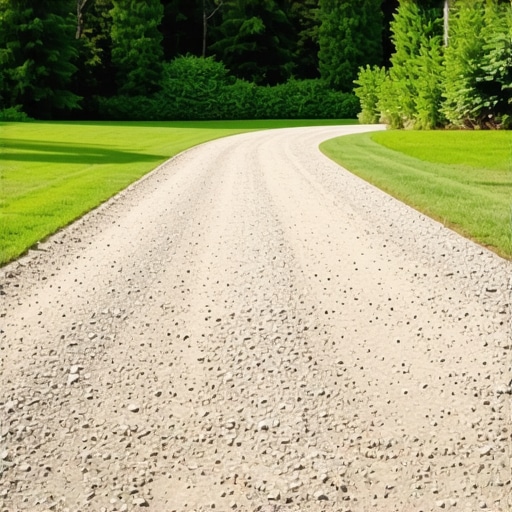
The Engineering Reality of Residential Driveways
Building a durable gravel driveway requires more than just dumping stone on dirt; it is a structural engineering project involving soil stabilization, hydrostatic pressure management, and particle interlock. To prevent washouts, you must treat the driveway as a multi-layered pavement system that manages water flow while supporting heavy vehicular loads without rutting or shifting.
The Hardscape Autopsy: Why Most Gravel Driveways Fail
I recently got called out to tear up a $30,000 driveway and patio install that was sinking into the earth like a lead weight in a marsh. The homeowner was furious. The previous contractor had simply scraped the grass away, ignored the subgrade compaction, and dumped six inches of #57 stone directly onto native clay soil. Within six months, the stone had migrated into the clay, and the clay had pumped up through the stone. It was a muddy, expensive mess. This happens when you ignore the separation layer. Without a geotextile fabric, your expensive stone is just very sharp mulch that will eventually disappear into the soil. It is a fundamental violation of civil engineering principles. Dirt and stone should never mix. If they do, the stone loses its structural integrity. You are left with a sponge, not a road.
The Critical Importance of Subgrade Preparation
A durable gravel driveway starts with a compacted subgrade excavated to a depth of at least 8 to 12 inches, depending on the local soil load-bearing capacity. This excavation must be cleared of all organic matter, including roots and topsoil, which will rot and create voids over time.
“A retaining wall or pavement base doesn’t fail because of the stone; it fails because of the water trapped behind or beneath it.” – Hardscape Engineering Axiom
How deep should I excavate for a new gravel driveway?
For a standard residential driveway, you must excavate 8 to 12 inches deep to accommodate a multi-layered stone base. This depth allows for a 4-inch sub-base of large aggregate and a 4-inch base of dense-graded aggregate, ensuring the structure can support vehicle weights without shifting or sinking into the native soil.
The Three-Layer Structural System
To achieve maximum durability, you must use a tiered approach with different stone sizes. Each layer serves a specific mechanical purpose in the load-transfer hierarchy. Don’t skip a layer. Don’t go cheap.
| Layer | Material Recommended | Purpose | Thickness |
|---|---|---|---|
| Sub-Base | #3 or #4 Crushed Stone | Structural Foundation & Drainage | 4-6 Inches |
| Base Layer | #411 or DGA (Crusher Run) | Compaction & Stability | 4 Inches |
| Surface Layer | 3/4″ Minus or Fines | Driving Surface & Water Shedding | 2-4 Inches |
The Non-Negotiable: Geotextile Fabric
The geotextile separation layer is the single most important component of a driveway that doesn’t wash away. This heavy-duty non-woven fabric acts as a filter, allowing water to pass through while preventing the fines of the subgrade from contaminating the clean stone of your base. Use it. It is cheap insurance. Without it, your driveway has a shelf life of three years. With it, you get twenty. In areas with high water tables or heavy irrigation runoff, this fabric prevents the ‘pumping’ action where tires force mud up into the gravel. If you are doing a sod install adjacent to the driveway later, the fabric also prevents grass roots from easily migrating into your stone base. It keeps the systems separate. It keeps the system clean.
Mastering the Crown and Cross-Slope
To prevent surface erosion and washouts, the driveway must be crowned, meaning the center is higher than the edges, typically by 1/4 to 1/2 inch per foot of width. This parabolic shape forces water to move laterally toward the shoulders rather than running down the length of the driveway, which creates rills and gullies. Water is the enemy. You must give it a path to escape. If your driveway is on a slope, you might need riprap-lined swales or French drains to handle the velocity of the runoff.
“Effective drainage is the primary determinant of pavement longevity; moisture in the subgrade reduces soil shear strength by up to 80%.” – USDA Forest Service Engineering Manual
What is the best gravel for a steep driveway?
On steep inclines, use angular, crushed stone such as **#411 crusher run** or **dense-graded aggregate** (DGA) because the jagged edges interlock under pressure. Avoid rounded stones like pea gravel or river rock, which act like ball bearings and will wash away or slide down the slope during the first heavy rainstorm.
The Compaction Protocol: 4-Inch Lifts
You cannot dump 10 inches of stone and expect it to be solid. You must compact in lifts. Spread 4 inches of stone, then run a vibratory plate compactor or a trench roller over it until you achieve at least 95% Proctor density. The stone should feel like concrete. If it shifts under your boot, it isn’t ready. Repeat this for every layer. This mechanical interlocking is what gives the driveway its strength. If you are also doing a yard cleanup or landscaping overhaul, ensure your heavy equipment doesn’t traverse the uncompacted layers, as this creates uneven density that leads to future potholes.
Maintenance and Long-Term Stability
Even a perfectly built driveway needs a maintenance schedule. Over time, the fines in the surface layer may wash away or settle. Adding a thin top-dressing of crushed stone every 3 to 5 years maintains the crown. Keep the edges clear. If grass or weeds start growing in the gravel, it means organic matter has accumulated. Clean it out. Use a pre-emergent if necessary. Don’t let irrigation heads spray directly onto the gravel. This leads to localized saturation and base failure.
- Check the crown after heavy spring rains.
- Clear debris from drainage swales and culverts.
- Fill potholes immediately by digging them out, not just filling them.
- Ensure 811 is called before any deep excavation for culverts.
- Maintain a clear edge between gravel and lawn to prevent contamination.
The Physics of Stone Selection
The shape of the stone matters more than the color. Angular stone is produced by mechanical crushing. It has sharp edges that wedge against each other. Rounded stone is weathered by water. It is smooth. Smooth stone moves. If you want a driveway that stays put, buy the ugly, sharp stuff. The limestone dust in crusher run acts as a natural binding agent when wet and compacted, essentially turning your driveway into a low-grade macadam surface. It is durable. It is functional. It works. Stop listening to the guy at the big-box store who says pea gravel is ‘fine’ for driveways. It isn’t. It’s for landscaping beds, not 3-ton pickup trucks.