
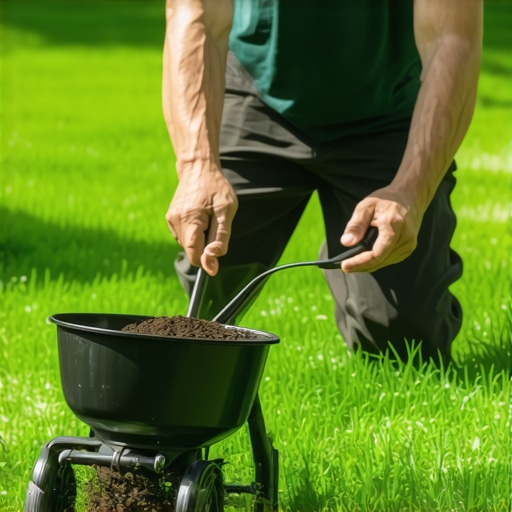
The Chemical Nightmare: When Guessing Turns Grass into Straw
I recently walked onto a property where the front yard looked like a neon zebra. The homeowner had deep green stripes alternating with scorched, yellowed earth that smelled faintly of ammonia. He had bought a high-nitrogen synthetic blend and guessed the setting on his broadcast spreader. He did not just waste sixty dollars on fertilizer; he functionally salted his soil. This is the inevitable result of mechanical ignorance. Most people treat a spreader like a toy, but in the hands of a professional, it is a precision instrument of soil chemistry. If you do not calibrate, you are not gardening; you are gambling with your land. This post-mortem analysis of failed turf will show you how to avoid the chemical burn through rigorous mechanical calibration.
How to Calibrate Your Fertilizer Spreader for Even Greenery
To calibrate your fertilizer spreader, you must measure the amount of product discharged over a known square footage (typically 100 square feet) to ensure the NPK ratios match the label instructions. This process prevents nutrient leaching, turf burn, and uneven growth patterns across your property.
“Uniform distribution of nitrogen is critical; even a 10% deviation in application rate can lead to visible turf striping or localized nitrate toxicity in the soil profile.” – Agronomy Manual of Turfgrass Science
The Forensic Autopsy of a Striped Lawn
When you see dark green streaks in a yard, that is not a sign of success. It is a sign of poor overlapping or a clogged orifice. The darker grass is receiving an overdose of nitrogen, while the lighter grass is starving. Over time, the overdosed areas develop thatch buildup and become magnets for fungal pathogens like Pythium. The starving areas eventually succumb to weed pressure. Your landscaping efforts are wasted if the foundation of the lawn is chemically inconsistent. This often happens because the user failed to account for their walking speed or the prill size of the fertilizer. Every brand of fertilizer has a different bulk density. A setting of ‘4’ for one brand is not the same as a ‘4’ for another. You must test.
How do I know if my fertilizer spreader is accurate?
You verify accuracy by performing a catch-pan test or a weight-based trial on a hard surface or a tarp. If you are using a broadcast spreader, the distribution pattern must be symmetrical. Often, the impeller plate throws more product to the right than the left. This is called a ‘skewed pattern.’ Without adjusting the ‘gate’ or the ‘diffuser,’ you will always have one side of your pass heavier than the other. Before you even think about sod install or maintenance, you need to know your equipment’s bias. It is mechanical reality. Don’t ignore it.
The Physics of the Orifice and Walking Speed
The spreader is a gravity-fed system. The faster you walk, the less product hits any given square inch. Most homeowners walk at different speeds depending on if they are tired or going uphill. This creates chaos. You need to maintain a consistent 3 miles per hour. That is a brisk pace. If you slow down to navigate a flower bed or an irrigation head, you are dumping triple the required nitrogen. Stop the flow before you turn. Every time.
| Spreader Type | Calibration Method | Recommended Test Area | Target Precision |
|---|---|---|---|
| Broadcast/Rotary | Catch-Pan Array | 100 Sq. Ft. | +/- 5% |
| Drop Spreader | Weight-Box Catch | 50 Linear Ft. | +/- 2% |
| Handheld | Timed Weight Release | 250 Sq. Ft. | +/- 10% |
Step-by-Step Calibration Protocol
Follow this checklist before any major application. If you skip a step, you are just throwing money into the wind. Literally.
- Conduct a yard cleanup to remove sticks, rocks, or debris that could jam the spreader impeller.
- Measure a 10-foot by 10-foot square on a clean driveway or tarp.
- Fill the hopper with a weighed amount of fertilizer (e.g., 5 pounds).
- Run the spreader over the test area at your normal walking speed.
- Sweep up the remaining fertilizer and weigh it. Subtract this from the starting weight.
- Multiply the result by 10 to find your rate per 1,000 square feet.
“A fertilizer spreader is only as accurate as the calibration of its operator. Environmental factors such as humidity can alter the flow rate of hygroscopic fertilizers by up to 20%.” – Penn State Extension: Turfgrass Management
How many pounds of nitrogen per 1,000 square feet do I need?
Most cool-season grasses require 0.5 to 1.0 pound of actual nitrogen per 1,000 square feet per application. To calculate this, divide the desired nitrogen rate by the first number in the NPK sequence on the bag. If you have a 20-0-0 bag and want 1 pound of nitrogen, you need 5 pounds of raw product. If your spreader is throwing 7 pounds, you are over-applying by 40%. It will burn. Adjust the gate lower and retest.
The Maintenance Routine for Longevity
Fertilizer is corrosive. Most spreaders fail because the owner doesn’t wash them. The salt in the fertilizer eats the metal linkages and the plastic gears. After every use, wash the hopper and the impeller with high-pressure water. Let it dry completely. Lubricate the axle with a dry graphite spray. Wet grease just attracts more dust and jams the system. If the gears are grinding, your application rate is fluctuating. Keep the machine clean or throw it away. There is no middle ground in professional turf care. Your irrigation system will thank you because it won’t be trying to wash away excess salts from a botched application.