
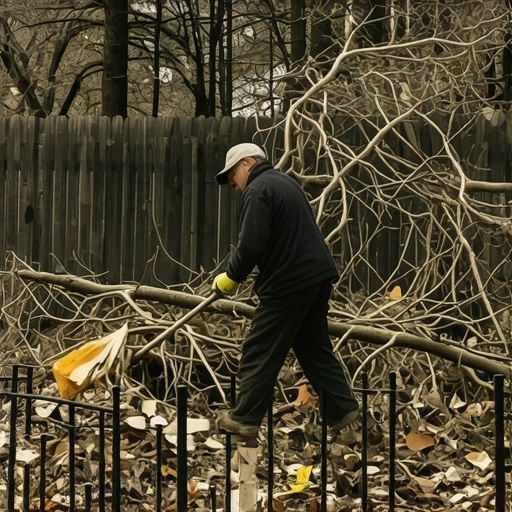
A major wind storm is a violent mechanical stressor that does more than just scatter leaves. It alters the hydrostatic balance of your soil, stresses root flares, and creates micro-fractures in woody plant tissue. Most homeowners make the mistake of thinking yard cleanup is a weekend chore involving a rake and some leaf bags. It is not. It is a forensic engineering task. If you don’t understand the physics of wind-throw or the biological cost of bark stripping, you are simply waiting for your plants to die a slow death over the next two seasons. Stop looking for a quick fix and start looking at the structural integrity of your landscape.
The Foreman’s Perspective: Why Grading and Soil Integrity Rule the Cleanup
I always drill into my new crew members: if you don’t fix the soil grading first, every plant you put in the ground is just expensive compost. After a storm, the ground is often saturated and shifted. I’ve seen sod install projects fail within weeks because the contractor ignored the 2-inch depression created by a fallen oak’s root ball. That depression becomes a stagnant pool, turning the soil anaerobic and rotting the new landscaping from the bottom up. We don’t just move debris; we recalibrate the earth.
“A retaining wall doesn’t fail because of the stone; it fails because of the water trapped behind it. Storm-driven saturation is the leading cause of hydrostatic failure in residential hardscapes.” – Hardscape Engineering Axiom
Immediate Hazard Assessment and Debris Classification
Professional storm recovery begins with a structural audit of all high-impact zones, focusing on arboriculture safety and drainage clearance to prevent immediate irrigation failure or foundation flooding. Don’t touch a single branch until you’ve scanned for downed utility lines and compromised hangers. Heavy limbs suspended in the canopy are kinetic energy waiting to be released. You need to categorize your debris into three tiers: organic mulchable material, structural timber, and inorganic sediment. Failure to separate these immediately leads to soil contamination and equipment damage during the yard cleanup process. Small twigs are nuisance; large limbs are engineering problems.
How do I know if my irrigation lines are broken after a storm?
Check for irrigation leaks by monitoring your water meter for movement when all valves are closed or looking for localized saturation zones where uprooted trees may have severed lateral lines or PVC piping. High-wind events often cause root plates to heave, which can snap 1-inch schedule 40 pipes buried 12 inches deep. Look for bubbling or ‘spongey’ turf near former tree sites. If you see a drop in PSI at the furthest sprinkler head, you have a breach. Do not run the system until you have pressure-tested the main line.
The Forensic Autopsy of Damaged Turf and Soil
When a storm hits, the weight of the water and the debris causes soil compaction. This isn’t just ‘hard dirt.’ It is the collapse of the macropores and micropores that allow nitrogen cycles to function. If you leave wet mats of leaves on your lawn for more than 48 hours, you are inducing turfgrass chlorosis. The grass cannot breathe, and the heat trapped under the debris will cook the crown. For a professional-grade sod install to survive post-storm, you must first address the bulk density of the soil. [IMAGE_PLACEHOLDER] This usually requires deep-core aeration to a depth of 3 to 4 inches to re-introduce oxygen to the rhizosphere.
| Damage Type | Immediate Action | Long-term Remediation |
|---|---|---|
| Tree Blow-over | Root ball excavation | Soil grading & Sod install |
| Silt Accumulation | Mechanical removal | Soil pH testing & Aeration |
| Branch Breakage | 3-point structural cut | Canopy thinning |
| Irrigation Breach | Main line shutoff | Pipe splicing & Pressure test |
Restoring the Hydrological Balance
Water is the enemy during a storm cleanup. High winds often come with torrential rain that bypasses your existing drainage systems. You need to inspect every French drain, catch basin, and gutter downspout. If they are packed with organic grit, your next rain will flood your basement. I’ve seen $50,000 landscaping packages destroyed because a $10 drain grate was clogged with pine needles. Clear the exits first. Then, look at your irrigation sensors. Many ‘smart’ controllers get fried by lightning or water-logged by horizontal rain. If your rain sensor is bypassed, you’ll end up over-watering an already saturated lawn, leading to root rot (Phytophthora).
“Excessive soil moisture following storm events reduces oxygen availability, leading to the production of toxic compounds by anaerobic microorganisms.” – USDA Soil Quality Manual
How much does a professional sod install cost after storm damage?
A professional sod install typically costs between $1.50 and $2.50 per square foot, depending on soil preparation needs, grading requirements, and the variety of turf grass selected for the local climate. Don’t just throw sod over the mud. You must excavate the top 2 inches of debris-laden soil, till in organic matter to break up compaction, and ensure a 95% compaction rate on the sub-base to prevent settling. Cheap contractors skip the prep; professionals build the foundation.
The Recovery Checklist: 72 Hours Post-Storm
- Visual Canopy Scan: Look for ‘widow-makers’ and split crotches in all hardwoods.
- Utility Marking: Call 811 before digging out any root balls to avoid hitting gas or fiber lines.
- Irrigation Pressure Test: Manually run each zone for 2 minutes to check for geysers or low pressure.
- Debris Removal: Prioritize large organic matter that blocks sunlight from the turf.
- Soil pH Check: Rain is often acidic; check if you need a lime application to stabilize the NPK availability.
The Post-Storm Maintenance Cycle
Your yard is in shock. This is not the time for heavy nitrogen fertilization. High nitrogen forces succulent growth, which the plant cannot support while it is trying to repair its root system. Instead, focus on potassium to help with cell wall strength and stress recovery. Check the USDA hardiness zone recommendations for your specific species. If you have an oak with a 20% canopy loss, it needs three years of careful monitoring, not a one-time pruning. Watch for borers and fungal pathogens that enter through storm-ripped bark. A storm is a single event, but the landscaping recovery is a marathon. Maintain a strict 1-inch-per-week irrigation schedule—deep and infrequent—to force those roots to chase moisture back down into the stabilized soil profile. The storm might be over, but the work of keeping the yard alive has just begun.