
The Apprentice Lesson: Why Your Dog’s Favorite Path is a Civil Engineering Failure
I always drill into my new crew members: if you don’t fix the soil grading and compaction first, every plant you put in the ground is just expensive compost. I saw it last week on a site in the suburbs. The homeowner had a 90-pound German Shepherd that had carved a literal trench into the side yard. They kept throwing quick-fix seed mixes at it, and the mud just swallowed the seed whole. I told my lead tech, “Look at that soil. It’s as hard as the concrete on the driveway.” When a dog runs, their paws exert a force of over 100 PSI on a small surface area. You aren’t just losing grass; you are destroying the soil’s pore space. If you don’t fix the structure, you’re just wasting money. To fix a dog scratch without seed, you have to treat it like a biological repair job, not a cosmetic one. It requires understanding how stolons and rhizomes move across a substrate. If the substrate is too dense, the grass cannot colonize the gap.
The Anatomy of a Turf Scratch: Why It Won’t Grow Back on Its Own
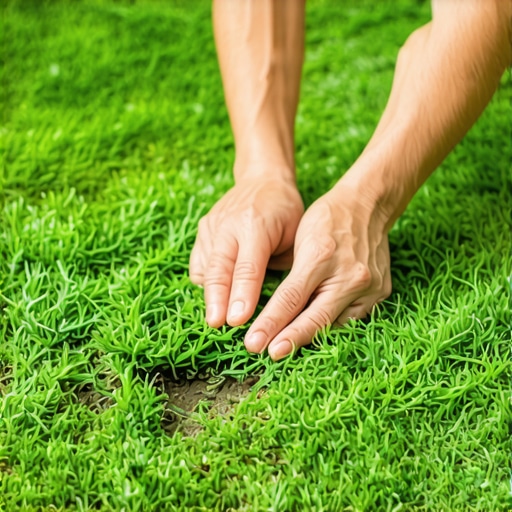
Dog scratches cause **mechanical failure of the turf canopy** by shearing the crown from the root system while simultaneously increasing **bulk density** through repeated impact. This trauma prevents the **gas exchange** necessary for the grass to undergo natural vegetative reproduction, leaving the soil in an **anaerobic state** where only opportunistic weeds thrive. [image_placeholder] When a dog pivots, the friction doesn’t just rip the blades; it generates heat and pressure that can cook the delicate meristematic tissue of the grass crown. This crown is the heart of the plant. If the crown is intact but buried under compacted silt, the plant suffocates. Most homeowners see a brown patch and think “dead,” but a veteran landscaper sees a “dormant and suppressed” system. The goal is to lower the mechanical resistance of the soil so the surrounding healthy grass can creep back in via lateral shoots. This process is known as tillering. In species like Kentucky Bluegrass or Bermudagrass, this is a natural defensive mechanism, but it is entirely dependent on the soil’s Cation Exchange Capacity (CEC) and the availability of pore space for new roots to penetrate.
“Soil compaction is the most overlooked factor in turf recovery, as it restricts oxygen exchange and water infiltration, effectively locking out the nutrients required for stoloniferous expansion.” – University of Minnesota Extension Service
The Soil-First Recovery Protocol: Remediating the Substrate
Repairing dog scratches without seed requires **optimizing lateral growth** through aggressive manual aeration and high-carbon top-dressing to remediate the damaged site. By reducing **surface resistance** and providing a nutrient-rich medium, you trigger the grass’s **rhizomatous response**, allowing the existing turf to knit over the damaged soil without the need for high-maintenance new seed. Most people skip the aeration. That’s a mistake. You need to break the surface tension. Take a manual core aerator and pull three to four plugs directly from the center of the scratch. This creates a vertical corridor for oxygen. I don’t care if the hole looks ugly. That hole is a lung for the soil. Next, you need a top-dressing that mimics the native soil profile but with higher porosity. A mix of 70% screened sand and 30% organic compost is the industry standard for high-traffic repairs. The sand provides the structural skeleton that resists future compaction from the dog’s paws, while the compost provides the humic acid needed to stimulate root branching. You aren’t just filling a hole; you are building a micro-habitat for the surrounding grass to move into.
How much soil compaction does a 50-pound dog cause?
A 50-pound dog can exert enough pressure to increase soil bulk density from a healthy 1.2 g/cm3 to a restrictive 1.6 g/cm3 in just a few weeks of repeated play. This level of density physically stops root tips from penetrating the earth, forcing the plant to grow only on the surface where it is vulnerable to desiccation and further mechanical damage.
Is it better to patch or let the grass crawl back?
If the scratch is under four inches wide, allowing the grass to crawl back through stoloniferous growth is often superior to patching because the resulting turf is genetically identical and better integrated into the existing root network. This avoids the “checkerboard” look often seen with mismatched sod installs or different seed cultivars.
| Repair Method | Estimated Recovery Time | Traffic Resistance | Technical Difficulty |
|---|---|---|---|
| Compost Top-Dressing | 3-5 Weeks | Moderate | Low |
| Plug Transplanting | 2-3 Weeks | High | Medium |
| Irrigation Adjustment | Seasonal | Low | Low |
| Vertical Slicing | 4-6 Weeks | High | High |
The Mechanical Process: Step-by-Step Reconstruction
The first step in yard cleanup for dog damage is removing the “glaze.” When a dog runs over wet soil, it creates a smooth, sealed layer of clay that acts like a plastic wrap. You must break this glaze. Use a sharp garden rake or a vertical mower to score the earth at least 1/2 inch deep. This is not about aesthetics; it’s about surface area. A scored surface has three times the surface area of a flat one, allowing for better water infiltration. Once the surface is prepped, check your irrigation schedule. Most people over-water damaged spots, which leads to Pythium root rot. You want deep, infrequent cycles. If you are seeing moss or algae in the dog’s scratch, you are watering too much and the soil is too tight. You need to dry it out to let the air in. After scoring and aerating, apply a localized application of a high-phosphorus “starter” fertilizer, even though we aren’t seeding. Phosphorus is the primary driver of root elongation. Look for an NPK ratio like 10-20-10. This will tell the surrounding grass to send its energy into the “wound.”
- Manual Core Aerator: Removes 3-inch plugs to relieve deep-tissue compaction.
- Screened Mason Sand: Fills the pores to prevent the soil from collapsing again.
- Leveling Rake: Ensures the patch is flush with the surrounding grade to prevent tripping hazards.
- Organic Compost: Provides the microbial life needed to break down urea salts from dog urine.
- Bio-stimulants: Kelp or humic acid products to reduce the stress on the grass crowns.
“A retaining wall doesn’t fail because of the stone; it fails because of the water trapped behind it, and a lawn repair fails because of the air trapped out of it.” – Hardscape and Turf Engineering Axiom
The Local Expert Advantage: Managing the Nitrogen Cycle
In regions with heavy clay, like the Southeast, dog scratches are prone to holding water, which creates a “puddle effect” that drowns the grass. In these areas, your top-dressing must be heavier on the sand side to facilitate drainage. If you’re in a sandy region like Florida, the opposite is true; you need more organic matter to hold onto the nutrients. Regardless of your location, you must account for the nitrogen cycle. Dog urine is high in urea, which is a form of nitrogen. In small amounts, it’s a fertilizer. In high concentrations, it’s a herbicide. When a dog scratches an area they also frequent for “potty breaks,” the salt index in the soil spikes. You must flush these salts out. Use a gypsum-based soil conditioner. Gypsum (calcium sulfate) helps displace the sodium and urea salts from the soil particles, allowing them to wash away below the root zone. This chemical remediation is often the missing piece in why a dog-damaged area won’t regrow. If the pH is off—anything outside the 6.2 to 7.0 range—the grass simply cannot uptake the nutrients it needs to repair itself. This is basic agronomy, not guesswork. If you skip the soil test, you are just throwing darts in the dark. Call 811 before doing any deep aeration or digging to ensure you don’t hit shallow irrigation lines or utility cables. Municipal drainage codes often dictate how much you can change the grade, so keep your repairs flush with the existing lawn surface to avoid runoff issues during heavy rains. It will rot if you leave it as a bowl. It will thrive if you treat it as a bed.