
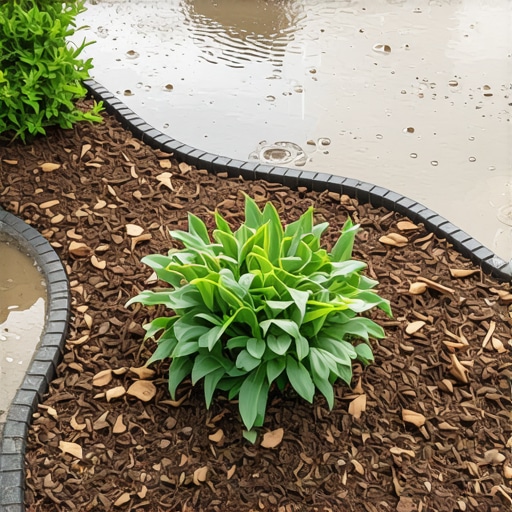
How to Stop Your Bark Mulch from Washing Away in Rain
I recently got called out to tear up a $30,000 patio that was sinking because the previous contractor ignored the hydrostatic pressure and site grading. The same level of negligence usually applies to mulch. Homeowners think they can just throw wood chips on a slope and hope for the best. They wake up after a three-inch downpour to find their expensive landscaping investment sitting in the middle of the street. This isn’t bad luck; it is a failure of physics and site preparation. If you don’t understand how water moves across your specific soil profile, you are just throwing money into the gutter.
The Science of Mulch Migration and Sheet Flow
Bark mulch washes away primarily due to low density and a lack of interlocking fibers when confronted by sheet flow. When rain hits compacted soil, it cannot infiltrate, creating a surface current that lifts organic media. To stop this, you must increase surface friction and manage water velocity.
“A retaining wall doesn’t fail because of the stone; it fails because of the water trapped behind it.” – Hardscape Engineering Axiom
The same principle applies to your garden beds. If you haven’t performed a proper yard cleanup to remove the 1/2 inch of old, hydrophobic mulch from last season, the new layer has nothing to grab onto. It sits like a loose carpet on a waxed floor. You need to understand the coefficient of friction between your media and the subgrade. Smooth pine nuggets are the worst offenders. They are buoyant and round. They roll. Shredded hardwood, on the other hand, features jagged edges that knit together like Velcro. This creates a structural mat that resists the kinetic energy of falling rain.
Material Selection: Comparing Weight and Interlock
To prevent mulch from floating, you must select materials based on their specific gravity and fiber morphology. Sod install prep often requires different drainage logic than bed prep, but both rely on soil density. Heavy, double-shredded hardwood mulch is the industry standard for slopes. It stays put because the fibers physically weave into one another, creating a permeable but stable barrier. Avoid ‘nugget’ style barks on any grade steeper than 5 percent. They are essentially tiny boats.
| Mulch Type | Erosion Resistance | Interlock Factor | Typical Longevity |
|---|---|---|---|
| Shredded Hardwood | High | 9/10 | 12-18 Months |
| Pine Bark Nuggets | Very Low | 2/10 | 24 Months |
| Pine Straw | Moderate | 7/10 | 6-9 Months |
| Cedar Chips | Low | 4/10 | 18-24 Months |
How do I calculate the slope for a garden bed?
To determine if your mulch will stay, measure the vertical rise over a 10-foot horizontal run. Anything over a 12-inch rise (10% slope) requires specialized erosion control blankets or tackifiers. If you ignore the grade percentage, gravity will eventually win, regardless of how much you paid for the landscaping materials. I tell my crew: measure twice, or you’ll be shoveling the same mulch three times.
The “Edge Trench” Protocol: Creating a Catchment Basin
An edge trench stops mulch washouts by creating a mechanical transition between the lawn and the planting bed, acting as a sediment trap for migrating wood fibers. A professional 4-inch deep ‘V’ notch prevents water from gaining enough lateral velocity to carry the mulch over the turf line.
Don’t use those cheap plastic or metal edgings from the big-box store. They act as dams. When the water level behind the plastic edging rises, it creates a surge effect that carries the mulch over the top in a single wave. A hand-dug spade edge is superior. It allows water to settle into the trench, drop its sediment (the mulch), and then slowly infiltrate or move along the sub-grade. This is foundational irrigation logic applied to surface drainage. If you skip the trench, you’re just decorating a landslide.
- Step 1: Clear all debris and old, matted mulch.
- Step 2: Cut a 4-inch deep ‘V’ trench at the bed’s perimeter.
- Step 3: Grade the bed toward the center, not the edge.
- Step 4: Apply a 2-inch layer of double-shredded hardwood.
- Step 5: Tamp the mulch lightly to engage the fiber interlock.
Will pine straw stop mulch from washing away?
Pine straw is an excellent stabilization layer when used underneath or mixed with bark mulch on steep inclines. The long needles create a nested matrix that traps smaller wood particles. However, it acidifies the soil as it breaks down, so monitor your pH levels—keep it between 6.0 and 7.0 for most ornamentals. This is agronomy 101.
Advanced Stabilization: Tackifiers and Planting Density
Mulch tackifiers are liquid ‘glues’ (usually guar-based or synthetic polymers) that bind the top 1/2 inch of mulch into a crust that is permeable to water but resistant to wind and rain displacement. This is the same technology used in hydroseeding for highway embankments. It is not ‘fake’ landscaping; it is civil engineering for your front yard.
“Surface crusting from tackifiers reduces sediment transport by up to 85% on 2:1 slopes when applied at recommended rates.” – Agricultural Extension Research
Furthermore, you need to increase your planting density. The best way to stop mulch from moving is to replace it with living mulch—groundcovers. Roots bind the soil, and the foliage breaks the terminal velocity of raindrops. Until those plants fill in, you must use mechanical means to keep the ground covered. If you have bare dirt for more than 48 hours, you’re losing topsoil. That is a failure of stewardship. In areas with freeze-thaw cycles, the soil expands and pushes the mulch upward, making it even more prone to washing away during spring rains. Compaction is your friend here. Not enough to kill the roots, but enough to remove the air pockets. 20 pounds of pressure per square inch is usually the sweet spot for setting a bed.