
Lay Sod Over Old Grass in 2026: 3 Essential Steps
I always drill into my new crew members: if you do not fix the soil grading and biology first, every plant or piece of turf you put in the ground is just expensive compost. After 20 years in this trade, I have seen too many ‘professionals’ take the easy route. They slap high-dollar sod right over a dying lawn, collect the check, and disappear before the methane from the rotting grass underneath starts choking the new root system. This is not just a shortcut; it is a fundamental misunderstanding of soil physics and horticultural engineering. If you are planning to install sod over an existing lawn in 2026, you are essentially managing a biological decomposition project while trying to establish a new ecosystem. It requires more than a rake and a hose. You are dealing with carbon-to-nitrogen (C:N) ratios, anaerobic zones, and hydrostatic barriers that can turn your investment into a brown mat of dead fiber in less than fourteen days.
Step 1: Mechanical Scalping and Biological Thatch Management
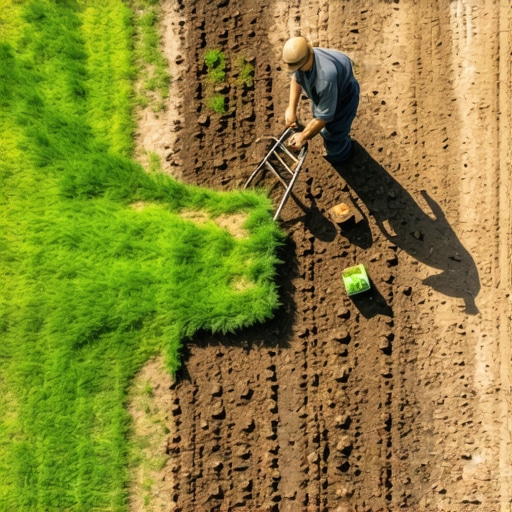
Laying sod over old grass requires aggressive scalping to the soil level, dethatching to remove organic barriers, and core aeration to prevent anaerobic rot. Without these critical steps, the new root system cannot penetrate the compacted layer of old vegetation, leading to total turf failure within weeks. Most homeowners think they can just mow low and go. They are wrong. You need to take that existing turf down to the dirt. We use a power rake set to its lowest setting to physically rip out the stolons and rhizomes of the previous crop. This is not about aesthetics; it is about eliminating the physical barrier between the new sod’s root zone and the mineral soil below.
When you leave old grass underneath, you are creating a ‘thatch sandwich.’ As that buried grass dies, microbes begin the process of decomposition. This process is nitrogen-intensive. If the microbes are busy eating the old grass, they will rob the new sod of the nitrogen it needs to establish its primary root structure. This is known as nitrogen immobilization. Furthermore, if the old layer is too thick, it creates an anaerobic environment. Without oxygen, you get the production of hydrogen sulfide gas, which is toxic to new roots. I have pulled up failed sod and smelled that rotten-egg odor; it is the smell of a contractor who did not understand gas exchange in the soil profile. You must ensure that at least 70% of the soil surface is visible before the first roll hits the ground.
“A successful turfgrass establishment depends heavily on the soil-to-root contact and the ability of water and air to move through the interface of the two layers.” – Penn State Center for Turfgrass Science
Step 2: Chemical Correction and Substrate Engineering
To ensure long-term survival, you must analyze the soil pH, apply a high-phosphorus starter fertilizer, and incorporate calcined clay or organic compost to improve the Cation Exchange Capacity (CEC). Most soils are too compacted or acidic to support the rapid root expansion required for 2026 turf cultivars. You are not just laying grass; you are building a biological engine. I recommend a soil test before you even call the sod farm. If your pH is below 6.0, your new sod will struggle to uptake nutrients, regardless of how much you water it. We typically look for a pH of 6.5 to 7.0 for optimal nutrient availability.
| Phase | Tool/Material | Critical Metric |
|---|---|---|
| Surface Prep | Power Rake / Verticutter | 0.25-inch height or less |
| Compaction Relief | Core Aerator | 3-inch plug depth / 40 holes per sq ft |
| Nutrient Loading | Starter Fertilizer (10-20-10) | 1 lb Phosphorus per 1,000 sq ft |
| Hydraulic Contact | 300lb Water-Filled Roller | 95% surface contact target |
Once the old grass is scalped and the soil is exposed, we apply a layer of top-dressing. But do not just buy the cheap stuff from the big-box store. You want a blend of 80% sand and 20% organic matter. This provides the structural integrity of the sand to prevent future compaction while the organic matter feeds the microbial life. If you are in a region with heavy clay, this step is non-negotiable. Clay acts like a brick when it dries. If your new sod’s roots hit a hard clay shelf, they will grow sideways (girdling) rather than downwards. Deep roots are what allow a lawn to survive a July drought. You have to force those roots to chase the moisture down into the profile by providing a path of least resistance.
How much topsoil do I need for sod prep?
You should aim for a minimum of 0.5 to 1 inch of fresh, high-quality topsoil spread over the scalped remains of the old lawn. This layer acts as the primary rooting medium and helps bridge the gap between the new sod’s soil base and the existing ground. It also helps level out minor undulations that could cause dry spots or scalping during future mows.
Step 3: Hydraulic Integration and The Rolling Protocol
The final phase of sod installation involves mechanical rolling to eliminate air pockets and heavy initial irrigation to saturate the soil profile to a depth of six inches. Air is the enemy of a new root. If there is a gap between the sod and the soil, the root hair will dry out and die instantly. We call this desiccation. I do not care how good your sod looks on the pallet; if you do not roll it in, you are leaving its life to chance. We use a water-filled roller that weighs at least 300 pounds. You should see the sod being pressed firmly into the soil, almost to the point where the seams begin to disappear.
Irrigation management in 2026 is about precision, not just volume. You do not want to keep the grass ‘wet’; you want to keep the ‘interface’ moist. For the first seven days, this means short, frequent bursts of water—perhaps three to four times a day. By day ten, you should be transitioning to deeper, less frequent watering. This transition is critical. If you keep the surface perpetually soaked, the roots have no reason to grow deeper. They will stay lazy and shallow. By the end of the second week, you should be watering once a day, but for a longer duration, to pull that moisture deep into the subsoil. This forces the roots to stretch. A root that has to work for its water is a root that will survive the winter.
How long does it take for sod to root over old grass?
Under optimal conditions, sod laid over old grass will begin to tack down within 7 to 10 days. You can test this by gently tugging on a corner of the sod. If you feel resistance, the primary roots are penetrating the substrate. Full structural integration and the ability to withstand foot traffic typically take 4 to 6 weeks.
“Phosphorus is immobile in the soil; therefore, it must be placed in the root zone during the preparation phase to ensure the plant can access it during the critical first days of growth.” – Agronomy Manual 101
- Checklist for 2026 Sod Success:
- Verify 811 utility markings are complete before aeration.
- Flag all irrigation heads to avoid damage from the power rake.
- Apply a pre-emergent weed control three weeks prior (optional, depends on sod type).
- Ensure sod is delivered and installed within 24 hours of being cut at the farm.
- Roll the entire area in two directions (North-South and East-West).