
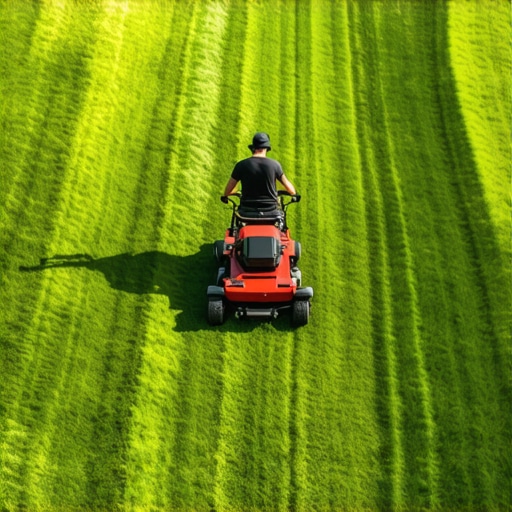
The Anatomy of Overgrown Turf: Why One Pass is Never Enough
Cutting overgrown grass requires multiple passes because removing more than one-third of the leaf blade shocks the plant, depletes stored carbohydrates, and creates a thick clipping mat that smothers the crown. Professionals use incremental height adjustments to preserve photosynthetic capacity and root health during a yard cleanup. When you see a lawn that has been neglected for three weeks, you are looking at a biological system in distress, not just a messy yard.
A homeowner called me in a panic last June after they completely torched their front lawn by applying a high-nitrogen ‘turf builder’ and then leaving for a two-week vacation. By the time they returned, the grass was eight inches tall and dark green. In their rush to fix it, they dropped their mower deck to its lowest setting and tried to take it all down in one pass. Within 48 hours, the entire yard turned the color of a cardboard box. They didn’t just cut the grass; they committed botanical homicide. The crown of the plant was exposed to direct UV radiation, and the sudden loss of leaf surface area caused the roots to prune themselves back. This is the chemical and mechanical nightmare I see every year. It takes months of irrigation management and soil conditioning to fix a mistake that took thirty minutes to make.
“The one-third rule is the cornerstone of turfgrass physiology; removing more than 33 percent of the leaf tissue causes immediate root growth cessation.” – Penn State Center for Turfgrass Science
How Blade Speed and Deck Height Control Recovery
Mechanical efficiency in commercial mowing relies on maintaining high tip speeds and optimal airflow within the mower deck. When grass exceeds six inches, the volume of organic material exceeds the deck’s discharge capacity, leading to clumping and uneven cuts that invite fungal pathogens like Brown Patch or Pythium. If you try to force a mower through ten-inch fescue, the blade speed drops. Instead of a clean, surgical cut, the blade tears the grass. These jagged edges increase the surface area for moisture loss and provide an entry point for disease. It is sloppy work.
How much can I cut off my lawn at once?
You should never remove more than one-third of the total height of the grass in a single cutting session. If your grass is six inches tall, your first pass should only take it down to four inches. This maintains the auxin levels in the plant and prevents the grass from shifting its energy from root development to emergency leaf repair. You wait 48 to 72 hours, then you go back for the second pass. This isn’t a suggestion. It is biology.
| Initial Height | First Pass Height | Second Pass Height (3 Days Later) | Recovery Rate |
|---|---|---|---|
| 6 Inches | 4.0 Inches | 3.0 Inches | 95% |
| 8 Inches | 5.5 Inches | 3.5 Inches | 88% |
| 10 Inches | 6.5 Inches | 4.5 Inches | 72% |
The Physics of the Mulching Deck and Hydrostatic Pressure
When dealing with 2026 tall grass, the moisture content inside the stalk is at its peak. This is not just water; it is a slurry of sugars and cellulose. In a single-pass scenario, this slurry coats the underside of the mower deck, killing the lift required to stand the grass up for a clean cut. Without lift, you get ‘stragglers.’ Multiple passes allow the first layer of cut debris to dehydrate slightly before the second pass pulverizes it into micro-mulch. This return of nitrogen to the soil is vital, but only if the particles are small enough to reach the soil surface. Heavy clumps will create an anaerobic environment, rotting the sod install beneath.
“A lawn is a living, breathing ecosystem that requires precise mechanical intervention to maintain a state of homeostasis.” – Agronomy Manual of Standards
What happens if I mow tall grass too short?
Mowing tall grass too short, a process known as scalping, removes the protective canopy that shades the soil. This leads to rapid soil moisture evaporation and triggers the germination of weed seeds like crabgrass that require light to sprout. Furthermore, the meristematic tissue or the growing point of the grass can be permanently damaged, requiring a full sod install to repair the bare patches. You are effectively stripping the plant of its ability to regulate its own temperature.
The Professional Yard Cleanup Checklist
Before you even engage the PTO, you need a plan. A yard cleanup is a forensic exercise. You are looking for why the grass got this way and what is hiding underneath it. Don’t be the guy who hits a hidden irrigation head because he was in a hurry.
- Scout for Obstacles: Walk the entire perimeter to find hidden rocks, toys, or fallen branches that the tall grass has swallowed.
- Check Soil Moisture: Never mow tall, heavy grass if the soil is saturated; you will create ruts that last for years.
- Sharpen Your Blades: Tall grass requires a razor edge. Dull blades will shred the stalk, causing the tips to turn white.
- Adjust the Discharge: Open the side discharge chute. Do not attempt to bag or mulch eight-inch grass on the first pass.
- Set the Height: Start at the highest setting your machine allows.
Integrating Irrigation and Soil Health Post-Mow
The stress of a major cut requires immediate irrigation support. However, do not drown it. You need deep, infrequent watering to encourage the roots to dive back down after the shock. If the soil is compacted, the water will simply run off the surface, especially on graded slopes. This is where landscaping engineering comes into play. If your yard has a slope greater than 3:1, your mowing pattern must change to prevent erosion and ‘scalp-sliding’ where the mower loses traction and gouges the turf. The soil pH should be tested; often, tall grass is a sign of high acidity where the grass is struggling to find the right balance of nutrients, leading to leggy, weak growth. It will rot if you don’t manage the drainage. Don’t skip the aeration phase in the fall.