
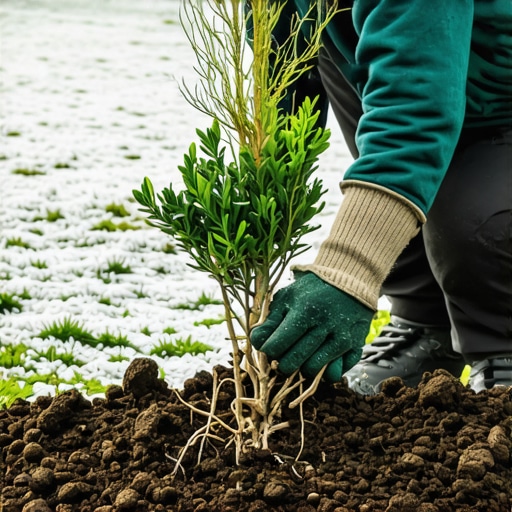
The Engineering of Soil Thermal Stability and Root Protection
Frost heave protection for 2026 shrub roots requires a precise strategy of managing soil moisture, optimizing drainage, and insulating the root flare to prevent ice lenses from physically ejecting plants from the ground. Without these structural interventions, the expansion of water in the soil will snap tender root hairs and expose the root ball to lethal desiccation. It is not just about the cold; it is about the physics of freezing water.
The Apprentice Lesson: Grading Is Not Optional
I always drill into my new crew members: if you don’t fix the soil grading first, every plant you put in the ground is just expensive compost. I remember a job back in 2014 where a rookie ignored my specs on a landscaping project. He planted twenty high-end Boxwoods in a low-lying area where the irrigation runoff pooled. By February, the freeze-thaw cycles had pushed those root balls three inches out of the soil. The roots looked like they had been through a meat grinder. We had to rip the whole line out. The lesson was clear: water is a structural enemy when it cannot move. If you do not have a 1-2% slope away from the root zone, you are building a grave, not a garden. Proper yard cleanup isn’t just about leaves; it’s about clearing the path for water to leave the site before it turns into an ice wedge.
The Microscopic Reality of Frost Heave
Frost heave is driven by the formation of ice lenses. When soil temperatures drop, water in the macropores freezes first. This creates a pressure gradient that draws liquid water up from the warmer subsoil via capillary action. As this water reaches the freezing front, it adds to the ice lens, expanding the soil volume by roughly 9%. This expansion exerts massive upward force. If your sod install or planting bed is compacted, there is nowhere for that pressure to go but up, taking your shrubs with it.
“Frost heaving occurs when ice lenses grow in the soil, fueled by water migrating from the unfrozen subsoil toward the freezing front.” – Penn State Agricultural Extension
The Ground-Up Build: Selecting the Right Thermal Buffers
Protecting a new install starts before the plant touches the dirt. You must analyze the soil texture. Heavy clay is a nightmare for frost heave because it holds excessive water. Sandy loam is your ally. If you’re stuck with clay, you must amend with expanded shale or coarse organic matter to increase pore space. This isn’t for nutrition; it’s for air. Air is an insulator. Compacted soil has no air. It conducts cold like a copper wire.
How deep should I mulch to prevent frost heave?
To effectively stabilize soil temperatures and prevent the rapid freeze-thaw cycles that cause heaving, you must apply three to four inches of coarse organic mulch, specifically keeping it away from the trunk to prevent bark rot. Fine mulches mat down and block oxygen. Use wood chips or arborist mulch. These materials create a complex lattice that traps air pockets. This buffer slows the descent of the frost line. It gives the plant time to acclimate. Don’t use rock. Stone is a thermal conductor. It will bake your roots in the summer and freeze them in the winter. Use carbon.
Does irrigation help or hurt shrubs in winter?
Hydration is critical for winter survival, but you must stop active irrigation once the ground reaches 40 degrees Fahrenheit to allow the plant to enter dormancy. A dehydrated plant is more susceptible to cell wall collapse during a freeze. However, saturated soil is the primary fuel for ice lenses. You want the soil moist, not muddy. If you have an automatic system, blow it out before the first hard freeze. Hand-water only if the winter is unseasonably dry and the ground isn’t frozen.
| Material Type | Thermal Insulation Value | Drainage Rating | Frost Heave Risk |
|---|---|---|---|
| Hardwood Mulch | High | Excellent | Low |
| River Rock | Very Low | Moderate | High |
| Pine Straw | Moderate | Excellent | Medium |
| Wood Chips | High | Excellent | Low |
The 2026 Winter Protection Checklist
- Inspect Root Flares: Ensure the transition between the trunk and roots is visible and not buried.
- Moisture Audit: Check for standing water after a rain; regrade if necessary.
- Mulch Maintenance: Replenish to a 4-inch depth in a 3-foot radius around each shrub.
- Anti-Transpirants: Apply to broadleaf evergreens to reduce moisture loss.
- Windbreaks: Use burlap screens for shrubs in high-exposure zones.
“A root system’s ability to withstand thermal shock depends heavily on the presence of pore space for air, which acts as an insulator.” – USDA NRCS Soil Manual
The Physics of Root Desiccation
Winter kill is often misdiagnosed. People think the plant froze. Usually, the plant dried out. When the soil is frozen solid, the roots cannot uptake water. Meanwhile, winter winds are stripping moisture from the leaves. This is called physiological drought. Frost heave exacerbates this by breaking the contact between the roots and the soil. Once that contact is lost, the root dies. It will rot. You must ensure the soil is firmed—not compacted—around the root ball. Use your body weight, not a machine. Feel the resistance. It should be firm like a mattress, not hard like a sidewalk. This is the difference between a professional install and a hack job. Pay attention to the details. The soil doesn’t care about your feelings; it only cares about the laws of thermodynamics.