
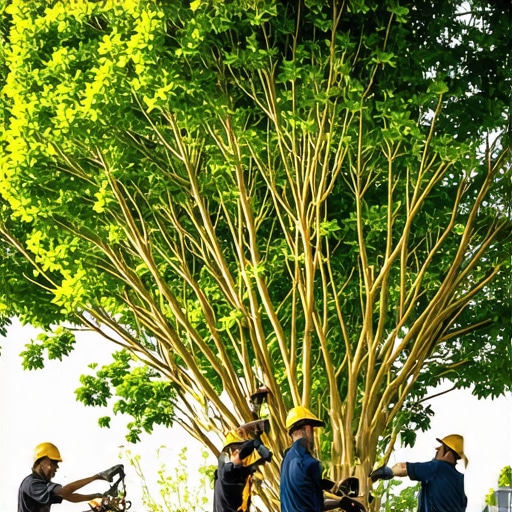
The Forensic Autopsy of a Mutilated Landscape
I always drill into my new crew members: if you don’t fix the soil grading first, every plant you put in the ground is just expensive compost. But the second lesson is even more vital: if you take a chainsaw to a Lagerstroemia with the intent of topping it, you are not a landscaper; you are an executioner. I recently walked a property where a client had paid a ‘mow-and-blow’ crew to prune thirty mature Natchez Crape Myrtles. What I found was a horticultural crime scene. They had ‘topped’ every single lead, leaving behind hideous, swollen knuckles of scar tissue known as pollarding scars. This practice, colloquially called Crape Murder, does not just look ugly; it compromises the structural engineering of the tree. The resulting epicormic sprouts are weakly attached to the cambium layer and will inevitably snap under the weight of summer blooms or heavy rain. We had to spend three days performing rehabilitative pruning just to ensure these trees didn’t become a liability in the next windstorm.
The Physiological Cost of Topping Crape Myrtles
Topping Crape Myrtles forces the tree to rapidly mobilize stored carbohydrates from the root system to generate emergency foliage, which bypasses natural auxin regulation. This stress response creates dense clusters of thin, whip-like branches that lack the lignification necessary for structural load-bearing. Instead of a strong trunk, you get a ‘lion’s tail’ effect that invites Cercospora leaf spot and powdery mildew due to restricted airflow within the canopy. To understand why this happens, we must look at the xylem and phloem transport systems. When you make a heading cut into old wood, you destroy the apical dominance. The tree panics. It sends a flood of gibberellins to the nearest latent buds, resulting in the ‘knobby’ look that characterizes poor landscaping maintenance.
“A tree’s ability to compartmentalize decay is fundamentally limited when large-diameter heading cuts are made, as the exposed heartwood lacks the protective barrier of the branch bark ridge.” – International Society of Arboriculture (ISA) Best Management Practices
Proper Pruning Strategy: The Natural Thinning Method
Effective landscaping requires understanding that the goal of pruning is to enhance the tree’s natural form, not to fight its genetic height potential. The thinning cut is the gold standard for Lagerstroemia maintenance. By removing a branch at its point of origin or back to a lateral branch that is at least one-third the diameter of the primary limb, you maintain the vascular integrity of the plant. This prevents the formation of those dreaded knobs. You should focus on the ‘Four Ds’: Dead, Damaged, Diseased, and Deranged (branches that cross or rub). For a 2026 growth cycle, you want to clear out the interior to improve air circulation. This is critical for preventing fungal pathogens in humid climates. If your tree is too big for its space, you didn’t prune it wrong; you planted the wrong cultivar. A Natchez will hit 30 feet; don’t try to force it to be a 6-foot hedge.
How much should I prune off my Crape Myrtle?
You should never remove more than 25 percent of the total canopy in a single season to avoid triggering a starvation response in the root system. Focus on structural pruning that removes suckers from the base and low-hanging branches that interfere with mowing or sod access. Smaller cuts, under one inch in diameter, heal significantly faster and reduce the risk of borer infestations. Use sharp bypass pruners rather than anvil pruners to ensure a clean cut that doesn’t crush the vascular tissue.
When is the best time to prune Crape Myrtles in the South?
The ideal window for pruning Crape Myrtles is late winter (late January to early February) when the tree is in full dormancy and the deciduous structure is visible. Pruning in the fall is a disaster; it can stimulate new growth that won’t have time to harden off before the first hard freeze, leading to cambium kill. Waiting until the leaves have dropped allows you to see the skeleton of the tree, making it easier to identify crossing branches and competing leaders.
Integrating Pruning with Yard Cleanup and Soil Health
A successful yard cleanup involves more than just raking leaves; it requires a forensic look at the root flare and the surrounding soil biology. Most homeowners bury their Crape Myrtles under mulch volcanoes, which traps moisture against the bark and encourages adventitious roots to girdle the trunk. This is as lethal as a bad pruning cut. During your spring landscaping prep, pull back the mulch to expose the root flare. This ensures proper gas exchange for the fine feeder roots. If you are planning a sod install near your trees, be mindful of the critical root zone. Heavy machinery used during sod preparation can compact the soil, increasing bulk density and reducing pore space, which leads to root hypoxia. Always use a pneumatic air spade if you need to excavate near established trees to avoid mechanical damage to the root system.
| Pruning Metric | Correct Thinning Cut | Incorrect Heading Cut (Murder) |
|---|---|---|
| Growth Pattern | Strong, arched branches | Weak, vertical ‘water sprouts’ |
| Bloom Weight Support | High; minimal sagging | Low; branches often break |
| Fungal Resistance | High due to airflow | Low due to dense foliage |
| Aesthetic Value | Natural, sculpted trunk | Ugly, knobby ‘fists’ |
Irrigation and Nutrient Management for Peak Performance
While Crape Myrtles are drought-tolerant once established, their performance is tied directly to your irrigation strategy and nitrogen levels. While the internet tells you to water every day, turf grass actually needs deep, infrequent watering exactly 1 inch per week to force roots to chase the water down. This same logic applies to your trees. Over-watering with overhead irrigation is a primary driver of Erysiphe lagerstroemiae (powdery mildew). Instead, use drip irrigation at the drip line to keep the foliage dry. Regarding fertilization, stop using high-nitrogen ‘turf’ fertilizers near your trees. Excessive nitrogen (N) forces soft, succulent growth that attracts aphids and Crape Myrtle Bark Scale. Use a balanced, slow-release fertilizer with a 10-10-10 or 12-4-8 ratio in early spring to support bloom production without compromising structural wood strength.
“Hydrostatic pressure from poor drainage is the silent killer of urban trees, often misdiagnosed as nutrient deficiency when it is actually root rot.” – Agronomy Field Manual 2024
The Master Pruner’s Final Checklist
Before you step onto the lawn with a saw, follow this technical protocol to ensure you aren’t doing more harm than good. A tree is a living organism, not a piece of furniture. Every cut is a wound that the tree must CODIT (Compartmentalize Decay In Trees). If you don’t have a reason for a cut, don’t make it. It is that simple.
- Sanitization: Dip all blades in 70% isopropyl alcohol between trees to prevent the spread of bacterial blight.
- The Three-Cut Method: For any branch larger than 2 inches, use an undercut, a top cut, and a final collar cut to prevent bark stripping.
- Deadwood Removal: Remove all brash and dead wood first to see the true architecture of the tree.
- Sucker Control: Use a sharp spade to cut suckers at the root origin, not just at the soil surface.
- Debris Management: Incorporate yard cleanup by removing all pruned material from the site, as old wood can harbor scale insects.
If you follow these engineering principles, your Crape Myrtles will stand as the structural anchors of your landscaping for decades. Ignore them, and you’ll be calling me in three years to grind out the stumps of trees that ‘just didn’t make it.’ The choice is yours. Quality landscaping is about the long game, not the quick fix.