
Mastering the Chaos: Post-Storm Site Assessment and Safety
Effective storm debris removal begins with a technical site survey to identify structural hazards such as widow-makers, root heaves, and energized utility lines. Professionals prioritize stabilization of the canopy before any ground-level yard cleanup occurs to prevent fatal accidents from shifting loads. It is about physics and load-bearing math, not just muscle.
I always drill into my new crew members: if you do not fix the soil grading first, every plant you put in the ground is just expensive compost. After the record storms of 2026, I saw guys out there with big-box store saws and zero PPE, trying to tackle 80-foot downed oaks. It is a recipe for a morgue visit. I watched a rookie almost lose a leg because he did not understand the concept of a spring pole. A sapling was pinned under a primary limb, holding thousands of pounds of pressure. One wrong cut and that tree snaps back at 60 miles per hour. That is why we focus on horticultural engineering and mechanical advantage rather than raw speed.
“Safety requirements for pruning, repairing, maintaining, and removing trees and cutting brush shall be followed as per the ANSI Z133 standards to mitigate risks of electrical shock and mechanical failure.” – ANSI Z133 Arboricultural Safety Standard
How do I identify a dangerous tree after a storm?
Look for the root flare. If the soil is mounded on one side and depressed on the other, the root plate has failed. These trees are under extreme tension and require professional rigging. Any tree leaning more than 15 degrees with soil upheaval is a candidate for immediate removal before it hits a structure or crushes an irrigation system main line.
The Anatomy of Chainsaw Safety and Mechanical Logic
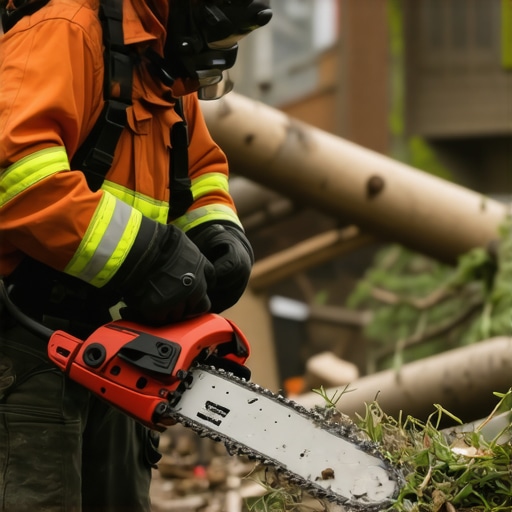
Proper chainsaw safety requires a combination of ballistic nylon chaps, a Class E hard hat, and an understanding of the kickback zone on the guide bar tip. Operators must maintain a high-chain speed to prevent binding while ensuring the dogs (spikes) are firmly engaged in the bark to provide a pivot point. Speed is safety; a slow chain grabs and jerks.
We do not use cheap equipment. A pro-grade saw like a Stihl MS 462 or Husqvarna 572 XP provides the power-to-weight ratio needed for 10-hour days. We run full-chisel chains for clean wood, but after a storm, you often need semi-chisel because the bark is packed with grit and mud. Dirt dulls a chain in seconds. A dull chain forces the operator to push, which leads to fatigue and mistakes. We check chain tension every time we refuel. If the drive links are hanging out of the groove, the saw is a liability.
| Equipment Component | Safety Specification | Operational Role |
|---|---|---|
| Chainsaw Chaps | UL Classified 3600 FPM | Stop chain rotation on contact |
| Guide Bar | Reduced Kickback Design | Minimize reactive forces at the tip |
| Fuel Mix | 50:1 Synthetic 2-Cycle | Prevent engine seizure under high heat |
| Chain Type | Full Chisel vs Semi-Chisel | Speed vs Durability in dirty debris |
What PPE is mandatory for chainsaw operation?
You need cut-resistant boots, hearing protection with a minimum 24dB NRR, and wrap-around eye protection. Never operate a saw without chaps; they are designed to clog the sprocket with high-strength fibers, stopping the chain instantly. This is the difference between a bruise and a severed femoral artery.
The Physics of Tension, Compression, and Reactive Forces
Managing downed timber requires an understanding of compression and tension wood to avoid binding the bar or causing a structural snap. The compression side of the log is where the fibers are being squeezed together, while the tension side is where they are being pulled apart. You always cut the compression side first to about one-third depth, then finish on the tension side.
If you mess this up, the weight of the tree will trap your $1,200 saw. Then you are stuck using wedges or a second saw to cut out the first one. We also watch for reactive forces: push, pull, and kickback. Push happens when you cut with the top of the bar; pull happens with the bottom. Kickback is the deadliest, occurring when the upper quadrant of the bar tip hits an object, throwing the saw up and back toward the operator’s face.
“A retaining wall doesn’t fail because of the stone; it fails because of the water trapped behind it, much like a tree doesn’t just fall; it fails due to saturated soil and wind-load torque.” – Hardscape Engineering Axiom
Protecting Turf and Irrigation Infrastructure During Cleanup
Heavy debris removal often causes soil compaction and irrigation lateral line damage that requires a full sod install and system recalibration once the wood is cleared. Skid steers and heavy loaders exert high PSI on the ground, crushing PVC pipes and compacting pore space in the soil. Without oxygen in the soil, your lawn dies from the roots up.
We use ground protection mats to distribute weight. If we see irrigation heads in the path, we flag them immediately. A broken head is cheap, but a crushed 110mm main line is a nightmare. After the debris is gone, we perform a pressure test on the irrigation system. Usually, the 2026 storms caused enough shifting that grading and drainage must be reassessed before any landscaping can be restored. We look for hydrostatic pressure buildup near foundations where fallen root balls created new low spots.
Post-Storm Cleanup Checklist
- Identify and flag all utility lines (Call 811).
- Remove overhead hazards (Widow-makers) using pole saws.
- Section downed timber using the compression-first method.
- Clear organic debris to prevent fungal growth on existing turf.
- Aerate soil to mitigate compaction from heavy machinery.
- Inspect irrigation zones for pressure loss or leaks.
- Perform a soil pH test as decaying wood can acidify the top layer.
Remediating the Scars: From Debris to New Growth
Once the wood is gone, the site often looks like a war zone. This is where soil microbiology comes into play. You cannot just throw sod over compacted, oil-stained dirt. We use mechanical aeration to break up the bulk density of the soil. If the storm brought in heavy rains, your nitrogen has likely leached out. We apply a starter fertilizer with a high phosphorus count to encourage root development for the new sod install.
Avoid the temptation to plant a tree in the exact same hole where the old one blew over. The decaying roots of the previous tree will create settling and can harbor pathogens like Armillaria. Shift the new planting site at least five feet. Ensure the root flare is visible above the soil line. Planting too deep is the number one cause of secondary tree failure. It will rot. We use drip irrigation for new installs to ensure water reaches the root ball directly without wasting 30 percent to evaporation. This is how you build a resilient landscape that survives the next decade of storms. “