
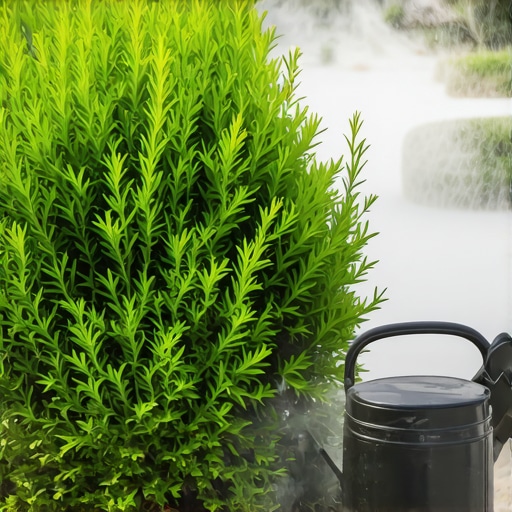
The Anatomy of Winter Kill: Why Your Landscape is Dying
Shrub browning from salt damage occurs when sodium chloride accumulates in the soil or on foliage, causing osmotic stress and ion toxicity. This process, often called physiological drought, forces water out of the plant cells and into the salt-saturated soil, leading to desiccation and needle necrosis. To stop 2026 browning, you must implement soil leaching and gypsum applications before the spring growth flush.
I remember a call I took last April in a high-end subdivision. The homeowner was frantic because their $15,000 double-stacked Boxwood hedge was turning a sickly copper color. They assumed it was a fungus. I walked the perimeter and saw the white crust of rock salt still sitting on the Belgian block curbing. The previous winter, their private plow guy had been overzealous with the spreader. I took a soil sample and the parts per million (PPM) of sodium were off the charts. We didn’t just have brown leaves; we had a chemical burn of the entire root system. We spent three weeks flushing the soil and injecting liquid calcium just to save half the plants. It was an expensive lesson in physics and chemistry that could have been avoided with a simple barrier and better material selection.
“A retaining wall doesn’t fail because of the stone; it fails because of the water trapped behind it. Similarly, a plant doesn’t fail just from the cold; it fails because the salt has stripped its ability to regulate hydration.” – Hardscape Engineering Axiom
The Forensic Diagnosis: Salt Spray vs. Soil Saturation
Before you start a yard cleanup, you need to know what killed the tissue. Salt damage presents in two distinct ways. First is the aerial spray. If your shrubs are brown only on the side facing the road or driveway, that is salt spray. The salt enters the stomata and kills the buds. The second is soil saturation. This happens when the snow melts and carries dissolved salt into the root zone. This is far more dangerous. It changes the cation exchange capacity (CEC) of your soil. Sodium ions kick out essential calcium and magnesium, collapsing the soil structure. Your soil becomes tight and anaerobic. Roots cannot breathe. They suffocate in a tomb of salt.
| Rock Salt | NaCl | Severe | Deadly to most evergreens |
| Calcium Chloride | CaCl2 | Moderate | Better for concrete, harsh on roots |
| Magnesium Chloride | MgCl2 | Low | Safest for pets and most shrubs |
| CMA | Calcium Magnesium Acetate | Minimal | The professional gold standard |
How do you fix salt-damaged soil?
Fixing salt-damaged soil requires aggressive leaching and the application of pelletized gypsum. Gypsum, or calcium sulfate, is the chemical antidote. The calcium ions in the gypsum replace the sodium ions on the soil particles. The sulfate then bonds with the sodium to form sodium sulfate, which is highly water-soluble and can be flushed below the root zone. For a standard landscaping bed, apply 10 to 20 pounds of gypsum per 100 square feet. You must then run your irrigation system for at least two hours to move those ions. Do not skip this. Without water, the gypsum just sits on top like decorative dust.
What shrubs are most resistant to salt spray?
If you are planning a new sod install or planting bed near a road, you must select halophytic or salt-tolerant species. Rugosa Rose, Bayberry, and Eastern Red Cedar are engineered by nature to handle high salinity. Avoid White Pine, Hemlock, and Yews near any surface that receives de-icing salts. These species are highly sensitive and will show signs of browning even with minimal exposure. It is a biological mismatch to plant a sensitive Boxwood three feet from a salted sidewalk. It will fail. Every time.
“The accumulation of soluble salts in the root zone can increase the osmotic pressure of the soil solution to the point where the plant can no longer extract sufficient water.” – Penn State Extension: Managing Salt Damage
The 2026 Salt Prevention Checklist
- Physical Barriers: Install burlap screens 6 inches away from the foliage of sensitive evergreens before the first snowfall.
- Anti-Desiccant Sprays: Apply a wax-based anti-transpirant in late November to seal the stomata against salt crystals.
- Soil Amending: Use high-quality compost to increase organic matter, which helps buffer the soil against chemical spikes.
- Irrigation Calibration: Ensure your irrigation system is blown out properly in winter but ready for an early spring ‘deep soak’ to leach salts.
- Grading: Grade your beds so that salty runoff from the driveway flows into a French drain or bioswale rather than pooling in the mulch.
Yard Cleanup and the Myth of ‘Wait and See’
When you start your spring yard cleanup, do not wait for the needles to drop. If you suspect salt damage, start the leaching process immediately after the ground thaws. Use a soil probe to check for compaction. If the probe won’t go down 6 inches, your soil is likely sodium-compacted. This is the time for core aeration even in the beds. You need to open up channels for water to carry the toxins away. If the damage is so severe that the turf is dead, a sod install is your only option, but you must excavate the top 2 inches of contaminated soil first. Placing new sod over salt-poisoned earth is just throwing money into a hole. The soil doesn’t lie. It keeps a record of every chemical you put on it. Treat it with respect, or your landscape will pay the price in 2026. Use deep, infrequent watering—exactly 1 inch per week—to force roots to chase the water down and stay away from the salty surface crust. This is not just gardening; it is civil engineering with living materials.