
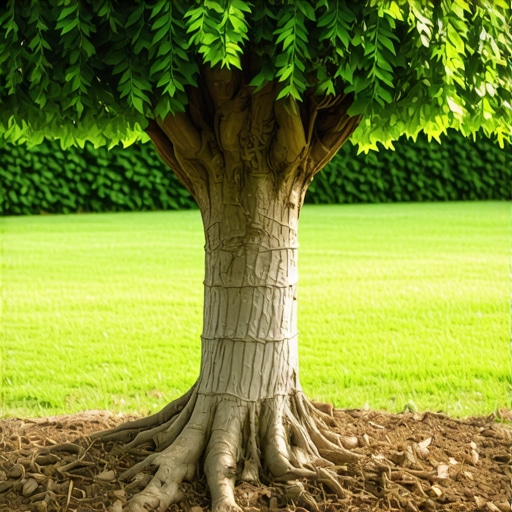
Walk onto any high-end property and you will likely see a death sentence masquerading as landscaping. It is the mulch volcano. You have seen them: those steep, conical mounds of shredded bark piled six, eight, or even twelve inches high against the trunk of a tree. To the untrained eye, it looks neat. To a veteran horticulturist, it looks like a slow-motion strangulation. I see the bark sloughing off in grey, mushy sheets and I know exactly what is happening underneath. The tree is suffocating. Its own roots are turning into ligatures that will eventually cut off its vascular system. This is not just an aesthetic issue; it is a structural and biological failure that costs homeowners thousands in removals and replacements.
The Apprentice Lesson: Why Root Flare is Non-Negotiable
Proper tree health begins with the root flare, the transition zone where the trunk widens into the root system, which must remain exposed to the air to prevent bark rot and girdling roots. I always drill into my new crew members: if you don’t fix the soil grading first, every plant you put in the ground is just expensive compost. I remember taking an apprentice out to a job site in late 2023. We were doing a massive yard cleanup and sod install on a property that had been handled by a mow-and-blow crew for years. I handed him a trowel and told him to find the root flare on a $2,000 Japanese Maple. He dug through eight inches of sour, fermenting mulch before he hit the first lateral root. By then, the bark was so soft I could indent it with my thumb. That tree was already girdling. The moisture trapped against the trunk had invited secondary pathogens and wood-boring insects. We spent three hours hand-excavating that one tree. If we hadn’t, that tree wouldn’t have survived until 2026. It is a fundamental law of arboriculture: trunks are for air, roots are for soil.
“A tree’s root flare is the critical junction where gas exchange occurs; burying this area leads to anaerobic conditions that promote fungal decay and the development of adventitious roots that eventually girdle the main stem.” – International Society of Arboriculture (ISA) Best Management Practices
Why Mulch Volcanoes Are Slow-Motion Killers
Mulch volcanoes kill trees by trapping excessive moisture against the trunk, causing bark decay and forcing the tree to grow adventitious roots that circle the trunk instead of spreading outward into the soil. When you pile mulch against the bark, you are creating a dark, moist environment perfect for decay. Bark is designed to protect the tree from the elements, but it is not waterproof from the inside out. Constant moisture causes the bark to lose its structural integrity. This leads to a total breakdown of the phloem and xylem, the tree’s internal plumbing. Once those are compromised, the tree cannot transport sugars from the leaves to the roots or water from the roots to the canopy. It starves to death while standing in a puddle.
How much modified gravel do I need for a patio base?
While unrelated to mulch, this question highlights the engineering mindset needed for all landscaping. For a standard residential patio, you need a minimum of 6 inches of compacted 21A or CR-6 modified gravel. This ensures the hydrostatic pressure doesn’t heave your pavers, much like how proper soil grading ensures water doesn’t pool at the base of your trees. Compaction is key. If the base isn’t solid, the finish fails.
The Science of Root Girdling and Hydrostatic Stress
Root girdling occurs when roots encounter a barrier or a highly localized moisture zone (like a mulch volcano) and begin to circle the trunk. Over time, these roots grow in diameter, just like the trunk. Eventually, they press against the trunk with hundreds of pounds of pressure. This is a biological tourniquet. It effectively chokes the tree. In our landscaping projects, we often see this in trees that were planted too deep in the nursery or those that have had mulch piled on them for years. The roots stay in the mulch layer because it is the only place they can find oxygen. They never dive deep into the mineral soil. This makes the tree incredibly susceptible to drought and wind-throw. A tree with a mulch volcano has no structural anchor. It is a sail on a stick with no roots holding it down.
| Condition | Root Flare Status | Bark Integrity | Longevity Projection |
|---|---|---|---|
| Mulch Volcano | Buried (6+ inches) | Soft, decaying, fungal growth | 3-5 years before decline |
| Proper Mulching | Fully Visible | Hard, dry, protective | 50+ years (species dependent) |
| Deep Planting | Sub-surface (2-4 inches) | Localized rot at soil line | 10-15 years until girdling |
Remediating the Damage: A Step-by-Step Recovery
Remediating a girdled tree involves carefully excavating the excess mulch and soil around the trunk using an air spade or hand tools to expose the root flare and prune any encircling roots. Do not just kick the mulch away. If the tree has been buried for years, there may be roots the size of your wrist circling the trunk. These need to be professionally pruned. We use a methodical approach. First, we clear the perimeter. We pull back the mulch to a 3-foot radius. Then, we use small hand tools to find the flare. If we find girdling roots, we use a sharp, sanitized saw to make clean cuts, removing the section of root that is applying pressure to the trunk. We then treat the area with a light application of compost tea to stimulate soil microbiology, but we leave the flare exposed to the sun and air. It needs to dry out. It needs to breathe. We also check the irrigation. If your spray heads are hitting the trunk directly, you are just speeding up the rot. Adjust the nozzles. Aim for the drip line, not the wood.
“Effective mulch management should never exceed a depth of three inches and must always maintain a three-inch gap from the trunk to prevent crown rot and rodent nesting.” – Penn State Agricultural Extension
How do I stop my tree from dying after a sod install?
Sod installation often involves adding 2-3 inches of topsoil to level the yard. If you pile this soil over existing tree roots or up the trunk, you are essentially creating a soil volcano. Ensure your landscaper carves out a ‘tree well’ that maintains the original grade around the root flare. The sod should stop at the drip line of the tree, or at least 2 feet from the trunk, transitioned into a thin layer of mulch. Never overlap sod onto the root flare.
The Expert’s Yard Cleanup Checklist
- Inspect the Flare: Can you see where the trunk widens at the ground? If not, start digging.
- Check Mulch Depth: Use a ruler. Anything over 3 inches is too much. 2 inches is ideal.
- Clear the 3-Inch Ring: Ensure there is a 3-inch gap of bare earth between the mulch and the bark.
- Prune Suckers: Remove any small shoots growing from the base of the trunk; these are signs of stress.
- Analyze Soil pH: Excessive mulch can acidify the top layer of soil. Test the pH to ensure nitrogen is actually available to the roots.
- Assess Irrigation: Ensure no irrigation emitters are spraying directly onto the trunk of the tree.
Landscaping is a long game. When you hire a crew for a yard cleanup, they want to make it look ‘pretty’ fast. They blow the leaves, they dump the mulch, and they leave. They don’t care if the tree dies in three years because they will be long gone. You have to be the advocate for your canopy. Proper mulching isn’t a mountain; it’s a donut. Flat, wide, and away from the center. If you follow these engineering standards, your trees will thrive well past 2026. Skip them, and you are just waiting for the next storm to knock over a hollowed-out trunk. Do the work now. Protect the flare. Stop the suffocation.