
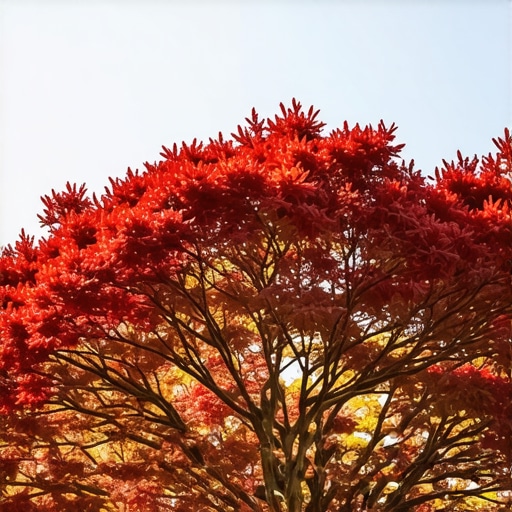
The Forensic Autopsy of a Scorched Canopy
Your 2026 Japanese Maples are failing because of a Vapor Pressure Deficit (VPD) imbalance where the transpiration rate of the leaves exceeds the hydraulic conductivity of the root system. When UV intensity climbs, the plant cannot pull moisture through its xylem fast enough, resulting in marginal leaf necrosis and twig dieback. This is not a simple heat issue; it is a mechanical failure of the tree’s internal plumbing. I always drill into my new crew members: if you don’t fix the soil grading first, every plant you put in the ground is just expensive compost. I have seen too many rookies slap a $500 Acer palmatum into a hole with 4 inches of standing water or, worse, compacted red clay that has the density of a sidewalk. If the roots cannot breathe, the leaves will burn. Period. We are seeing a massive spike in leaf scorch lately because homeowners are trying to treat these specimen trees like they are a common sod install or a generic shrub. A Japanese Maple is a high-performance engine; you cannot run it on low-grade soil and expect it to handle 100-degree days.
“A tree’s ability to survive heat stress is intrinsically linked to the available water capacity of its soil profile and the absence of root-zone compaction.” – ISA Arborist Manual
The Anatomy of Metabolic Failure in Acer Palmatum
Japanese Maple leaf scorch occurs when the mesophyll cells in the foliage lose turgor pressure and collapse due to osmotic stress. This usually happens in high-exposure areas where solar radiation and wind accelerate moisture loss beyond the plant’s stomatal control. You see it first at the tips. The edges turn brittle, brown, and curl upward. This is the tree’s way of trying to reduce its surface area to stop the bleed. It is a survival mechanism, but it is a sign that your tree is in the ICU. If you see this, stop the yard cleanup crew from blowing high-velocity air near the root zone. You are just stripping the remaining humidity from the canopy. Most people think they need more water. Usually, they need better drainage or a lower soil pH. If the soil is at a pH of 7.5, the tree cannot even uptake the nutrients it needs to build cell wall thickness. You are starving it while you drown it.
“How do I stop my Japanese Maple from turning brown?”
To stop Japanese Maples from browning, you must increase root-zone insulation with 2 to 3 inches of organic mulch and apply an anti-desiccant spray during peak heat. Ensuring soil moisture tension remains consistent through drip irrigation prevents the xylem cavitation that leads to permanent leaf damage and branch dieback.
The Soil Hydrology Factor: Why Your Base Matters
Landscaping is 80 percent civil engineering and 20 percent biology. When I perform a forensic check on a dying maple, I look at the bulk density of the soil. If you just did a sod install nearby, the heavy rollers used to flatten the turf likely crushed the macropores in the soil around your maple. Roots need oxygen just as much as water. Without gas exchange, the roots stop growing, and the canopy starts burning. We use a penetrometer to check this. If I can’t push a probe 6 inches into the ground with 50 PSI of pressure, your tree is essentially growing in a concrete pot. It will rot. You need to aerate the root zone or use radial trenching to introduce air. Do not ignore the soil structure.
| Soil Type | Infiltration Rate (Inches/Hr) | Maple Stress Risk | Recommended Mitigation |
|---|---|---|---|
| Heavy Clay | 0.05 – 0.10 | Severe (Root Suffocation) | Vertical Mulching / Drainage Tiles |
| Silt Loam | 0.20 – 0.50 | Moderate | Annual Core Aeration |
| Sandy Loam | 0.50 – 1.00 | Low (Optimal) | Consistent Drip Irrigation |
“How much water does a Japanese Maple need in summer?”
A mature Japanese Maple requires approximately 10 to 15 gallons of water per week, delivered via low-flow irrigation to ensure deep soil saturation. You should aim for 1 inch of water over the drip line, avoiding overhead irrigation which can lead to powdery mildew and leaf scald under direct sun.
The Critical Installation Checklist for 2026 Climate
If you are putting a tree in the ground today, you are planting for the weather of five years from now. The old rules are dead. You cannot just dig a hole twice the size of the root ball and call it a day. You have to account for the thermal mass of your landscaping. If that maple is next to a concrete driveway, it is being cooked from the bottom up by reflected heat. Here is the checklist we use for every high-end install:
- Expose the Root Flare: If you cannot see where the trunk flares into the roots, it is too deep. Dig it out.
- pH Balancing: Test the soil. Maples want a pH between 5.5 and 6.5. Anything higher locks out iron and manganese.
- Mulch Diameter: Create a 4-foot ring of mulch around the base, but keep it 3 inches away from the bark. No mulch volcanoes.
- Tensiometer Installation: Use a soil moisture sensor. Don’t guess. If the soil is 40% saturated at 8 inches deep, leave it alone.
- Windbreaks: If the tree is in a corridor, use a temporary burlap screen to reduce wind-induced transpiration.
“A retaining wall doesn’t fail because of the stone; it fails because of the water trapped behind it, and a tree doesn’t fail because of the sun, but because of the soil’s inability to manage that energy.” – Hardscape Engineering Axiom
Remediation: Bringing the Scorched Back to Life
If your maple is already looking like a burnt potato chip, do not fertilize it. I see this mistake every year. Adding high-nitrogen fertilizer to a stressed tree is like giving a marathon runner a steak in the middle of a race. The salts in the fertilizer will draw even more moisture out of the roots, finishing the job the sun started. Instead, focus on mycorrhizal inoculants. These fungi form a symbiotic relationship with the roots, effectively increasing the surface area of the root system by 100x. This allows the tree to find pockets of moisture that its own roots can’t reach. Next, look at your irrigation. If you are watering every day for 10 minutes, you are killing the tree. You are encouraging shallow roots that fry the second the top inch of soil dries out. Water deep. Water twice a week. Force those roots to go down 12 inches where the soil is cool. That is how you build a resilient tree. Don’t skip this. It is the difference between a specimen and a stump.