
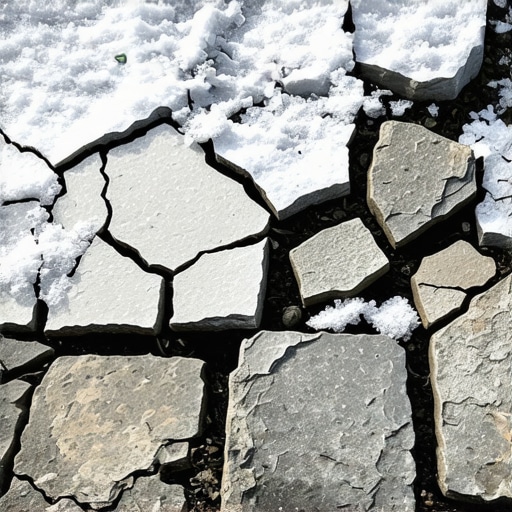
Why Your Patio Pavers Are Cracking After One Winter
The visual of a newly installed patio is often deceptive. You see the clean lines of the stone and the tight joints of the polymeric sand, but the reality of a hardscape investment is buried six to twelve inches underground. If you walk out after the first spring thaw and notice hairline fractures, uneven heights, or wide gaps in your stones, you are witnessing a structural failure of the foundation. These issues do not stem from the pavers themselves but from a fundamental misunderstanding of soil mechanics and hydrology. Most failures are preventable, yet they are repeated by contractors who prioritize speed over engineering standards.
The Invisible Forces Behind Paver Displacement
Cracked or shifting pavers occur when hydrostatic pressure builds up in an improperly drained base, causing the soil to expand during freeze cycles. This displacement is exacerbated by thin base layers and poor soil compaction, which fail to distribute loads and resist the vertical movement of frozen groundwater in the sub-grade.
I recently got called out to tear up a $30,000 patio that was sinking because the previous contractor used stone dust as a base material. Stone dust is essentially a sponge that retains moisture through capillary action. When the first freeze hit that property, the water trapped in the dust expanded by approximately 9 percent in volume. This expansion exerts thousands of pounds of pressure per square foot. The result was a patio that looked like a topographical map of a mountain range. The homeowner thought they had a ‘bad batch’ of pavers. They didn’t. They had a catastrophic engineering failure hidden beneath the surface. If you do not account for the way water moves through your specific soil type, whether it is heavy clay or sandy loam, your hardscape is on a countdown to failure.
The Physics of Freeze-Thaw Cycles
The primary culprit in winter paver damage is the freeze-thaw cycle, a process where water enters the voids in the base material, freezes, expands, and then thaws, leaving behind larger voids. This cycle repeats dozens of times in a typical northern winter. Without a properly compacted aggregate base, the pavers have no structural integrity to resist this movement.
“A retaining wall or patio doesn’t fail because of the stone; it fails because of the water trapped behind or beneath it.” – Hardscape Engineering Axiom
How much modified gravel do I need for a patio base?
For a standard pedestrian patio, you need a minimum of 6 inches of 21A modified stone or 3/4-inch crushed aggregate compacted in 2-inch lifts. If the area handles vehicular traffic or has poor-draining clay soil, that depth must increase to 10 or 12 inches to reach below the frost line and provide adequate drainage. Skipping even two inches of base material reduces the structural load capacity by nearly 40 percent. This is where most ‘mow-and-blow’ operations cut corners to save on material costs and labor. They dump four inches of gravel, run a light plate compactor over it once, and call it a day. That is not a foundation; it is a suggestion.
Why Soil Compaction Is Non-Negotiable
Compaction is the process of removing air pockets from the soil and aggregate. We measure this using the Standard Proctor Density test. For a patio to survive a winter, the base must be compacted to 95 percent density. If you do not achieve this, the first heavy rain or snow melt will cause the pavers to settle into the soft spots, leading to ‘dipping’ or ‘birdbaths’ where water pools on the surface. Pools of water on the surface lead to ice sheets in winter and accelerated degradation of the paver face. Below is a comparison of materials often used in the industry.
| Material Type | Drainage Rating | Compaction Stability | Primary Risk Factor |
|---|---|---|---|
| 21A Modified Stone | Excellent | Very High | None if compacted correctly |
| #57 Washed Stone | Superior | Moderate | Requires geotextile fabric |
| Stone Dust | Very Poor | Low | High water retention and heaving |
| Common Sand | Moderate | Low | Washout and insect tunneling |
The Impact of Irrigation and Yard Cleanup on Paver Integrity
Many homeowners overlook how their irrigation and yard cleanup routines affect their hardscaping. A poorly aimed irrigation head that sprays directly onto the edge of a patio is essentially injecting water into the structural sub-base every single morning. This constant saturation softens the soil and makes it far more susceptible to frost heaving when temperatures drop.
Can poor drainage cause pavers to crack?
Yes, poor drainage is the leading cause of paver failure because it allows water to remain in the porosity of the base material. When water cannot exit the system through a French drain or proper grading, it creates a saturated environment that loses all load-bearing capacity during a thaw. Furthermore, failing to perform a thorough yard cleanup before winter can be detrimental. Organic debris like wet leaves and grass clippings trap moisture against the pavers and joint sand. As these materials decompose, they produce organic acids that can etch the surface of the stone and weaken the polymeric sand bonds. If the joint sand fails, water enters the base even faster, accelerating the cycle of destruction. Even a sod install near the patio can cause issues if the new grass height sits above the paver surface, effectively creating a dam that prevents water from shedding off the stone.
“The drainage characteristics of the sub-grade soil must be evaluated to ensure that the pavement system can handle the expected moisture load without losing structural stability.” – ICPI Tech Spec Number 2
How do you fix pavers that have shifted?
Fixing shifted pavers requires a full ‘autopsy’ of the affected area. You must remove the pavers and the bedding sand to inspect the aggregate base. If the base is soft or contains stone dust, it must be excavated and replaced with clean, angular stone. Simply ‘re-leveling’ the sand is a temporary fix that will fail during the next freeze. You must also check the edge restraints. If the plastic or aluminum edging was not secured with 10-inch steel spikes every 12 inches, the entire field of pavers will ‘creep’ outward over time, opening up the joints to water infiltration.
The Professional Remediation Checklist
Before the next winter hits, every homeowner should perform a hardscape audit to identify potential failure points. Use the following checklist to ensure your investment survives the freeze.
- Verify that the patio has a minimum 2 percent slope (1 inch of drop for every 4 feet of length) away from the house foundation.
- Inspect all polymeric sand joints and refill any gaps where the sand has washed away or cracked.
- Ensure irrigation zones are adjusted so heads do not spray directly onto the patio surface or edges.
- Check that gutter downspouts discharge at least 5 feet away from the patio edge to prevent sub-base saturation.
- Perform a yard cleanup to remove all organic matter that can trap moisture and harbor mold or mildew.
- Audit any recent sod install areas to ensure the soil level is at least one inch below the paver surface.
The Maintenance Horizon
A patio is a living engineering project. It settles, it breathes, and it reacts to the environment. If you treat it like a ‘set it and forget it’ feature, you will be replacing it in five years. High-end hardscaping requires precision in the initial build and vigilance in the years following. Focus on the water. Control where it goes, how it drains, and how much of it stays in the ground. If you master the water, you master the stone. Don’t let a cheap contractor or a lazy maintenance routine turn your backyard into a construction site next spring. Do the work now or pay for it later.