
The Forensic Autopsy: Why That Vertical Crack Appeared
Tree bark splits primarily due to sunscald and frost cracks caused by rapid temperature fluctuations between freezing nights and sunny winter days. This thermal expansion and contraction ruptures the cambium layer, specifically in young or thin-barked species, leading to vertical fissures that expose the heartwood to pathogens and moisture. It is a structural failure at the cellular level that can compromise the vascular system of your specimen. I always drill into my new crew members: if you don’t fix the soil grading first, and understand the internal hydraulics of the plant, every tree you put in the ground is just expensive compost. I remember a job last November where a client insisted on high-nitrogen fertilizer late in the season. That new, soft growth didn’t harden off, and by January, the bark looked like a burst pipe. We spent the spring doing yard cleanup that felt more like a morgue visit because those cells literally exploded from the inside out.
“Frost cracks are the result of wood shrinking or expanding at different rates due to moisture content and temperature gradients.” – Cornell University Agricultural Extension
Sunscald vs. Frost Cracks: Identifying the Culprit
To fix the issue, you must first diagnose if you are looking at sunscald or a true frost crack. Sunscald typically occurs on the south or southwest side of the tree where the afternoon sun is strongest. It happens when the sun warms the bark enough to wake up the cells from dormancy. Once the sun dips behind the horizon and the temperature drops below freezing, those active cells are killed instantly. Frost cracks, conversely, are often deeper and follow the grain of the wood. These are caused by the differential expansion of water within the xylem. When the outer layers of the wood freeze and shrink faster than the inner core, the tension reaches a breaking point. The sound can be as loud as a gunshot. It is a mechanical failure of the 1000-plus PSI internal pressure within the trunk.
| Condition | Primary Cause | Visual Identifier | Long-term Impact |
|---|---|---|---|
| Sunscald | Afternoon solar radiation | Sunken, discolored patches | Vascular interruption |
| Frost Crack | Differential freezing rates | Deep vertical split | Fungal entry point |
| Borer Damage | Insect infestation | D-shaped exit holes | Structural hollows |
“When should I wrap my trees for winter?”
The operational window for tree wrapping is between Halloween and Easter. You want the tree to be fully dormant before the wrap goes on, and you must remove it before the spring thaw triggers new growth. If you leave the wrap on during the growing season, you create a humid micro-climate that invites canker diseases and allows insects like the emerald ash borer or bronze birch borer to hide from predators. Don’t skip the removal date. A wrap left on in May is a death sentence for the bark.
The Engineering of a Proper Tree Wrap
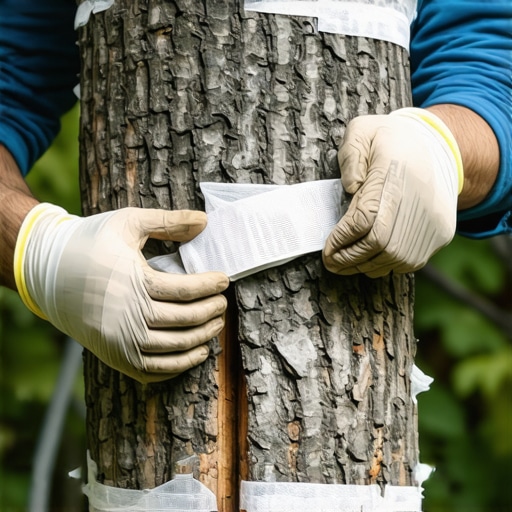
Protective wrapping is not about keeping the tree “warm”; it is about light reflection and temperature stabilization. You are essentially creating a heat shield. White or light-colored paper wraps are the industry standard because they reflect the highest percentage of infrared radiation. This prevents the bark from reaching the 50-degree threshold that breaks dormancy on a sunny winter day. When we perform a sod install or new landscaping project, we factor in the exposure to reflect radiation from nearby windows or white siding, which can double the thermal load on a young trunk.
- Step 1: Start at the base of the tree, slightly below the soil line to prevent mice from nesting.
- Step 2: Wrap upward in a spiral pattern, overlapping each layer by 50 percent.
- Step 3: Maintain consistent tension; it should be snug but not restrictive.
- Step 4: Stop just above the lowest scaffold branches.
- Step 5: Secure with weather-resistant tape, ensuring the tape only touches the wrap, not the bark.
“Can a tree recover from a split trunk?”
Trees do not “heal” in the way human skin does; they compartmentalize. When a split occurs, the tree attempts to grow callus tissue over the wound to seal off the damaged area from the rest of the healthy wood. This is known as CODIT (Compartmentalization of Decay in Trees). If the split is less than 25 percent of the circumference, the tree has a high probability of survival if you manage its stress levels. This means ensuring your irrigation system provides deep, infrequent watering during the following summer to support the massive energy expenditure required for callus growth.
“A tree’s survival during winter depends on the gradual acclimation of the cambium to lower temperatures; sudden shifts can cause lethal intracellular freezing.” – International Society of Arboriculture
Irrigation and Bark Health: The Invisible Link
Hydration levels in the fall directly correlate to winter bark resilience. A dehydrated tree has less thermal mass and more air pockets within its structure, making it more susceptible to rapid freezing. However, over-watering in late autumn can be just as dangerous. Saturated soil prevents the tree from entering deep dormancy, keeping the cells plump with water that will eventually expand and crack the bark. Your irrigation schedule should taper off as the photoperiod shortens, focusing on keeping the root zone moist but not anaerobic. Proper drainage is key. If you have standing water near the root flare, you are inviting hydrostatic pressure to assist in the bark-splitting process. It will rot. Don’t forget that.