
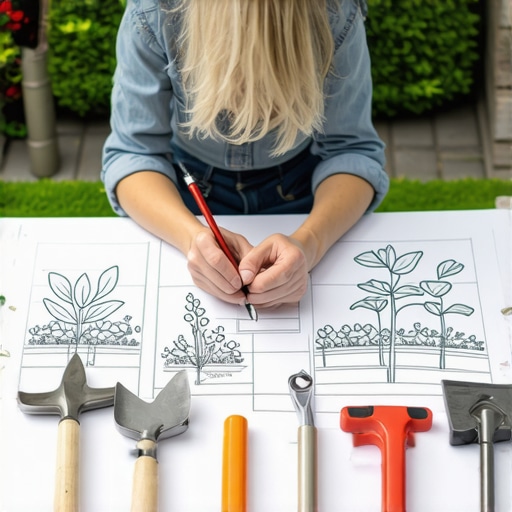
Professional Landscape Engineering: Avoiding The Three Deadly Sins of Flower Bed Design
Success in professional landscaping is measured in years, not the first week after a sod install. I always drill into my new crew members: if you don’t fix the soil grading first, every plant you put in the ground is just expensive compost. Most homeowners approach a new flower bed as a cosmetic hobby, but we view it as a biological and structural system. If the foundation is flawed, the biology fails. Period.
Mistake 1: Ignoring Soil Subsurface Mechanics and Grading
Homeowners often fail to address soil compaction and grading, leading to localized flooding or anaerobic conditions that suffocate plant roots in new flower beds. This mistake typically occurs during the yard cleanup phase when the focus is on surface aesthetics rather than the structural integrity of the soil profile.
When I walk onto a site for a forensic analysis of a failed garden, the first thing I look for is bulk density. Soil is not just dirt; it is a matrix of sand, silt, clay, and pore space. In a healthy bed, 50 percent of the soil volume should be pore space, split evenly between water and air. When you drag heavy equipment over a yard for a sod install or walk repeatedly over a future bed, you collapse those pores. The result is a soil with the consistency of concrete. Roots cannot penetrate it. Water cannot infiltrate it. Gas exchange stops. Your plants literally drown in a dry hole because the water cannot move through the compacted clay layers. Don’t skip the aeration. If you can’t push a 12 inch screwdriver into the ground with one hand, your soil is too compacted for a planting bed.
“Soil compaction is the single most difficult factor to correct once a perennial bed is established, as mechanical intervention risks destroying the existing root architecture.” – Penn State Agricultural Extension
How deep should a flower bed be dug?
A professional flower bed requires a minimum depth of 12 to 18 inches of loose, amended soil to facilitate deep root penetration and proper drainage. For landscaping involving larger shrubs, the depth should match the root ball size plus an additional 6 inches of loosened sub-grade material.
Mistake 2: The Lethal Depth of Planting and Mulch Volcanoes
Improper planting depth and excessive mulching are the primary causes of premature tree and shrub death in new flower beds, often resulting in girdling roots and bark necrosis. Homeowners and low-cost contractors frequently bury the root flare, which is the biological transition zone between the trunk and the root system.
This is where the science of horticulture meets the reality of the shovel. The root flare is designed to be exposed to air. When you bury it, either under soil or 4 inches of mulch, you create a dark, moist environment that invites fungal pathogens and wood-boring insects. Furthermore, the plant will often respond by sending out adventitious roots into the mulch. These roots eventually wrap around the trunk, essentially strangling the plant as it grows. We call these girdling roots. Within five years, a $500 specimen tree can be dead because of a 3 inch mistake. Stop the mulch volcanoes. Mulch should be a flat 2 to 3 inch layer, never touching the bark of the plant. It is a moisture regulator, not a decorative mound.
What is the best soil for new flower beds?
The ideal soil for most landscaping applications is a sandy loam mix containing approximately 5 to 10 percent organic matter with a pH range between 6.0 and 7.0. This allows for optimal nutrient availability, particularly phosphorus and iron, which become chemically locked in high-alkaline soils.
| Material Type | Particle Size (mm) | Drainage Rating | Cation Exchange Capacity (CEC) |
|---|---|---|---|
| Concrete Sand | 0.05 to 2.0 | Very High | Low |
| Aged Leaf Compost | Variable | Medium | High |
| Native Clay Soil | Under 0.002 | Very Low | Very High |
| River Silt | 0.002 to 0.05 | Low | Medium |
Mistake 3: Incompatible Irrigation and Sod Integration
Failures in irrigation design often occur when homeowners mix plant species with varying water requirements or fail to separate sod install water zones from garden bed zones. This leads to hydrostatic stress where turf grass is over-watered or perennials are starved for moisture.
A common error is running the same irrigation zone for the lawn and the flower bed. Turf grass needs frequent, shallow watering to maintain the 1 inch per week standard. However, established perennials and woody shrubs prefer deep, infrequent watering that encourages roots to seek moisture 12 inches deep or more. If you water them like grass, they develop shallow, weak root systems that cannot survive a three day heatwave. You must also account for the grading of the bed in relation to the lawn. If the bed is lower than the sod install, all the nitrogen-heavy runoff from the lawn will pool in the bed, causing nutrient burn and root rot in sensitive species. Build your beds with a 2 percent slope away from the house and the lawn edge to ensure positive drainage.
“A retaining wall doesn’t fail because of the stone; it fails because of the water trapped behind it.” – Hardscape Engineering Axiom
Professional Pre-Planting Checklist
- Test soil pH and NPK levels through a local extension office.
- Mark all underground utilities via 811 before excavation.
- Verify the USDA Hardiness Zone for every plant species selected.
- Check the 12 inch percolation rate: a hole should drain at 1 to 2 inches per hour.
- Ensure the root flare is visible on all woody nursery stock.
The first year after a yard cleanup and install is the most critical. You are not just watering plants; you are managing a biological transition. Watch the leaf turgor pressure. If the leaves are drooping in the morning, the soil is too dry. If they droop in the afternoon heat but recover by night, the plant is just regulating its transpiration. Don’t over-react with the hose. Let the roots chase the water. That is how you build a landscape that lasts for decades rather than one that needs replacing next spring.