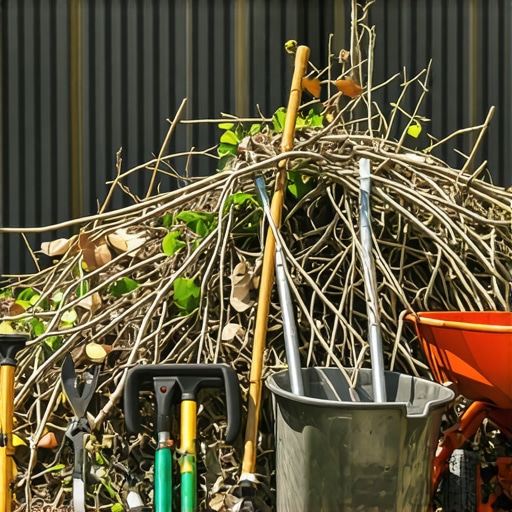
4 Fast Hacks to Clear 2026 Brush Piles Without a Chipper: Professional Biomass Management
I always drill into my new crew members: if you don’t fix the soil grading first, every plant you put in the ground is just expensive compost. It is a fundamental truth of civil engineering in the backyard. Last spring, I watched a greenhorn try to shove a three-inch diameter oak limb into a consumer-grade chipper. The machine screamed, the belt smoked, and we wasted four hours of billable time for a gallon of mulch. That is when I reminded him that landscaping is not about fighting nature with loud machines; it is about managing the carbon cycle and understanding biological degradation. If you are staring at a massive pile of brush and do not want to lease a commercial Vermeer, you need to understand the structural chemistry of wood. Brush is just locked-up energy. To clear it fast, you have to break the lignin bonds or utilize the bulk for structural benefit. Stop thinking like a homeowner and start thinking like a land manager.
The Bio-Reactor Strategy for Rapid Carbon Breakdown
To clear 2026 brush piles quickly without a chipper, you must implement a bio-reactor strategy by saturating the pile with high-nitrogen fertilizers and moisture to trigger thermophilic decomposition. This process utilizes microbes to chew through cellulose, reducing a five-foot pile to six inches of organic matter in a single season. Most hacks just leave a pile to rot. Professionals accelerate the process. You need a carbon-to-nitrogen (C:N) ratio of roughly 30:1 for maximum efficiency. Woody brush is often 400:1. By dousing the pile in urea or a high-nitrogen liquid fertilizer, you provide the fuel those bacteria need to ignite.
“The rate of wood decay is primarily governed by the availability of nitrogen and the surface-to-volume ratio of the material.” – USDA Forest Service Wood Handbook
Don’t just dump it on top. You have to penetrate the core of the pile. This is where your irrigation knowledge comes in. If the pile stays bone-dry, it will stay there forever. It will mummify. Keep it at the consistency of a wrung-out sponge.
How do I make a brush pile rot faster?
Start by mechanical compression. Use a heavy tractor or even a manual tamper to break the structural integrity of the branches. This increases the surface area for fungal hyphae to take hold. Once compressed, layer in green grass clippings from your latest yard cleanup. The heat generated by the nitrogen-rich clippings will cook the wood from the inside out. It is a biological furnace. Do not skip the compaction. It is the most important step.
The Hügelkultur Foundation for Future Sod Installs
Utilizing brush as a Hügelkultur base involves burying the debris under soil to create a self-fertilizing, water-retaining mound that serves as a perfect substrate for a future sod install. This turns a waste problem into a long-term irrigation solution by creating an underground sponge. In 2026, we are seeing more drought-restricted zones where traditional watering is banned. A buried brush pile can hold moisture for months. You dig a trench at least two feet deep, pack your brush tight, and backfill with soil.
“A retaining wall doesn’t fail because of the stone; it fails because of the water trapped behind it, but a Hügelkultur bed thrives on that very moisture.” – Hardscape Engineering Axiom
This is civil engineering 101. You are managing drainage and biomass simultaneously. Just ensure you aren’t burying walnut or cedar, as their allelopathic properties can kill your grass later. Stick to maple, oak, and birch.
| Wood Type | Decomposition Rate | Nitrogen Demand | Best Use Case |
|---|---|---|---|
| Oak/Hardwoods | Very Slow | High | Hügelkultur Base |
| Pine/Softwoods | Medium | Moderate | Bio-Reactor Pile |
| Green Brush | Fast | Low | Surface Mulch |
| Willow/Poplar | Very Fast | Very Low | Soil Amendment |
Mechanical Reduction and the “Bundle and Bury” Method
The Bundle and Bury method requires using high-tension wire or biodegradable twine to compress brush into tight cylinders that are then used as perimeter drainage fill. This is a contrarian take: stop trying to make the brush disappear and start using it as a French drain alternative. In heavy clay soils, these bundles, known as fascines, create air pockets that allow water to move. It is a classic engineering trick for slope stabilization. If you have a grading issue, don’t buy expensive gravel. Use your brush. Just make sure you are at least ten feet from any foundation. It will settle over time. You must account for that. Don’t be the guy who builds a patio over a brush pile. It will sink. 100 percent of the time.
What tools are best for manual brush clearing?
Forget the loppers. You need a high-quality machete or a brush hook with a 12-inch blade. A chainsaw is overkill for 2026 brush piles and creates too much noise. You want clean, shear cuts. If you are clearing large areas, a tactical brush axe allows you to sever stems at the soil line without bending over. It saves your back. It saves your time. Buy professional grade or don’t buy at all.
The High-Temperature Bio-Char Production Technique
Bio-char production involves a controlled, low-oxygen burn of brush piles to create a permanent soil amendment that increases nutrient retention for your landscaping projects. This is not a bonfire. A bonfire is a waste of carbon. A bio-char burn is a precision operation. You create a flame cap at the top of the pile that consumes the smoke, while the bottom layers undergo pyrolysis. Once the wood turns to glowing coals but before it turns to ash, you quench it with water. The result is a porous carbon structure that lasts 500 years in the soil. It is the ultimate hack for sod install success in sandy soils. It locks in your irrigation and prevents fertilizer runoff. It is pure science. Use it.
- Inspect for utility lines (Call 811) before any deep trenching.
- Identify invasive species like Buckthorn; do not compost these.
- Check local fire ordinances before attempting bio-char quenching.
- Wear Level 5 cut-resistant gloves during manual reduction.
- Ensure the pile is at least 30 feet from any structure.
Landscaping is about the long game. That brush pile isn’t an eyesore; it is a resource. Whether you are using it to build a better soil structure or to create a biological reactor, you are working with the environment rather than against it. Stop looking for the easy way out with a chipper and start looking for the smart way out with biology and engineering.