
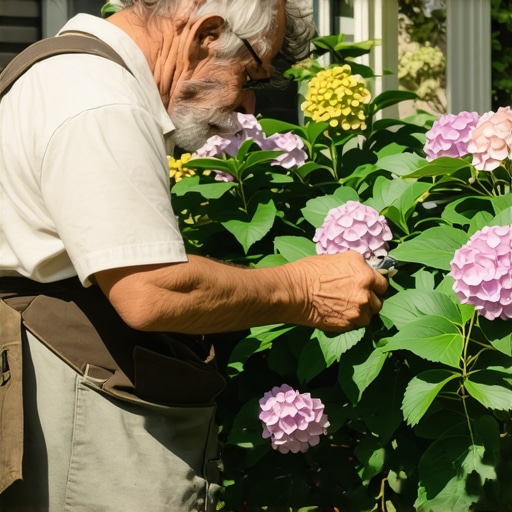
The Cost of a Bad Cut: Why Your Hydrangeas Aren’t Blooming
I always drill into my new crew members: if you do not understand the terminal bud location of a specific cultivar, you are just making expensive brush. I have stood in too many high-end backyards where the client spent thousands on landscaping and sod install services, only to have a ‘mow-and-blow’ crew come in and decapitate their prize hydrangeas. They treat the plant like a boxwood hedge, shearing it into a neat little ball. The result is a green mound with zero flowers and a frustrated homeowner. It is a biological failure caused by a lack of horticultural education. You can do the best yard cleanup in the world, but if your shears hit the wrong wood at the wrong time, you have killed the show for the next twelve months.
The Apprentice Lesson: Biology Over Aesthetics
When a new guy joins my team, the first thing I do is walk him over to a dormant Hydrangea macrophylla. I show him the buds. They look like tiny green or brown scales. I tell him: ‘That is the next six months of this client’s happiness right there. If you snip that, we lose the account.’ Most hacks do not realize that hydrangeas are not just shrubs; they are complex vascular systems that respond to hormonal cues. Pruning is not about ‘cleaning up.’ It is a surgical intervention that redirects auxins, the hormones responsible for plant growth. If you do not respect the apical dominance of the plant, you get stunted growth and weak stems that flop the moment a irrigation head hits them. We do things the right way, or we do not do them at all.
“Hydrangea macrophylla and H. quercifolia bloom on old wood; pruning these after midsummer will remove next year’s flower buds.” – Penn State Extension
1. Pruning at the Wrong Time for the Species
To avoid stunting growth, you must identify if your hydrangea variety blooms on old wood or new wood before cutting. Pruning at the wrong time removes the dormant flower buds, resulting in a season of green leaves without a single blossom appearing on the shrub. This is the most common reason for bloom failure. You have to know what you are looking at. If you have a Bigleaf (Macrophylla) or Oakleaf (Quercifolia) hydrangea, those buds were set last August. If you go out there in March with your bypass pruners and start ‘shaping’ things, you are cutting off the flowers. It is that simple. Conversely, Panicle (Paniculata) and Smooth (Arborescens) hydrangeas bloom on the current season’s growth. You can cut those back to the ground in late winter and they will still produce massive heads. Mixing these two up is the fastest way to ruin a landscape. Don’t do it.
| Hydrangea Type | Bloom Wood Type | Optimal Pruning Window | Risk of Wrong Timing |
|---|---|---|---|
| Bigleaf (Macrophylla) | Old Wood | Immediately after flowering | No blooms next year |
| Oakleaf (Quercifolia) | Old Wood | Late summer | Loss of fall color and buds |
| Panicle (Paniculata) | New Wood | Late winter / Early spring | Floppy stems if not pruned |
| Smooth (Arborescens) | New Wood | Late winter / Early spring | Undersized flower heads |
How do I know if my hydrangea blooms on old wood?
Look at the stems in the early spring. If you see fat, green buds forming on woody, brown stems that survived the winter, that is old wood. If the plant dies back to the ground every year and only sends up fresh green shoots from the soil, it is likely blooming on new wood. Never prune the woody stems of a Macrophylla unless they are dead, brittle, and have no green cambium layer when scratched. Use your fingernail to check for life. If it is brown inside, it is dead. If it is green, leave it alone. This is basic plant biology. You have to pay attention to the details or you will fail.
2. The ‘Haircut’ Method: Excessive Heading Cuts
Excessive heading cuts involve shearing the outer edges of the hydrangea to maintain a specific size, which creates a dense outer shell of foliage. This prevents sunlight penetration and airflow to the interior of the plant, leading to fungal pathogens and weakened internal structure. When you ‘haircut’ a hydrangea, you are forcing the plant to use its energy to repair the damage at the tips rather than developing a strong root system or large flower heads. It creates a ‘witch’s broom’ effect: a cluster of thin, weak shoots that cannot support the weight of a heavy flower after a rainstorm. I see this all the time after a poor yard cleanup where the crew just used gas shears on everything. It is lazy. It is wrong. You should be using thinning cuts, taking select branches back to the main trunk or the ground to let the plant breathe.
Why thinning is better than shearing
Thinning cuts allow for better irrigation efficiency because water can reach the root zone without being deflected by a thick canopy. It also reduces the risk of powdery mildew. In my firm, we aim to remove about one-third of the oldest wood every year on mature plants. This keeps the shrub rejuvenated. It forces the plant to push new, vigorous growth from the base. This is how you get those massive, head-sized blooms. You don’t get them by ‘giving the plant a haircut.’ You get them by understanding the vascular flow. Every cut should have a purpose. If you can’t justify the cut, put the shears down.
3. Ignoring the Terminal Bud and Apical Dominance
Ignoring the terminal bud disrupts apical dominance, the process where the central stem suppresses the growth of lateral buds to prioritize height. When you cut the terminal bud, you trigger a hormonal surge in the lateral buds, often resulting in multiple smaller, weaker stems. For hydrangeas, the terminal bud is usually where the largest flower will form. If you are constantly ‘tipping’ your plants, you are sacrificing size for density. In high-end landscaping, we want architectural structure. We want those thick, sturdy stems that stand up straight. When you disrupt this dominance, you end up with a plant that looks like a messy bush instead of a specimen shrub. You need to understand the 1/4 inch rule: always cut 1/4 inch above a node at a 45-degree angle. This directs the energy exactly where you want it to go.
“A pruning cut is a wound; the plant’s ability to seal that wound depends on the location and cleanliness of the cut.” – International Society of Arboriculture (ISA)
How much should I cut back for better growth?
For varieties like ‘Annabelle’ (Smooth Hydrangea), you can be aggressive. We often take them down to 12 inches from the ground in late February. This results in huge flowers. For ‘Limelight’ (Panicle), we prune back about one-third of the overall height to create a sturdy frame. But for the blue and pink Macrophyllas? You only remove the dead wood. If you cut those back hard, you are resetting the clock to zero. You might not see a flower for two years. This is why you need a pro who knows the difference. Don’t let a guy with a lawnmower and a pair of rusty shears touch your hydrangeas. It is a recipe for disaster.
4. Using Dull or Unsanitized Tools
Using dull or dirty tools causes jagged tears in the plant tissue, which creates an entry point for diseases and pests. Clean, sharp cuts allow the hydrangea to produce callous tissue quickly, sealing the vascular system and preventing moisture loss or infection. I have seen entire rows of hydrangeas succumb to bacterial wilt because a contractor moved from a diseased plant to a healthy one without cleaning his blades. We use high-carbon steel bypass pruners and we wipe them down with isopropyl alcohol between every single plant. It sounds like overkill until you see a $500 specimen die because of a dirty blade. Dull blades also crush the stem rather than slicing it. This damage stunts the growth of the new buds immediately below the cut. If your pruners are tearing the bark, they are garbage. Throw them away or sharpen them.
- Bypass Pruners: Best for live wood; they act like scissors for a clean slice.
- Anvil Pruners: Only for dead wood; they crush stems and should never be used on live hydrangea tissue.
- Loppers: Necessary for thick old-growth stems at the base of the plant.
- Pruning Saws: For rejuvenating ancient shrubs with wood thicker than 1.5 inches.
5. Over-Pruning and the Root-to-Shoot Ratio
Over-pruning a hydrangea destroys the root-to-shoot ratio, forcing the plant to deplete its stored carbohydrate reserves to replace lost foliage. This stress makes the plant more susceptible to drought, heat, and pests, often resulting in stunted, yellowing leaves and a lack of vigor. A plant’s roots and its leaves are in a constant state of balance. If you remove 70% of the canopy, the roots have no way to get the sugars they need from photosynthesis. The plant goes into survival mode. It stops flowering. It stops growing. It just tries to stay alive. We never remove more than 25-30% of a healthy plant’s biomass in a single season. This is a hard rule in professional landscaping. If the plant is too big for the space, you didn’t prune it wrong; you planted the wrong variety. You can’t fight genetics with shears. You will lose every time.
When is it too late to prune hydrangeas?
For most varieties, once you see the leaves fully expanded in late spring, it is too late for structural pruning. Any major cuts made in the heat of June or July will stress the plant’s irrigation needs. The plant is pushing water to the leaves to stay cool through transpiration. If you open up big wounds during a heatwave, you are asking for trouble. Late-season pruning also encourages new growth that won’t have time to ‘harden off’ before the first frost. That tender growth will freeze, turn black, and die, often carrying the rot down into the main stem. Stop cutting by early August at the latest. Let the plant go dormant. Respect the cycle.
Summary Checklist for Hydrangea Success
- Identify your species: Is it Macrophylla, Paniculata, Arborescens, or Quercifolia?
- Check for ‘old wood’ buds before making any spring cuts.
- Use sharp, sanitized bypass pruners for every cut.
- Focus on thinning out old wood rather than shearing the tips.
- Monitor irrigation after pruning to support the recovery phase.
- Leave the terminal buds alone if you want the largest possible flowers.