
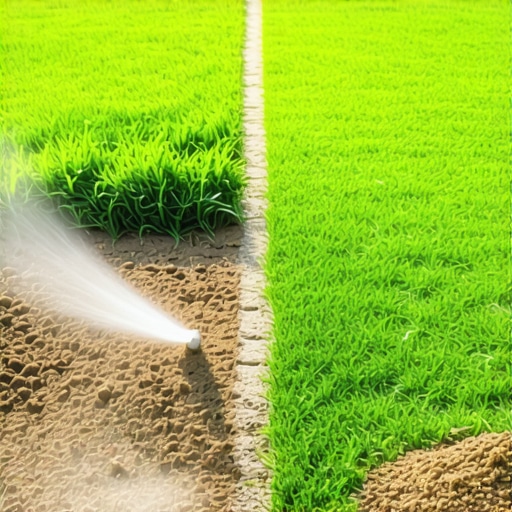
The Chemical Autopsy of a Scorched Lawn
A homeowner called me in a panic last summer after they completely torched their front yard by applying a high-nitrogen ‘weed and feed’ during a 95-degree heatwave. They didn’t just kill the weeds; they chemically altered the soil’s osmotic potential, literally sucking the moisture out of the grass roots. When I arrived, the lawn wasn’t just brown—it was brittle, smelling of sulfur and burnt carbon. This is the reality of modern landscaping gone wrong. Most people treat fertilizer like magic dust, but it is actually a precise chemical calculation of NPK ratios and salt indices. If you don’t understand the difference between liquid and granular fertilizer, you are playing Russian roulette with your soil biology.
Liquid Fertilizer: The Foliar IV Drip for 2026 Turf
Liquid fertilizer provides an immediate nutrient boost to turfgrass by bypassing the soil and entering the plant through the stomata in the blades, known as foliar uptake. This delivery method is ideal for correcting immediate nutrient deficiencies or prepping a lawn for a high-traffic event where rapid green-up is the priority. It offers unmatched precision in application rates, allowing for ‘micro-dosing’ that prevents the massive surge growth associated with cheaper alternatives. It will react fast. Don’t blink.
“Foliar fertilization is most effective when the plant is not under moisture stress and temperatures are moderate, as the goal is to maximize absorption before the solution evaporates on the leaf surface.” – Penn State Center for Turfgrass Science
How much liquid fertilizer do I need for a 5,000 sq ft lawn?
To treat a 5,000 sq ft area, you typically need 0.5 to 1.0 pounds of nitrogen per 1,000 sq ft, which often translates to 2.5 to 5 gallons of diluted product depending on the concentration. Always calibrate your sprayer to ensure an even irrigation-like mist that coats rather than drenches. Over-application leads to immediate tip burn.
Granular Fertilizer: The Slow-Release Structural Engine
Granular fertilizer is the backbone of long-term soil health and landscaping stability, utilizing slow-release coatings like poly-coated urea (PCU) or sulfur-coated urea to meter out nutrients over 8 to 12 weeks. Unlike liquids, granules must be broken down by soil microbes and water, making them less prone to leaching into groundwater. They are the superior choice for a sod install where you need a steady supply of phosphorus to stimulate root elongation without overwhelming the young plant. This is the long game. Patience pays.
“Granular fertilizers with high Water Insoluble Nitrogen (WIN) percentages provide the most consistent growth curves and minimize the environmental risk of nitrate leaching into local aquifers.” – Texas A&M Agrilife Extension
Which fertilizer is better for a new sod install?
For a new sod install, granular fertilizer with a high phosphorus ‘starter’ ratio is significantly better because it provides a sustained nutrient reservoir for emerging roots. Liquids wash away too quickly in the heavy irrigation cycles required for new sod. You need that 10-20-10 ratio to sit in the soil profile and wait for the roots to find it.
Comparative Analysis: Fertilizer Performance Metrics
| Feature | Liquid Fertilizer | Granular Fertilizer |
|---|---|---|
| Nutrient Delivery | Foliar (Leaf) & Root | Root Only (Soil) |
| Uptake Speed | 12-48 Hours | 7-14 Days |
| Longevity | 2-4 Weeks | 8-12 Weeks |
| Equipment Needed | Tank Sprayer / Hose-end | Broadcast Spreader |
| Risk of Burn | High (if concentrated) | Moderate (Salt-based) |
The Yard Cleanup and Prep Protocol
Applying fertilizer to a messy lawn is a waste of money. A comprehensive yard cleanup must precede any nutrient application. This means removing the thatch layer—that spongy mat of dead organic matter that sits between the green blades and the soil surface. If your thatch is thicker than half an inch, your fertilizer (liquid or granular) will never reach its destination. It gets trapped, feeds the fungus, and starves the roots. Clean it first. No excuses. I tell my crew: if you can’t see the soil, you aren’t ready to feed it. Landscaping is about the foundation, not just the facade.
- Step 1: Mechanical aeration to relieve soil compaction.
- Step 2: Power-raking to remove excessive thatch.
- Step 3: Soil pH testing (Target: 6.0 to 7.0 for most turf).
- Step 4: Calibration of the spreader or sprayer.
- Step 5: Post-application irrigation to activate the chemistry.
Irrigation: The Vehicle of Delivery
Your irrigation system is not just for watering; it is the transport mechanism for your entire turf program. For granular fertilizer, you need exactly 0.25 to 0.5 inches of water immediately after application to move the prills off the blades and into the thatch. For liquid fertilizer, you often need to wait 24 hours before watering to allow for foliar absorption. If you have a ‘mow-and-blow’ guy who sprays and then sets the sprinklers for an hour, he’s washing your money into the storm drain. It’s a rookie mistake. Don’t be a rookie.
How often should I water my lawn after fertilizing?
After the initial activation soak of 0.5 inches, you should return to a deep and infrequent irrigation schedule, aiming for 1 inch of water per week delivered in two sessions. This forces the roots to grow deeper into the soil profile to find moisture, which increases the plant’s drought resistance. Shallow watering creates weak grass. Deep roots create a fortress.