
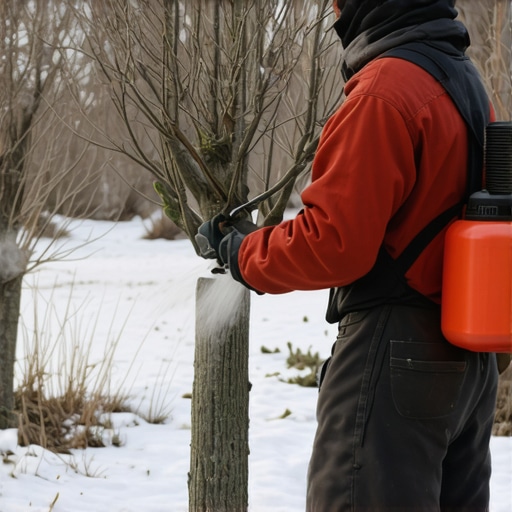
Why Dormant Oil is the Foundation of Long-Term Orchard Health
Dormant oil spraying is a critical preventative measure involving highly refined petroleum or vegetable-based oils applied to fruit trees during their inactive phase to suffocate overwintering pests like scale, aphids, and mite eggs before they emerge in the spring. This practice ensures structural integrity for the 2026 harvest cycle.
I always drill into my new crew members: if you don’t fix the soil grading first, every plant you put in the ground is just expensive compost. The same logic applies to arboriculture. You can’t wait until you see a leaf curl or a scale infestation in June to start your management plan. By then, the vascular system is already under stress. I’ve seen 20-year-old apple trees die because a homeowner ignored the basic mechanical protection of a dormant spray. They want the fruit, but they don’t want to do the dirty work of monitoring the overwintering biology. Real landscaping isn’t about making things look pretty for a weekend; it’s about engineering a biological system that survives the next decade. If you aren’t thinking about 2026 right now, you’re already behind the curve.
“The application of horticultural oils during the dormant season is the most effective way to reduce populations of San Jose scale and European red mites without disrupting beneficial predatory insect cycles.” – University of California Integrated Pest Management Manual
The Mechanical Science of Suffocation
We aren’t using poisons here; we are using physics. These oils work by coating the respiratory spiracles of insects and the shells of their eggs. It is a mechanical kill. If the oil doesn’t touch the pest, the pest doesn’t die. This is why coverage is everything. You aren’t just misting the tree; you are saturating the bark crevices where these organisms hide. Most ‘mow-and-blow’ guys will tell you a quick spray is enough. It isn’t. You need to reach the point of runoff. If you miss a single branch, you’ve left a colony that will explode once the degree-days hit the right threshold in April.
The Critical Window: Timing Your Application by the Numbers
The optimal timing for dormant oil application occurs in late winter or early spring, specifically when ambient temperatures remain above 40°F for at least 24 to 48 hours to prevent the oil emulsion from breaking and causing phytotoxicity or uneven coverage on the fruit tree bark.
Don’t guess. Use a thermometer. If you spray and the temperature drops below freezing before that oil dries, you’ll damage the cambium layer. I’ve seen bark split wide open because a contractor tried to beat a frost. You also have to watch the bud stage. We call it ‘delayed dormant’ when the silver tip or green tip just starts to show. That is the sweet spot. Wait too long, and you’ll burn the emerging tissue. Too early, and the insects haven’t increased their respiration enough for the oil to be 100% effective. It’s a narrow window. Use it wisely.
How much oil do I need for a standard fruit tree?
For a semi-dwarf fruit tree approximately 10-12 feet tall, you will typically need 2 to 3 gallons of finished spray solution to achieve full saturation. This depends on the density of the branching and the texture of the bark. Older trees with deeply furrowed bark require more volume to ensure the oil penetrates the hidden voids where eggs are tucked away.
| Pest Type | Damage Mechanism | Oil Concentration | Ideal Timing |
|---|---|---|---|
| San Jose Scale | Saps nutrients, kills limbs | 3% to 4% | Late Dormant |
| Aphid Eggs | Distorts new foliage | 2% | Delayed Dormant |
| Spider Mites | Stippling and leaf drop | 2% | Late Winter |
| Pear Psylla | Sooty mold growth | 3% | Early Spring |
Integrating Spraying with Your Total Yard Cleanup
A comprehensive yard cleanup strategy must include the removal of fallen fruit and leaf litter, which serve as primary reservoirs for fungal spores and larvae, effectively supplementing the mechanical protection provided by dormant oil applications on fruit-bearing species.
You cannot separate the tree from the ground it stands on. If you’re paying for a sod install or a new irrigation system but leaving rotted ‘mummy fruit’ on the ground, you’re wasting money. Those old fruits are bunkers for pests. During a professional landscaping cleanup, we strip that debris away. We check the irrigation emitters to ensure they aren’t spraying the trunk directly—which causes crown rot—and we make sure the mulch isn’t piled against the root flare. A ‘mulch volcano’ is a death sentence. It holds moisture against the bark, inviting the very pests we’re trying to kill with the oil.
The Impact of Soil Moisture on Spray Efficacy
Hydration matters. Never spray a drought-stressed tree. If your irrigation system has been off all winter and the ground is bone-dry, the tree is already in survival mode. The oil can actually increase stress in these conditions. Soak the root zone a few days before you plan to spray. This ensures the tree’s internal turgor pressure is high, allowing it to handle the temporary coating on its respiratory pores.
“Hydrostatic pressure within the plant tissue must be maintained; a dehydrated tree is significantly more susceptible to oil-induced tissue injury than one with adequate soil moisture.” – International Society of Arboriculture (ISA) Standards
Do I need a permit for dormant oil spraying?
In most residential zones, dormant oils—which are often classified as OMRI-listed or organic—do not require specific municipal permits for application. However, always check your local HOA regulations and ensure you are not spraying near open waterways, as even organic oils can affect aquatic oxygen levels if there is significant runoff into ponds or streams.
The Master Landscaper’s 2026 Protection Checklist
- Inspect all trees for ‘scale’—look for small, greyish bumps that can be scraped off with a fingernail.
- Check the 10-day forecast; ensure no freezes are predicted within 48 hours of application.
- Calibrate your sprayer; a coarse droplet is better than a fine mist for bark penetration.
- Clean the base of the tree; remove all organic debris within the drip line to eliminate pest bunkers.
- Prune dead or crossing branches first; don’t waste oil on wood that needs to be removed.
- Check the root flare; ensure the transition between trunk and root is visible and not buried by soil or mulch.
It will rot. If you ignore the root flare, the base of that tree will rot regardless of how much oil you spray on top. Precision matters. Every measurement, from the PSI of your sprayer to the pH of your soil, dictates whether that tree will be a producer in 2026 or just another piece of firewood. Get it right the first time. Don’t skip the details.