
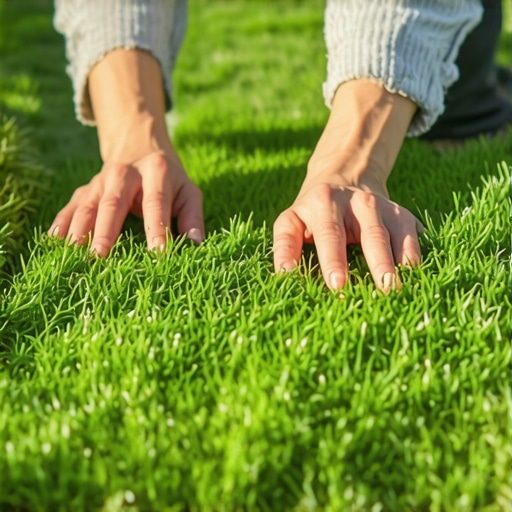
The Fatal Flaw of Modern Sod Installation
Sod edges brown primarily due to desiccation caused by air gaps and exposed root mats that act as a wick, pulling moisture away from the grass. To prevent this, professional sod install requires a technique called tucking, where the perimeter is physically recessed into the soil to eliminate air contact with the root zone.
I always drill into my new crew members: if you don’t fix the soil grading first, every plant you put in the ground is just expensive compost. I’ve watched too many rookies lay down a beautiful field of Kentucky Bluegrass only to see the edges turn into brittle straw within forty eight hours. They blame the heat or the irrigation, but the failure started the second they left the edge of the sod slab sitting flush with the soil surface. This creates a thermal bridge. The sun hits that exposed vertical edge of the peat or dirt mat, and it bakes the life out of the roots. You are essentially leaving a wound open to the elements. If you want that sod to survive the 2026 season, you have to seal the edges. It is a matter of civil engineering on a micro scale. You are managing the micro-climate at the intersection of the grass and the bare earth.
The Anatomy of a Sod Edge: Why Desiccation Occurs
Desiccation in new turf is driven by the wicking effect where the exposed root mass loses moisture faster than the center of the slab. This imbalance causes the edges to shrink, widening the gaps between rolls and accelerating the drying process in a landscaping death spiral.
“A successful sod installation is dependent on the immediate establishment of root-to-soil contact, which is often compromised at the perimeter of the project where air infiltration is highest.” – Penn State Center for Turfgrass Science
When you lay sod, you are dealing with a living organism that has had 90 percent of its root system sliced off. It is in shock. The soil you are placing it on must be prepped to a specific bulk density. If the soil is too compacted, the roots cannot penetrate. If it is too loose, it will settle and create air pockets. The edge is where these problems are magnified. Air is the enemy of a new root. When air gets under the edge, it stops the capillary action that allows water to move from the subsoil into the sod mat. This is why you see browning even if you are watering three times a day. The water is hitting the blades, but it is not staying in the root zone at the edge. It is evaporating through the side of the slab. Don’t skip the compaction check. Use a water-filled roller. It should weigh at least 200 pounds to ensure the seams are pressed firm.
The Tucking Secret: Step-by-Step Engineering
The tucking secret involves cutting a shallow trench along the perimeter of the install area and folding the edge of the sod down into it. This yard cleanup and prep step ensures the root mat is completely buried, protecting it from wind and sun exposure.
How do I stop my sod edges from drying out?
You stop sod edges from drying out by eliminating the vertical exposure of the root mat. Use a spade or an edger to create a 2 inch deep bevel at the border where the sod meets a flower bed or sidewalk. Place the edge of the sod into this bevel and firmly press it down. This seals the root zone and forces the grass to grow downward rather than drying out horizontally.
| Feature | Standard Lay Method | The Tucking Method | |||||||||
|---|---|---|---|---|---|---|---|---|---|---|---|
| Edge Exposure | High (exposed peat mat) | Zero (buried root zone) | Moisture Retention | Low (wicking occurs) | High (sealed environment) | Root Establishment | 14-21 Days | 7-10 Days | Visual Seams | Visible for months | Disappear in weeks |
The mechanics of the tuck are simple but physically demanding. You cannot just slap the grass down and walk away. You need to use a sharp sod knife to trim the edges so they fit tightly. No overlapping. If you overlap the slabs, the top layer will die because it has no contact with the soil. If you leave a gap, the edges will brown. You must butt the edges tightly together, like a hardwood floor, and then use your thumb or a hand tamper to roll that outer edge down into the soil. This creates a physical barrier. It’s about managing the hydraulic conductivity of the site. You want the water to move vertically through the profile, not escape out the sides. It will rot if you don’t manage the drainage, but it will burn if you don’t manage the edges.
Soil Preparation: The Biology of the Base
The success of a sod install depends on the Cation Exchange Capacity (CEC) and the pH of the receiving soil. Before the first roll is dropped, the site must be cleared of debris and the soil amended with organic matter to support landscaping longevity.
“Soil pH should be maintained between 6.0 and 7.0 to ensure maximum nutrient availability for newly transplanted turfgrass rhizomes.” – Texas A&M Agronomy Manual
Most homeowners and cheap contractors skip the soil test. That is a mistake. If your pH is at a 5.0, your grass is starving even if you dump nitrogen on it. You need to know your numbers. For 2026, we are looking at more volatile weather patterns. You need a soil base that can hold moisture. This means incorporating compost or a high-quality topsoil blend at least 4 inches deep. Get the 811 utility marks before you till. Don’t be the guy who hits a gas line because he wanted a better lawn. Once the soil is prepped, you need a starter fertilizer with a high phosphorus count, something like a 10-20-10, to encourage root branching. Phosphorus doesn’t move well in soil, so it needs to be worked into the top inch before the sod goes down. Do not just throw it on top of the grass. That is a waste of money.
How much water does new sod need per day?
New sod requires approximately 1 inch of water per day, split into three short cycles to keep the soil consistently moist but not saturated. Over-watering leads to anaerobic conditions where the roots rot due to a lack of oxygen in the soil pores. Monitor the soil daily with a screwdriver; if it cannot penetrate 4 inches easily, it is too dry.
The Master Landscaper’s Sod Install Protocol
- Perform a 4-inch deep soil core test to check pH and nutrient levels.
- Clear all rocks, weeds, and old debris; this is the core of yard cleanup.
- Grade the site to ensure water moves away from the foundation at a 2 percent slope.
- Cut a 2-inch perimeter trench for the tucking technique.
- Install sod in a staggered brick pattern to minimize long seam exposure.
- Roll the entire area with a 200lb water roller to remove air pockets.
- Irrigate immediately, ensuring the water penetrates the sod mat and the top 2 inches of soil.
While the internet tells you to water every day indefinitely, turf grass actually needs deep, infrequent watering exactly 1 inch per week after the first 21 days to force roots to chase the water down. If you keep the surface wet forever, the roots stay in the top half-inch. That makes for a weak lawn that will die the first time the temperature hits 90 degrees. You have to train the grass. After the seams have knitted together—usually by week three—you start backing off. This is where the engineering meets biology. You are building a system, not a decoration. Every step, from the initial landscaping design to the final tuck of the edge, is a link in a chain. If one link fails, the whole lawn fails. Don’t be the hack who cuts corners on the edges. Tuck them in. Seal the life in. It’s the difference between a lawn that lasts a decade and one that you’ll be replacing in 2027.