
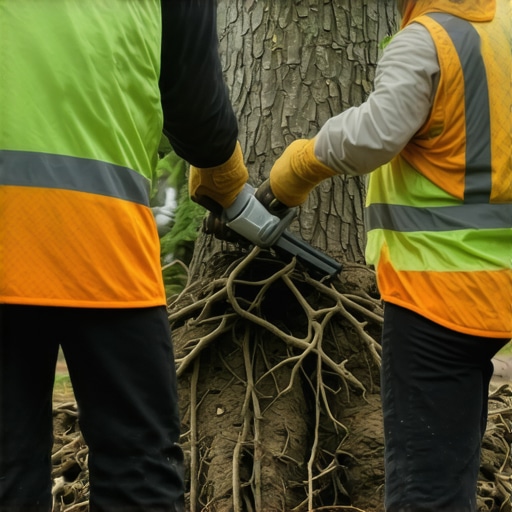
Understanding the Mechanics of Tree Girdling and Vascular Compression
Tree girdling occurs when secondary xylem and phloem are compressed by roots growing in a circular pattern around the main stem. To prevent tree death by 2026, you must identify these encircling roots before they fuse with the trunk and sever the tree’s nutrient transport system. Effective remediation requires root flare excavation and surgical pruning to restore sap flow and long-term structural integrity.
I always drill into my new crew members: if you don’t fix the soil grading first, every plant you put in the ground is just expensive compost. I have seen hundreds of landscape projects fail not because of a lack of water, but because the installer buried the root flare. A tree planted too deep is a time bomb. When the flare—the area where the trunk transitions into the roots—is buried under even two inches of excess soil or mulch, the tree responds by sending out adventitious roots. These roots, seeking oxygen near the surface, eventually wrap around the trunk. As the tree grows in diameter, these roots tighten. It is a slow-motion strangulation that can take a decade to kill the tree, but by the time the canopy shows dieback, the damage is often irreversible. We don’t just dig holes; we engineer environments where roots can move laterally into the native soil profile without crossing over the main structural supports.
“Girdling roots can reduce the growth of the entire tree by restricting the movement of water and nutrients through the vascular system, eventually leading to secondary pest infestations.” – ISA Arborists’ Certification Guide
How do you tell if a tree is girdled?
Visible symptoms of root girdling include a flat side on the trunk at the soil line, a lack of root flare visibility, and premature fall coloration or early leaf drop. Inspect the base of your trees; if the trunk goes straight into the ground like a telephone pole, you have a problem. The flare should be wider than the trunk above it. If you see a root crossing the main stem, it is already beginning the strangling process. These roots act like a tourniquet, cutting off the flow of photosynthates from the leaves to the roots.
Can you save a tree with girdling roots?
Saving a girdled tree depends on the percentage of the circumference affected; generally, if more than 50% of the trunk is compressed, the tree’s structural stability is compromised beyond repair. For trees with less damage, we use a process called Air-Spading. This involves using a high-pressure pneumatic tool to blow away soil without damaging the delicate bark of the roots. Once exposed, we can see exactly which roots are the offenders. Using sterilized bypass pruners or a sharp chisel, we make clean cuts to remove the encircling roots. This is not a job for a homeowner with a dull saw. You need to understand where the branch bark ridge and the stem-root transition are to avoid causing a fatal wound.
The Blueprint for New Installations: Avoiding the Container Trap
Prevention starts at the nursery, where container-grown stock often develops circling roots that must be shaved or teased out before the sod install or final landscaping occurs. Most people buy a tree from a big-box store, pull it out of the plastic pot, and drop it in a hole. That is a recipe for failure. Those roots have been hitting the plastic walls and turning in circles for months. If you don’t break that pattern, the tree will never establish a healthy root architecture. We use a method called ‘box pruning’ or ‘shaving the root ball’ to ensure every root tip is pointing outward into the backfill soil.
| Root Type | Risk Level | Required Action | Tools Needed |
|---|---|---|---|
| Surface Crossing Roots | Moderate | Selective Pruning | Hand Pruners / Chisel |
| Deep Girdling Roots | Extreme | Air-Spade Excavation | Pneumatic Air-Spade |
| Container Circling | High (Future) | Root Ball Shaving | Sharp Spade / Knife |
| Embedded Roots | Critical | Structural Assessment | Arborist Consultation |
During a yard cleanup, we often find what I call ‘mulch volcanoes.’ This is where some ‘landscaping’ hack piles six inches of dyed mulch against the trunk. It traps moisture against the bark, causing decay and encouraging those deadly girdling roots to form. We keep mulch at a depth of 2 to 3 inches and always ensure it stays at least 4 inches away from the trunk itself. The soil pH also plays a role; in heavy clay soils common in suburban developments, poor drainage forces roots to stay near the surface, increasing the likelihood of crossing roots. We often recommend a French drain or specific irrigation adjustments to manage this moisture and encourage deep root penetration.
“A retaining wall doesn’t fail because of the stone; it fails because of the water trapped behind it, and a tree doesn’t fail because of the wind; it fails because the roots were never allowed to grow wide.” – Hardscape Engineering Axiom
- Check the Flare: Ensure the first main lateral root is at or just below the soil surface.
- Examine the Base: Look for ‘flat spots’ on the trunk where a root might be hiding underground.
- Prune Early: It is easier to cut a 1-inch root today than a 4-inch root in three years.
- Irrigate Properly: Use drip lines to encourage roots to grow outward, not just in the planting hole.
- Call 811: Always mark utilities before excavating root systems near the house.
Precision irrigation is non-negotiable for young trees. If your irrigation system only hits the top half-inch of soil, those roots are going to stay shallow. We install bubblers or drip emitters at the drip line of the tree, not the trunk. This forces the roots to reach out and colonize the surrounding soil, creating a stable base. If you are doing a sod install around a new tree, make sure the sod doesn’t overlap the root flare. We leave a 3-foot diameter ring of mulch to eliminate competition for nitrogen between the grass and the tree. Grass always wins the nutrient war, and your tree will suffer the consequences of stunted growth and weakened defenses against borers and fungus.
How much modified gravel do I need for a patio base?
While often asked in the context of tree health near hardscapes, the answer depends on the soil subgrade; typically, a 6-inch compacted base of 21A or 57 stone is required to prevent shifting that could crush nearby surface roots. If you are building a patio near a mature oak, you shouldn’t be using gravel at all in the critical root zone. We use permeable pavers and a ‘no-dig’ base to ensure the tree can still breathe. Oxygen is just as important as water for root health. If you pave over a root system with non-porous materials, you are essentially suffocating the tree. It will react by sending up ‘heaving’ roots that will eventually destroy your expensive stonework. It is a battle you won’t win.