
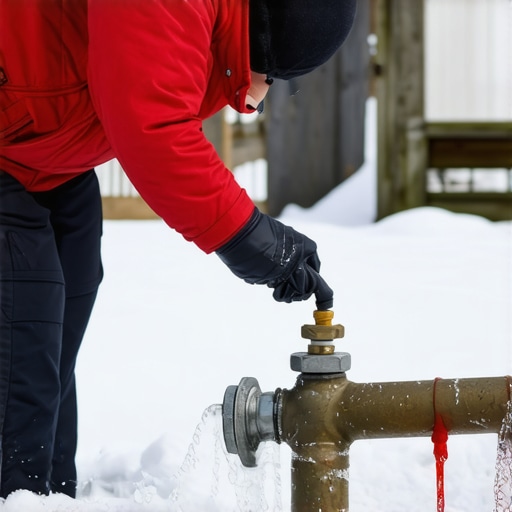
Why Winterizing Outdoor Faucets is Non-Negotiable
To prevent burst pipes, you must remove residual water from outdoor faucets and hose bibs before temperatures drop below 32°F. Ice expands by 9%, creating thousands of pounds of hydrostatic pressure that ruptures copper walls, often leading to catastrophic indoor flooding when the line thaws. This isn’t just about a leaky tap; it’s about structural integrity.
I’ve spent two decades in the dirt, and I’ve seen the same disaster play out every spring. A homeowner calls me because their basement wall is weeping, or their sod install is turning into a swamp. I recall one specific case where a client ignored my advice to winterize their irrigation system. They thought their ‘frost-free’ spigot was invincible. It wasn’t. They left a heavy-duty rubber hose attached over the winter. That hose trapped water inside the faucet’s stem. When the first hard freeze hit, the water expanded, and since it had nowhere to go, it split the copper pipe six inches inside the heated wall of the house. When it finally thawed in March, it dumped 400 gallons of water into their finished basement before they even realized the water was turned on. A $50 maintenance task turned into a $22,000 remediation project. Don’t be that homeowner.
“A retaining wall doesn’t fail because of the stone; it fails because of the water trapped behind it.” – Hardscape Engineering Axiom
How do I know if my outdoor faucet is frozen?
If you turn the handle and nothing comes out, or only a trickle appears despite high pressure elsewhere, you likely have an ice blockage. Do not force the handle; you will strip the seat washer or snap the stem. The real danger isn’t the ice you see; it’s the hydrostatic pressure building up between the ice plug and the indoor shut-off valve. This pressure can exceed 3,000 PSI, which is more than enough to compromise even Type L thick-walled copper.
| Pipe Material | Freeze Vulnerability | Expansion Tolerance | Failure Mode |
|---|---|---|---|
| Copper (Type M) | High | Low | Longitudinal Splitting |
| PEX | Medium | High | Fitting Separation |
| Galvanized Steel | Low | Zero | Thread Failure/Clogging |
| CPVC | Extreme | None | Shattering/Brittle Fracture |
The Forensic Step-by-Step Drainage Protocol
Winterizing a property requires more than just turning a knob. It is a systematic evacuation of fluids to ensure no volume remains to expand. If you leave even a tablespoon of water in a ball valve, that valve will crack. It’s physics. There is no middle ground.
- Disconnect All Attachments: Remove hoses, splitters, and timers. A hose attached to a frost-free faucet prevents the internal siphon from draining.
- Locate the Internal Shut-off: This is usually in the basement or crawlspace. Look for a gate valve or ball valve leading directly to the exterior wall.
- Close the Valve and Open the Tap: Turn the indoor valve to the ‘off’ position. Then, go outside and open the faucet fully.
- The Bleeder Valve: Back inside, place a bucket under the shut-off valve. Unscrew the small metal ‘bleeder cap’ on the side of the valve. This breaks the vacuum and allows the water trapped in the pipe to drain out.
- Leave the Outside Tap Open: This allows for air expansion should any residual moisture remain.
“The most common cause of plumbing failure in temperate climates is the lack of atmospheric venting in closed-loop exterior systems.” – National Standard Plumbing Code (NSPC)
Can a frost-free faucet still burst?
Yes, and they often do. A frost-free sillcock works by placing the actual valve seat 12 to 14 inches inside the house. However, it relies on gravity to drain the water out of the long stem. If the faucet is installed with a ‘back-pitch’ (sloping toward the inside of the house) or if a hose is left attached, the water cannot drain. It stays in the tube, freezes, and splits the pipe. You won’t know it’s broken until you turn it on in the spring and water starts spraying inside your walls. It is a silent killer of drywall and insulation.
Integrating Winterization into Your Yard Cleanup
Proper yard cleanup isn’t just about raking leaves; it’s about protecting your infrastructure. When we perform a landscaping audit, we look at the irrigation heads first. If your sod install was done recently, the soil might still be settling. This settling can change the pitch of your underground pipes, creating ‘bellies’ where water collects. During your winterization, you must blow out these lines with a high-volume air compressor. We aren’t talking about a small tire inflator. You need at least 20 CFM (Cubic Feet per Minute) to move the water without creating enough friction heat to melt the PVC fittings. If you leave water in the irrigation valves, the plastic diaphragms will tear, and come spring, you’ll be digging up your lawn to replace $100 valves. It will rot your budget. Don’t skip the blowout.
The Science of Soil Desiccation and Pipes
Many homeowners forget that dry winter air can be just as damaging as the freeze. In regions with heavy clay, the soil pulls away from the foundation as it dries, exposing buried pipes to colder air pockets. This is why a thorough yard cleanup should include mulching around the base of outdoor risers. It acts as an insulating blanket, keeping the soil microbiology active and preventing deep frost penetration. If you just laid new grass, a late-season sod install requires specific moisture levels before the ground freezes to ensure root attachment. Once the faucets are drained, your ability to spot-water is gone, so timing is critical. Ensure the root zone is hydrated, then purge the system completely. No exceptions.