
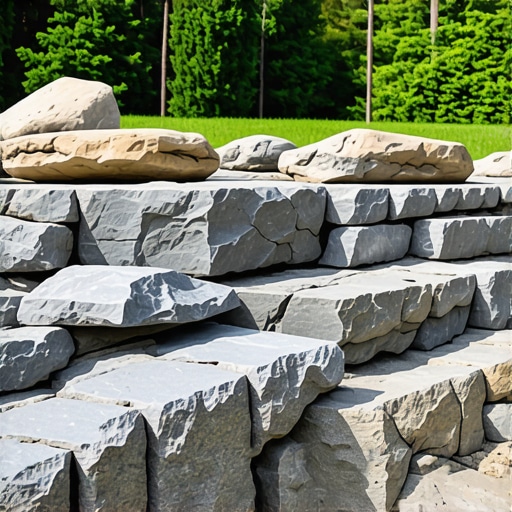
3 Best 2026 Stones for Natural Retaining Walls: Engineering Performance and Selection
Selecting the correct stone for a natural retaining wall is not an aesthetic choice; it is a structural decision governed by geology and physics. In 2026, the industry is moving away from soft, porous sedimentary rocks toward high-density igneous and metamorphic options that survive extreme freeze-thaw cycles. Most homeowners focus on the color, but as a contractor with two decades of experience, I focus on the specific gravity and the friction coefficient. If you pick a stone that absorbs water, it will shatter within five years of the first hard frost. This guide breaks down the three superior stone types for high-performance retaining walls that will outlast your mortgage.
The Engineering Reality of Natural Stone Selection
Selecting the right stone involves evaluating the material’s density, compressive strength, and resistance to environmental degradation to ensure the wall can withstand hydrostatic pressure. High-performance stones like Granite, Basalt, and Silica-rich Quartzite offer the best longevity for gravity-based wall systems in diverse climates.
I recently got called out to tear up a $30,000 gravity wall that was leaning at a 15-degree angle because the previous contractor used soft limestone and backfilled it with native clay. The stones were literally dissolving from the inside out because of the acidity in the soil and the lack of a proper drainage chimney. We spent three weeks excavating the mess, and it was a textbook case of why big-box store ‘landscape’ stones are just expensive compost. I told the client the same thing I tell my apprentices: you can pay for the right stone now, or you can pay me twice as much to fix the wrong one later. Water is the enemy of every structure you build. If you don’t account for the weight of the saturated soil and the expansion of freezing moisture, your wall is just a pile of debris waiting to happen.
“A retaining wall doesn’t fail because of the stone; it fails because of the water trapped behind it.” – Hardscape Engineering Axiom
1. Weathered Granite Gneiss: The Heavyweight Champion
Granite Gneiss is my top recommendation for 2026 due to its incredible density and metamorphic durability. Unlike standard granite, gneiss has been subjected to higher temperatures and pressures, creating a banded structure that makes it easier to split into workable, flat-faced blocks without losing structural integrity. It has a very low absorption rate, typically under 0.5%, meaning it won’t soak up water that leads to spalling. When you stack gneiss, the rough texture creates massive friction between layers. This is critical. You want the stones to bite into each other. For a wall over three feet, the sheer weight of gneiss provides the gravity needed to resist the lateral earth pressure from the slope behind it. It is heavy, it is hard to cut, and it will be there for 100 years. If your landscaper complains about the weight, find a new landscaper.
2. Columnar Basalt: The Civil Engineer’s Choice
Basalt is an extrusive igneous rock that provides some of the highest compressive strengths found in nature. For 2026, we are seeing a massive trend toward using vertical columnar basalt for naturalistic walls. These aren’t your typical stacked flat stones; they are hexagonal or pentagonal pillars. When installed correctly, they act as a soldier pile wall. You bury the bottom third of the column into a reinforced trench of 21A modified gravel. The strength of basalt comes from its fine-grained mineralogy, which resists chemical weathering from fertilizers and acid rain. It is virtually impervious to the salts often used on nearby walkways. If you are building near a driveway where de-icing is a factor, basalt is the only logical choice. It is brutally tough and requires specialized diamond-blade saws to trim. It doesn’t forgive mistakes.
3. Silica-CEMENTED Sandstone (Fieldstone): The Versatile Traditionalist
Not all sandstone is created equal. Most of the ‘fieldstone’ sold at local yards is clay-cemented, which is garbage that will flake apart. For 2026, I am specifying silica-cemented sandstone. This stone is bonded by quartz, making it much harder and more resistant to the elements. It provides that classic ‘natural’ look that many homeowners want for their landscaping projects. The key with silica-rich sandstone is the shape. We look for ‘snapped’ or ‘split’ edges that provide a flat bed for stacking. You cannot build a stable wall with round river rocks; it’s like trying to stack marbles. You need a stone with ‘heart’—the thick middle section that provides the stability. We use these for walls that need to blend into a wooded environment while still providing a reliable barrier against soil erosion.
The Core Construction Specifications for 2026
A successful retaining wall requires a foundation of compacted aggregate and a dedicated drainage system to manage the 1-inch of water per square foot that falls during heavy rain. Professionals utilize ASTM D448 No. 57 stone for backfill to ensure that water moves vertically to the perforated drain pipe rather than pushing against the stone face.
| Stone Type | Density (lbs/ft3) | Porosity (%) | Primary Fail Point |
|---|---|---|---|
| Granite Gneiss | 165 – 175 | 0.1 – 0.6 | Improper Base Leveling |
| Columnar Basalt | 180 – 190 | 0.1 – 0.4 | Inadequate Burial Depth |
| Silica Sandstone | 140 – 150 | 1.0 – 2.5 | Freeze-Thaw if Clay-Bonded |
“The primary cause of retaining wall failure is hydrostatic pressure build-up due to inadequate drainage systems.” – Penn State Agricultural Extension
How much modified gravel do I need for a patio base?
To calculate the required modified gravel, multiply the square footage of your patio by the depth of the base (usually 6 inches for foot traffic, 12 inches for vehicles), then divide by 324 to get cubic yards. Always add 20% for compaction. If the gravel doesn’t crunch and lock under a plate compactor, it is not the right material. You are looking for a mix of 3/4-inch stone down to dust. This is non-negotiable for a stable landscaping project.
How do I stop a retaining wall from leaning?
To prevent a wall from leaning, you must install a French drain directly behind the stone and use a ‘batter,’ which is the intentional backward tilt of the wall toward the slope. For every foot of height, the wall should set back at least one inch. If you build it perfectly vertical, gravity will eventually win and push it forward. Use non-woven geotextile fabric to separate the drainage stone from the soil to prevent ‘fines’ from clogging your pipe. If the pipe clogs, the wall fails. It is that simple.
Integrating Sod and Irrigation Post-Construction
Once the wall is set, the yard cleanup and sod install phase begins. This is where most hacks fail. They lay the sod right up to the wall without considering the irrigation requirements. You never put a sprinkler head directly behind a retaining wall. The excess water will saturate the backfill and increase the load on the stone. Instead, use drip-line irrigation for any plantings near the wall. When we perform a sod install after a major build, we ensure the grade slopes away from the wall’s top edge. We use a heavy roller to ensure the sod has 100% contact with the soil, then we perform a deep soak. But remember: the sod needs the water, the wall does not. Keep your water management tight. The 2026 standard for high-end properties is a clear separation of turf and structure. Don’t let your grass-cutting crew scalp the edges of the wall either; the vibration from heavy zero-turn mowers can disrupt the capstones if they aren’t properly adhered with polyurethane adhesive. Don’t skip the glue. It’s the cheapest insurance you’ll ever buy.
The 2026 Retaining Wall Checklist
- Excavate to a depth of at least 6 inches below grade for the base course.
- Use a plate compactor with a minimum force of 4,000 lbs to prep the trench.
- Ensure the first course of stone is buried (keyed in) to prevent ‘kick-out’.
- Backfill with 12 inches of clean crushed stone (no fines).
- Install a 4-inch perforated SDR-35 pipe with a daylight exit point.
- Apply professional-grade stone adhesive to the top two courses of the wall.