
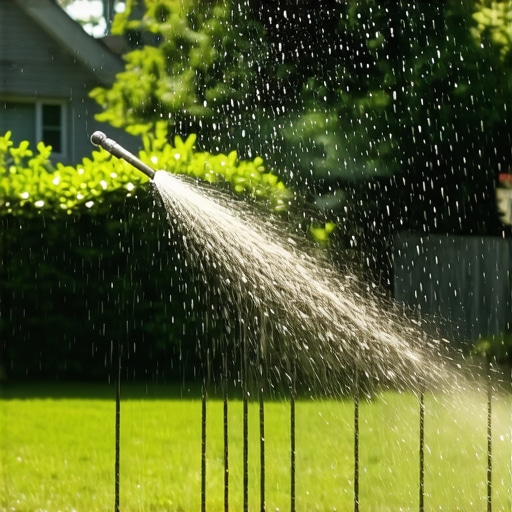
Why Sprinkler Overspray Destroys Property Assets
Sprinkler overspray occurs when irrigation water hits non-target surfaces like cedar fences, siding, and glass, leading to structural rot, fungal growth, and mineral calcification. To stop this, you must calibrate nozzle trajectory, adjust the arc of rotation, and ensure proper pressure regulation across the zone.
I always drill into my new crew members: if you don’t fix the soil grading and head placement first, every plant you put in the ground is just expensive compost. I recently got called out to inspect a luxury landscape where the homeowner had spent forty thousand dollars on a custom horizontal-slat cedar fence. In less than two years, the bottom three feet were black with rot. The culprit? A set of cheap, high-angle spray nozzles that were blasting the wood for twenty minutes, three times a week. The previous contractor didn’t account for the wind drift or the physics of the water hitting the vertical surface. They just installed the heads and walked away. That is not landscaping; that is negligence. We had to rip out the entire irrigation line along the perimeter, trench in new swing joints, and swap every head to precision rotators with a low-angle trajectory. It was a five thousand dollar fix for a problem that would have cost fifty bucks to prevent during the initial install.
“A retaining wall or fence doesn’t fail because of the material; it fails because of the water trapped behind or against it, leading to hydrostatic pressure or organic decay.” – Hardscape Engineering Axiom
The Physics of Water Damage on Hard Surfaces
When irrigation water strikes a window or a fence, it is not just getting it wet. You are dealing with two specific chemical and mechanical threats: mineral scaling and fungal colonization. Most well water or municipal water contains high levels of calcium and magnesium. When this water evaporates off a glass pane, it leaves behind a crystalline lattice that can permanently etch the surface. On wood, the constant wetting-drying cycle pulls the natural tannins out of the timber, weakening the cellular structure and inviting Basidiomycota—wood-decay fungi. This is not just an aesthetic issue; it is a structural failure in progress. If you see white crust on your glass or green slime on your fence, your irrigation system is actively depreciating your home’s value.
How do I adjust my sprinkler head radius?
To adjust a sprinkler head radius, use a flathead screwdriver or a hex key to turn the radius adjustment screw located on top of the nozzle. Turning the screw clockwise will reduce the throw by breaking up the stream, while counter-clockwise increases the distance by allowing a full, unobstructed flow of water.
| Nozzle Type | Standard Trajectory | Wind Resistance | Best Application |
|---|---|---|---|
| Fixed Spray Nozzle | 15 to 30 Degrees | Low | Small, sheltered turf areas |
| MP Rotator (Multi-Stream) | Standard to Low | High | Large lawns with wind exposure |
| Low-Angle Nozzle | 5 to 10 Degrees | Superior | Fence lines and under-tree canopies |
| Bubblers | 0 Degrees | Absolute | Individual shrubs and foundation beds |
Can I use vinegar to remove hard water stains on windows?
Yes, distilled white vinegar diluted with water can dissolve calcium carbonate deposits on glass caused by sprinkler overspray. However, for severe etching or silicate buildup, you may require a professional-grade phosphoric acid cleaner or mechanical polishing to restore the clarity of the glass pane.
The Precision Remediation Process
Fixing overspray is not about turning a screw and hoping for the best. It requires a systematic audit of your hydraulic pressure and nozzle selection. Most systems are over-pressurized. When a zone designed for 30 PSI is running at 60 PSI, the water atomizes into a fine mist. This mist does not fall on the grass; it drifts onto your windows and into your siding. You need to install pressure-regulating stems (PRS) to keep the water in large, heavy droplets that fall exactly where you aim them. We use heads with built-in 30 or 45 PSI regulators to ensure consistency regardless of the main line pressure.
“Irrigation efficiency is measured by the distribution uniformity; water hitting a fence is water not reaching the root zone, representing a 100% loss of resource efficiency.” – Texas A&M AgriLife Extension
- Inspect Nozzle Arcs: Ensure every head on the fence line is set to a strict 180-degree or 90-degree pattern with no ‘bleed’ over the edge.
- Check Head Straightness: A head tilted even two degrees toward a structure will throw water much higher and further than intended.
- Monitor Wind Patterns: If your local climate has a consistent afternoon breeze, you must downsize your nozzles to compensate for the carry.
- Clear Drainage Paths: Ensure the yard cleanup includes removing debris from the base of the fence so water doesn’t pool and wick up the wood.
- Evaluate Soil Saturation: In heavy clay soils, overspray leads to mud pits; in sandy soils, it creates localized erosion channels.
Maintenance and Long-Term Prevention
Once you have corrected the trajectory, your work isn’t done. Irrigation systems are dynamic. Soil shifts, heads get bumped by lawnmowers, and nozzles clog. A quarterly inspection is the only way to protect your assets. Check the ‘pop-up’ height of your heads. If the grass has grown too thick (thatch buildup), it can deflect the water stream upward, causing it to spray the very fence you’re trying to protect. This is where a proper sod install comes into play. If the sod is laid too high against a structure, it creates a ramp for water. You want a clear gap between your turf and your vertical assets. Don’t let a hack tell you that ‘a little water won’t hurt.’ I have seen ten-year-old fences that look brand new because the owner understood water management, and I have seen three-year-old fences that were ready for the landfill. Which one do you want? Precision matters. Engineering matters. Don’t skip the details.