
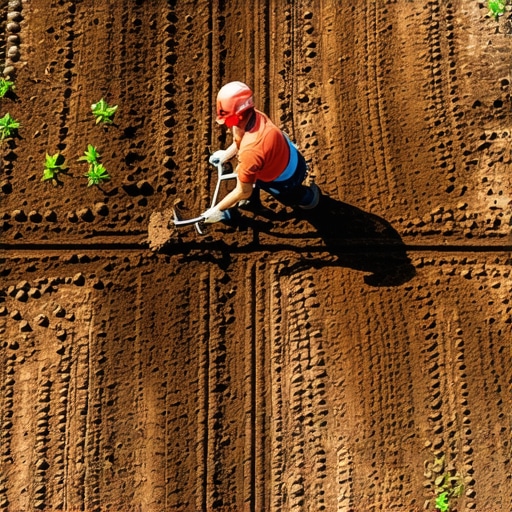
The Science of 48-Hour Root Establishment: Stop Burying Your Money
If you think laying sod is just unrolling green carpet over dirt, you are a ‘mow-and-blow’ hack’s favorite customer. Most residential sod installs fail not because of the grass quality, but because the homeowner or a cut-rate contractor ignored the fundamental laws of soil physics and biology. To get roots to knit into the subgrade within 48 hours, you have to manipulate the rhizosphere through precise chemical and structural preparation. It is about biology, not aesthetics.
The Core Secret to Rapid Root Migration
To achieve rooting in 48 hours, you must eliminate the physical barrier between the sod’s root zone and the native soil by creating a 4-inch deep transition layer rich in humates and mycorrhizal fungi. This biological bridge forces the grass to seek nutrients in the subsoil immediately, preventing the sod from staying ‘perched’ on top of the ground.
I always drill into my new crew members: if you don’t fix the soil grading first, every plant you put in the ground is just expensive compost. I’ve seen guys drop $10,000 on high-end fescue only to watch it turn into a yellowing mat because the soil was as hard as a highway. Roots cannot penetrate a compacted 3,000 PSI soil surface. They need pore space. They need oxygen. If you don’t give them a path down, they will rot in the heat.
“Soil compaction is the single greatest cause of plant failure in urban landscapes, limiting oxygen access to the rhizosphere and preventing nutrient uptake regardless of fertilizer application.” – USDA NRCS Soil Quality Technical Manual
The Ground-Up Build: Blueprint for 2026 Sod Standards
The process starts long before the pallet arrives. You need a comprehensive yard cleanup that goes beyond raking. You must strip the existing organic load. Old thatch, dying weeds, and debris create an anaerobic layer if buried under new sod. This layer produces methane and heat as it decomposes, literally cooking the new root initials from the bottom up. Don’t skip this.
The Soil Prep Hack: Liquid Carbon and Mycorrhizae
The ‘hack’ that the big-box stores won’t tell you involves two specific inputs: Liquid Humic Acid and Endo-Mycorrhizae inoculants. While the internet tells you to water every day, turf grass actually needs deep, infrequent watering—exactly 1 inch per week—once established. However, in that first 48-hour window, you need to saturate the soil with a carbon-rich solution. This lowers the surface tension of the water, allowing it to penetrate deeper into the clay or sandy loam, pulling the roots with it.
| Material | Purpose | Target Depth |
|---|---|---|
| Humic Acid | Increases CEC (Cation Exchange Capacity) | 6 Inches |
| Mycorrhizal Fungi | Extends root surface area by 100x | Surface Contact |
| 0-20-20 Starter Fertilizer | Phosphorus for root drive, no nitrogen burn | Top 1 Inch |
| Course Sand (for Clay) | Improves macro-pore space | 3 Inches |
How deep should I till before laying sod?
You need to fracture the soil to a depth of at least 6 inches. Use a rear-tine tiller, not a front-tine toy. The goal is to create a seedbed that is firm enough to walk on without sinking more than half an inch, but loose enough for a screwdriver to be pushed in by hand. If the soil is heavy red clay, you must incorporate 1 cubic yard of composted organic matter per 1,000 square feet to break the ionic bonds of the clay particles.
The Irrigation Mandate: Calibrating the Hydration Schedule
Irrigation is the lifeblood of the 48-hour root. But most people drown their sod. Over-watering creates a fungal playground. You need to hit the ‘field capacity’ of the soil—the point where the soil is holding all the water it can against the pull of gravity, but air is still present in the pores. After the initial soak, you switch to ‘syringing’—short, 5-minute bursts during the heat of the day to keep the leaf blades cool without saturating the roots. It will rot if you keep it underwater.
What is the best fertilizer for new sod?
Stop using high-nitrogen ‘lawn food.’ Nitrogen forces top growth (the green stuff), which is the last thing you want right now. You want a high-phosphorus starter (the middle number on the bag). Phosphorus is the engine of ATP production in the roots. Look for a 10-20-10 or a 0-20-20. The roots need the energy to bridge the gap into the native soil. High nitrogen will just cause salt burn on the delicate new root hairs.
“A successful sod installation is 90% soil chemistry and 10% laying the grass. Without proper pH balancing between 6.0 and 7.0, nutrients remain locked in the soil, unavailable to the plant.” – Agricultural Extension Agronomy Manual
The Installation Process: Sensory Checks
When the sod goes down, it must be rolled with a water-filled drum roller. This is non-negotiable. It ensures ‘soil-to-root’ contact. If there is an air pocket, the root will hit it and die. It’s called air-pruning, and it’s the enemy of the 48-hour root. You should feel the ground yield slightly under the roller, but the sod should not move. If it shifts, you have too much surface water. Stop. Let it drain.
- Strip all existing vegetation to the bare dirt.
- Perform a pH test; add lime or sulfur as needed.
- Apply the mycorrhizal inoculant directly to the soil surface.
- Lay sod in a staggered brick pattern to prevent erosion rills.
- Roll with a 200lb roller immediately after laying.
- Water until the bottom of the sod and the top 2 inches of soil are muddy.
By the 48-hour mark, you should be able to tug on a corner of the sod and feel resistance. That resistance is the mycorrhizal hyphae and root initials grabbing the earth. This isn’t luck. It’s engineering. If you follow this protocol, you won’t be one of the people calling me in three months to ask why their $5,000 lawn is turning into a hayfield.