
How to Test Soil pH in 2026 for a High-Performance Lawn
I walked onto a property last June that looked like a crime scene. The homeowner had spent six grand on a premium sod install only for the turf to turn a sickly, translucent yellow within three weeks. They assumed it was a lack of water and doubled down on their irrigation, effectively drowning the root zone. When I arrived, the ground was a muddy, anaerobic mess. I pulled a soil probe and tested the pH right there. It was 4.8. At that acidity level, you could dump a truckload of nitrogen on the yard and the grass wouldn’t see a drop of it. The chemistry was locked tight. The homeowner had torched their investment by ignoring the microscopic reality of their dirt. They thought they were ‘feeding’ the lawn, but they were actually acidifying a corpse.
The Critical Role of Soil pH in Modern Landscaping
Testing soil pH at home in 2026 requires precise landscaping tools to measure hydrogen ion concentration, determining whether your yard is acidic or alkaline. This measurement dictates nutrient solubility, ensuring your irrigation efforts and fertilizers actually reach the root zone of your grass rather than leaching into the groundwater. If your pH is off, your yard cleanup efforts are purely cosmetic. You are polishing a sinking ship.
“Soil pH is the single most important chemical property of soil because it controls the availability of all essential plant nutrients.” – USDA Natural Resources Conservation Service
Most turfgrasses thrive in a window between 6.2 and 7.0. Outside this range, the Cation Exchange Capacity (CEC) of your soil becomes a bottleneck. In acidic soils (below 6.0), phosphorus becomes fixed to iron and aluminum minerals, becoming insoluble. In alkaline soils (above 7.5), micronutrients like iron and manganese become unavailable, leading to chlorosis. You aren’t just growing plants; you are managing a chemical reactor. If you don’t understand the 2026 benchmarks for soil health, you are just a gardener with a hobby, not a land manager.
The Forensic Autopsy of a Failing Lawn
Identifying a pH imbalance requires looking past the surface yellowing and analyzing the structural integrity of the turf blades and root density. When a lawn is struggling, most amateurs reach for more fertilizer. This is a mistake. High acidity often presents as stunted growth and an inability to recover from foot traffic. High alkalinity often manifests as a deep, persistent yellowing despite high nitrogen applications. We call this ‘nutrient lockout.’ It is a structural failure of the soil chemistry.
| pH Level | Nutrient Availability Status | Required Remediation |
|---|---|---|
| 4.0 – 5.5 | Severe Lockout (High Al/Fe toxicity) | Aggressive Pelletized Lime Application |
| 6.2 – 7.0 | Optimal Nutrient Solubility | Maintenance and Core Aeration |
| 7.5 – 8.5 | Micronutrient Lockout (Iron/Zinc) | Elemental Sulfur or Aluminum Sulfate |
How often should I test my lawn’s pH?
For a high-performance lawn, you must test the soil twice a year: once in early spring before the first sod install or fertilization cycle, and once in late fall during your final yard cleanup. Soil chemistry is dynamic. It shifts based on rainfall, the type of nitrogen you apply, and the decomposition of organic matter. If you are using synthetic fertilizers, you are likely driving the pH down over time. Don’t guess. Measure.
The Scientific Method for At-Home Soil Testing
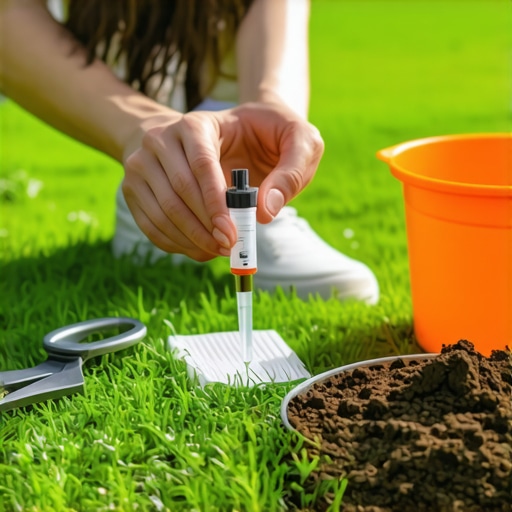
To get a reliable reading in 2026, forget the cheap color-changing strips from the grocery store. They are toys. You need a digital electrode meter or a professional laboratory submittal kit. Start by taking twelve cores from across the property at a depth of 6 inches. Remove the thatch layer and the grass itself. Mix these samples in a clean plastic bucket—never metal, as it can contaminate the trace mineral readings. This composite sample provides a true average of your soil profile.
“A retaining wall doesn’t fail because of the stone; it fails because of the water trapped behind it, and a lawn doesn’t fail because of the seed; it fails because of the chemical environment of the soil.” – Agronomy Handbook Standards
Once you have your composite sample, mix it with distilled water at a 1:1 ratio. Tap water is often alkaline and will skew your results. Insert your calibrated probe and wait for the reading to stabilize. If you see a 5.5, you need to calculate your Calcium Carbonate Equivalent (CCE) needs immediately. This isn’t a suggestion; it is a biological mandate for survival. If you ignore it, your irrigation will simply wash away expensive chemicals that the plant cannot physically ingest.
What is the best soil pH for fescue or bermuda grass?
Most cool-season grasses like Tall Fescue prefer a pH of 6.2 to 6.8, while warm-season varieties like Bermuda or Zoysia can tolerate slightly more acidity but perform best at 6.5. Maintaining this specific range ensures the microbial colony in the soil can break down organic matter into usable nitrates. If the pH drops below 5.5, the microbial activity halts. The thatch builds up. The lawn suffocates. It is a slow death that no amount of mowing can fix.
Correcting the Chemistry: Beyond the Bag
If your test results come back low, you need lime. But not all lime is equal. You have calcitic lime and dolomitic lime. If your soil is also low in magnesium, go with dolomitic. If magnesium is high, calcitic is your only choice. Over-applying magnesium can tighten clay soils, ruining pore space and destroying your irrigation efficiency. You must apply these amendments in the fall or early spring to allow for the chemical reaction to occur. It takes months, not days. Patience is a requirement of the trade.
- Step 1: Identify the target pH based on your grass species.
- Step 2: Calculate the square footage of the treatment area accurately.
- Step 3: Apply pelletized lime or sulfur using a calibrated broadcast spreader.
- Step 4: Water the area for 20 minutes to move the amendments into the soil profile.
- Step 5: Re-test in 90 days to verify the shift.
For those dealing with alkaline soil, the process is harder. Elemental sulfur is the standard, but it requires soil bacteria to convert it into sulfuric acid. This process is slow and temperature-dependent. If the soil is cold, nothing happens. This is why professional landscaping requires a deep understanding of soil temperature and biological windows. You cannot force biology; you can only facilitate it. Stop listening to the big-box store employees. They are selling products; I am selling results.
The 2026 Soil Preparation Checklist
Before you commit to a major sod install or an expensive yard cleanup, you must clear these hurdles. Skipping these steps is why I get called out for $30,000 ‘autopsies’ on dead yards. Do the work now or pay me more to fix it later. 811 must be called before any deep core aeration or drainage work. Do not skip this. One severed utility line will cost more than your entire landscape budget for the decade.
- Calibrate your digital pH probe using a 7.0 buffer solution.
- Collect 10-12 samples from different zones (front, back, shade, sun).
- Check for 811 markings before performing any deep soil sampling or grading.
- Match your fertilizer NPK ratio to the specific deficiencies found in the soil test.
- Verify that your irrigation system is providing 1 inch of water per week, measured with rain gauges.
While the internet tells you to water every day, turf grass actually needs deep, infrequent watering—exactly 1 inch per week—to force roots to chase the water down. Shallow watering creates shallow roots. Shallow roots lead to drought stress and disease. If you want a high-performance lawn, you have to treat it like an athlete. It needs the right fuel, the right environment, and no excuses. The soil test is your roadmap. Without it, you are just lost in the weeds.