
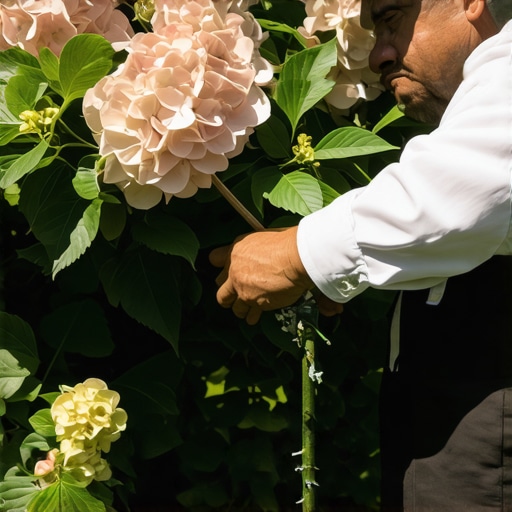
The Science of Future Blooms: Why 2026 Starts Today
Pruning hydrangeas for 2026 success requires identifying whether your specific cultivar sets buds on old wood or new wood to avoid cutting off next year’s floral potential. Professional horticulturists understand that a bloom isn’t just a flower; it is the result of a precise hormonal signal called auxin transport, which is influenced by the timing of your shears. If you hack at a Macrophylla in late autumn, you aren’t just ‘cleaning up’; you are performing a botanical vasectomy on your 2026 season. I always drill into my new crew members: if you don’t fix the soil grading and understand the plant biology first, every plant you put in the ground is just expensive compost. Most ‘mow-and-blow’ contractors treat every shrub like a boxwood, shearing them into spheres. That is rank amateurism. A hydrangea is a hydraulic system. It requires specific hydrostatic pressure maintained through deep irrigation and proper lignification of the stems to support the heavy heads we want to see two seasons from now.
“Pruning at the wrong time of year is the most common reason for a lack of flowers on hydrangeas. For those that bloom on old wood, the flower buds are formed during the previous late summer and fall.” – Penn State Extension, College of Agricultural Sciences
The Biology of the Bud: Auxins and Lignification
To get those massive 2026 blooms, we have to talk about terminal buds. In species like Hydrangea macrophylla (Bigleaf) and Hydrangea quercifolia (Oakleaf), the plant begins developing the 2026 embryonic flower tissue shortly after the 2025 blooms fade. This process is called differentiation. If your yard cleanup crew comes in with power trimmers in October, they are removing the very nodes that house these embryos. You must look for the ‘fat’ buds. These are your 2026 heavy hitters. Stop cutting once the wood starts to harden. Soft green growth is replaceable. Lignified, woody stems are the bank account of the plant. Do not bankrupt your garden. We also need to address the root flare. I see it constantly: homeowners and cheap landscapers piling ‘mulch volcanoes’ against the base of the shrub. This traps moisture against the bark, inviting fungal pathogens like Botrytis cinerea. It will rot. Keep the mulch back. Let the root flare breathe.
The Operational Lane: Planting and Arboriculture Focus
Successful hydrangea management for 2026 integrates soil pH adjustment, strategic nitrogen application, and precise irrigation to ensure the plant has the caloric reserves to push massive blooms. You cannot expect a plant to perform if it is struggling in compacted, anaerobic soil. During a professional sod install or yard cleanup, we evaluate the Cation Exchange Capacity (CEC) of the soil. Hydrangeas are heavy feeders. They need a steady supply of nutrients, but over-fertilizing with high-nitrogen runoff in late summer will trigger soft, succulent growth that will snap under the first frost. This kills the 2026 buds. We want slow, steady cell division. Use a balanced 10-10-10 fertilizer or specialized acidifying agents if you are chasing those deep blues. Remember, the blue color isn’t just about pH; it’s about the availability of aluminum ions in the soil solution. No aluminum, no blue. Simple as that.
How much should I cut back my hydrangeas for next year?
This depends entirely on the species. For Hydrangea paniculata (PeeGee) and Hydrangea arborescens (Smooth), you can be aggressive because they bloom on new wood produced in the spring of 2026. For Macrophylla, you only remove the dead wood and the spent flowers down to the first set of healthy buds. Never take a chainsaw to a Bigleaf. You will regret it for two years. Use bypass pruners, not anvil pruners. Anvil pruners crush the vascular tissue (xylem and phloem), creating a jagged entry point for disease. A clean, 45-degree bypass cut allows moisture to roll off the wound. Precision matters. Your tools should be sharp enough to shave with. Dull tools are the mark of a hack.
| Hydrangea Species | Pruning Timeframe | Wood Type | 2026 Bloom Strategy |
|---|---|---|---|
| Macrophylla (Bigleaf) | Immediately after 2025 bloom | Old Wood | Minimal pruning; preserve fat terminal buds. |
| Paniculata (PeeGee) | Late Winter / Early Spring 2026 | New Wood | Cut back by 1/3 to encourage strong new stems. |
| Arborescens (Annabelle) | Late Winter 2026 | New Wood | Can be cut to the ground for a total refresh. |
| Quercifolia (Oakleaf) | Post-bloom 2025 | Old Wood | Remove only dead or crossing branches. |
Irrigation and Hydrodynamics: The Hydrangea’s Lifeblood
Effective hydrangea irrigation requires deep, infrequent watering cycles that force the root system to descend into the subsoil rather than staying in the top two inches of the soil profile. People think hydrangeas are thirsty because they wilt in the afternoon sun. That’s not always a lack of water; it’s often a transpiration rate that exceeds the root system’s pickup capacity. If you have an irrigation system, don’t run it for 10 minutes every day. That is useless. Run it for 45 minutes twice a week. We want to saturate the root zone to a depth of 8 to 12 inches. This builds a resilient plant that can support the massive 2026 blooms you are aiming for. When we do a sod install near hydrangea beds, we ensure the grading slopes away from the house but doesn’t leave the shrubs in a bog. Standing water leads to root rot. If the roots die, the 2026 blooms die with them. It is basic engineering. Hydrostatic pressure must be managed. If your soil is heavy clay, we need to incorporate expanded shale or organic compost to break up those platelets and allow for oxygen exchange.
“Maintaining a consistent moisture level is critical, as hydrangeas have a high transpiration rate. Mulching with 2-3 inches of organic matter helps regulate soil temperature and moisture.” – Agricultural Research Service Standards
Can I prune hydrangeas in the winter?
Only if they are the Paniculata or Arborescens varieties. If you prune Macrophylla or Quercifolia in the winter, you are cutting off the flowers you’ve been waiting for. I see this every January. Homeowners get restless, grab the loppers, and destroy their summer display in twenty minutes. Don’t be that person. If you aren’t 100% sure what variety you have, wait until the plant leaves out in the spring. Dead wood will be obvious—it will be brittle and show no green when scratched with a fingernail. Only cut the brittle stuff. Leave the rest alone until the first flowers appear. Patience is a professional virtue. Haste is for the hacks who don’t understand the biology of what they are touching.
The Professional Pruning Checklist for 2026 Success
- Identify the species: Check leaf shape and previous bloom style (mophead vs. cone).
- Sanitize tools: Use 70% isopropyl alcohol between every shrub to prevent spreading tobacco mosaic virus.
- Check the soil pH: Aim for 5.5 for blue, 6.5 for pink.
- Inspect the irrigation: Ensure drip emitters are placed at the drip line, not the trunk.
- Remove the ‘Three Ds’: Dead, Damaged, and Diseased wood always goes first.
- Thin the center: Remove weak, spindly ‘spaghetti’ canes to improve airflow.
- Look for the nodes: Cut 1/4 inch above a healthy pair of buds.
- Monitor nitrogen levels: Stop high-nitrogen feeding by August 1st.
- Evaluate the grading: Ensure water isn’t pooling at the base after summer storms.
- Plan for size: If the plant is too big for the space, don’t prune it into a nub; transplant it to a better location during dormancy.
The Information Gain: The Hidden Danger of ‘Reblooming’ Varieties
While the industry pushes ‘reblooming’ or ‘remontant’ hydrangeas like the Endless Summer series, they are often a trap for the lazy gardener. These plants can bloom on both old and new wood, which sounds great. However, they are heavy consumers of energy. To get a 2026 bloom that actually looks like the picture on the tag, you have to manage the 2025 deadheading perfectly. As soon as a flower fades, cut it back to the first set of full-sized leaves. This prevents the plant from wasting energy on seed production and redirects those sugars into the 2026 bud bank. If you let the old flowers sit and rot on the stem, the plant slows down. It gets complacent. You have to stay ahead of it. A landscape is a living machine; it requires constant calibration. Don’t let the marketing fool you into thinking these are ‘set and forget’ plants. They aren’t. They require more technical skill, not less. Use these tips, keep your blades sharp, and watch the 2026 season deliver the best heads you’ve ever grown. Respect the biology, and the results will follow.