
The Engineering Behind Weed-Free Pavers: A Veteran’s Guide to Polymeric Sand
You see the gaps first. It starts as a thin green hairline of moss, seemingly harmless. Within one season, that moss becomes a foothold for crabgrass and dandelions. Their roots dive deep into the bedding sand, prying your pavers apart with relentless hydraulic force. By the time you notice the heave in your walkway, the structural integrity of the entire hardscape is already compromised. Weeds are not just an aesthetic nuisance; they are a biological sign of engineering failure. I recently got called out to tear up a $30,000 patio that was sinking because the previous contractor thought base prep was just a suggestion. The pavers were swimming in a sea of weeds because they used cheap masonry sand instead of a high-performance polymeric stabilizer. It was a $30,000 lesson in why cutting corners kills hardscapes. If you want a patio that lasts until 2040, you have to stop thinking like a gardener and start thinking like a civil engineer.
Why Traditional Joint Sand Fails the Longevity Test
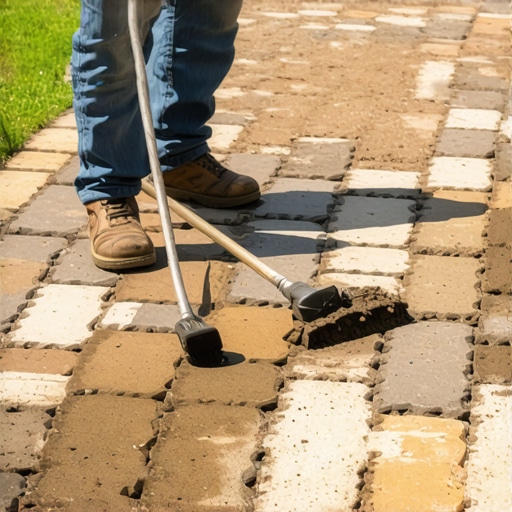
Traditional joint sand fails because it lacks the chemical binding agents required to resist erosion, insect intrusion, and weed colonization over multiple freeze-thaw cycles. Without polymeric sand, which utilizes high-tech polymers to create a flexible yet semi-impenetrable barrier, moisture infiltrates the sub-base, leading to shifting pavers and the accumulation of organic matter that fuels weed growth. Pure sand is granular and mobile. Every time it rains, a microscopic amount of that sand washes out. This creates voids. Voids invite wind-blown seeds. Those seeds find a perfect nursery in the damp, protected environment between your pavers. Once the root system establishes, it begins to draw moisture from the bedding layer, leading to localized settling. [image_placeholder_1]
“A interlocking concrete pavement system is only as stable as its jointing material; without proper interlock, the load-bearing capacity of the entire surface is reduced by up to 50%.” – Interlocking Concrete Pavement Institute (ICPI) Standards
How much modified gravel do I need for a patio base?
For a standard residential patio or walkway, you must install a minimum of 4 to 6 inches of compacted 21A or 3/4-inch modified stone. If you are dealing with heavy clay soils or vehicle traffic, this base depth must increase to 8 to 12 inches to prevent heaving and ensure proper drainage through the profile. Do not use pea gravel. You need angular stone that locks together under pressure.
The Chemistry of Polymeric Sand: Beyond the Bag
Polymeric sand is a calibrated mixture of graded sand and binder (often a combination of acrylic and synthetic polymers). When these polymers are hydrated, they undergo a chemical reaction that transforms the loose sand into a cohesive, flexible solid. This is not mortar. Mortar is rigid and will crack when the ground moves. Polymeric sand is designed to be elastomeric; it can handle the subtle shifts of the earth without losing its seal. This seal is your primary defense against the biological invasion of weeds. However, the polymers must be activated correctly. Too little water, and the bond never forms. Too much water, and you wash the polymers out of the sand and onto the face of the stone, creating a permanent, ugly white haze.
Why is my polymeric sand not hardening?
Polymeric sand usually fails to harden because of excessive moisture during installation or low temperatures that prevent the polymers from cross-linking. If the joints remain saturated due to poor sub-base drainage or if the ambient temperature drops below 50 degrees Fahrenheit during the 24-hour curing window, the chemical bond will be structurally compromised. You must ensure the joints are bone-dry before application. Even a hint of morning dew can ruin a $1,000 sand job.
Material Comparison: Choosing Your Joint Stabilizer
| Material Type | Weed Resistance | Erosion Resistance | Lifespan | Best Use Case |
|---|---|---|---|---|
| Masonry Sand | Zero | Low | 1-2 Years | Temporary filler only |
| Stone Dust | Low | Medium | 2-4 Years | Natural flagstone (not recommended) |
| Polymeric Sand | High | High | 10-15 Years | Interlocking pavers and high-traffic areas |
| Permeable Chip | Medium | High | 20+ Years | Permeable pavement systems for drainage |
The Forensic Step-by-Step for a Weed-Proof Install
Stop following the instructions on the back of the bag at the big-box store. They are written for DIYers who don’t care if the patio fails in three years. Follow the foreman’s protocol instead. First, perform a yard cleanup that goes beyond the surface. You must excavate down to the subsoil and check the compaction. Use a plate compactor. A hand tamper is a toy. You need at least 3,000 to 5,000 lbs of centrifugal force to achieve the required Proctor density. If the base isn’t solid, the joints will move, and the polymeric sand will crack. Second, when installing sod install around the perimeter, ensure the grade falls away from the patio at a 2% slope. This prevents water from pooling at the edges and undermining the sand joints. Third, check your irrigation heads. If a sprinkler is hitting your pavers every morning, it will eventually erode even the strongest polymers through sheer mechanical weathering.
The Installation Checklist
- Verify a 48-hour dry weather window (no rain, no heavy fog).
- Sweep sand into joints until they are filled to 1/8 inch below the paver chamfer (the beveled edge).
- Use a plate compactor with a protective mat over the pavers to vibrate the sand deep into the joints. This is the most skipped step.
- Leaf-blow the entire surface to remove every speck of dust before wetting.
- Apply a fine mist, not a jet stream, to activate the polymers in three separate stages.
“Weed seeds rarely germinate from below the pavers; 95% of weed growth in hardscapes comes from organic debris trapped in the top 1/4 inch of the joint.” – Penn State Agricultural Extension
I always drill into my new crew members: if you don’t fix the soil grading first, every plant you put in the ground is just expensive compost. The same applies to pavers. If your base is 1/2 inch off, or if your compaction is soft, that polymeric sand is just a band-aid on a broken bone. You must manage the hydrostatic pressure behind your retaining walls and under your patio. If water can’t get out, it will push up. That upward pressure is what cracks the joints and lets the weeds in. Don’t be the homeowner who has to call me in three years to redo a project because they saved $200 on sand but lost $10,000 in labor. Do it right. Compact the base. Use high-quality polymers. Keep the water moving. Your knees and your wallet will thank you.