
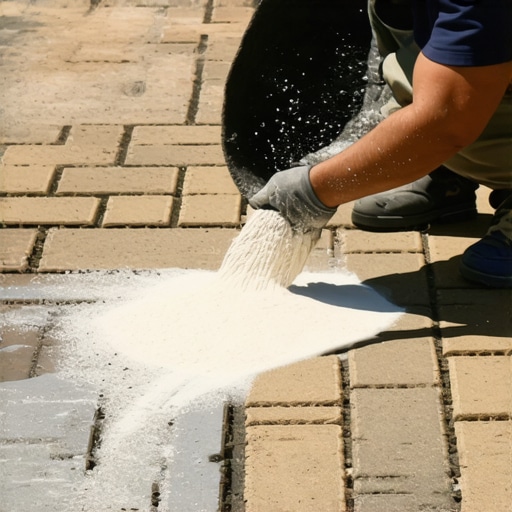
The Anatomy of a Sinking Patio
Most homeowners notice the failure too late. You walk out after a heavy rain and see a birdbath forming in the middle of your $20,000 investment. The pavers are dipping, the edges are kicking up, and the joints are filled with moss or, worse, nothing at all. To fix sinking pavers, you must understand that the jointing sand is not just aesthetic; it is a structural component that locks the entire system into a monolithic slab through interlock. Using a polymeric sand hack for $15 can stop minor settlement in its tracks before it requires a full excavation of the sub-base. It is about managing water. Water is the enemy of every hardscape. When joints are empty, water infiltrates the bedding layer, saturates the fines, and causes the base to pump out under foot traffic. This leads to the dreaded dip.
The $30,000 Hardscape Autopsy
I recently got called out to tear up a $30,000 patio that was sinking because the previous contractor used play sand in the joints and skipped the plate compactor on the sub-grade. Within two seasons, the play sand washed out, allowing hydrostatic pressure to build up beneath the pavers. As the water froze and thawed, it heaved the stones. By the time I arrived, the pitch was slanted toward the foundation of the house, threatening the basement. We had to rip out 1,200 square feet of Techo-Bloc because someone wanted to save $200 on proper materials. I see this every month. People focus on the stone, but the engineering is in the dirt. If you don’t fix the drainage, you are just rearranging deck chairs on the Titanic. You need 98% Proctor density on your base compaction or the project is doomed from day one. Don’t be that guy.
“A retaining wall doesn’t fail because of the stone; it fails because of the water trapped behind it.” – Hardscape Engineering Axiom
How to Use Polymeric Sand to Stabilize Pavers
To fix sinking pavers with polymeric sand, you must first ensure the base layer is still structurally sound and that the dip is less than 1/4 inch. Polymeric sand is a high-tech blend of graded sand and binder (polymers) that hardens when triggered by water, creating a semi-flexible joint that resists erosion and weed growth. For a $15 bag, you can re-stabilize approximately 50 to 75 square feet of standard pavers, effectively sealing the surface against water penetration. This prevents the bedding sand from migrating. If the pavers have sunk deeper, you must lift them, add modified gravel or coarse sand to level the area, and then re-joint. It is a surgical process. You cannot just pour sand over a mess and expect a miracle. Clean the joints first. Use a pressure washer but do not blow out the bedding layer. Let it dry for 24 hours. This is non-negotiable.
How much modified gravel do I need for a patio base?
For a standard pedestrian patio, you need a minimum of 4 to 6 inches of compacted modified gravel (often called 21A or CR-6) to provide a stable foundation. To calculate the volume, multiply the square footage by the depth in feet (e.g., 0.5 feet for 6 inches) and divide by 27 to get cubic yards. Most failures occur because the DIYer uses 2 inches of gravel and wonders why the ground moves after a frost. In heavy clay soils, you might need 8 inches or more to bridge the soft spots. Always over-build the base. It is the only part of the job you can’t fix later without a sledgehammer. Do it right the first time.
| Material Type | Erosion Resistance | Flexibility | Estimated Cost per Bag |
|---|---|---|---|
| Play Sand | Zero | High (Loose) | $5 |
| Masonry Sand | Low | Medium | $6 |
| Polymeric Sand | Maximum | Semi-Rigid | $15 – $25 |
| Resin Jointing | Ultra-High | Rigid | $60+ |
Why is my polymeric sand washing away?
The primary reason for polymeric sand failure is improper activation or installing it in wet conditions. If the sand stays