
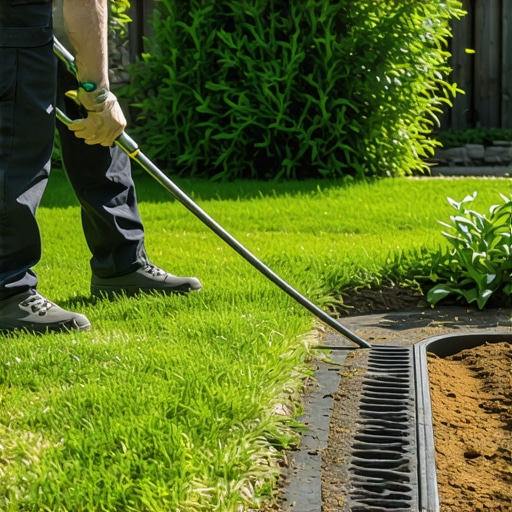
The Anatomy of a Failing Drainage System
A slow yard drain usually indicates a critical accumulation of sediment, organic biofilm, or root intrusion within the discharge pipe. By deploying a mechanical snake or hydro-jet, you can clear these obstructions, restoring the hydrostatic balance necessary to prevent water from saturating your sod install or destabilizing your hardscape foundations.
I recently got called out to tear up a $30,000 patio that was sinking because the previous contractor ignored the drainage pitch. The water wasn’t just sitting; it was actively undermining the modified gravel base. We found a four-inch corrugated pipe that was 90% full of silt and maple helicopter seeds. The homeowner thought the patio was the problem. It wasn’t. The pipe was the problem. If you see water pooling around your catch basins after the rain stops, your system is failing. It is a slow-motion disaster for your landscaping.
“A retaining wall doesn’t fail because of the stone; it fails because of the water trapped behind it.” – Hardscape Engineering Axiom
The Physics of the Blockage
When we talk about yard drainage, we are talking about gravity and friction. In a perfect world, a 2% grade keeps water moving fast enough to carry sediment. In the real world, 2026 yards are often flat. Silt settles. Algae grows. Eventually, you have a dam. This isn’t just about ‘cleaning.’ This is about restoring hydraulic capacity. If you ignore a slow drain, the hydrostatic pressure builds up behind the pipe, forcing water into the surrounding soil. This leads to soil liquefaction. Your expensive sod will turn into a marsh. Your irrigation lines will shift. You have to act before the pipe collapses.
Diagnosing the Slow Drain: Root vs. Silt
To fix a clogged landscape drain, you must first identify if the obstruction is organic debris or structural root penetration through the pipe walls. Root intrusions require a cutting blade attachment, while sediment clogs are best handled with a bulb head or a high-pressure water jet.
| Obstruction Type | Primary Symptom | Recommended Tool | Risk Level |
|---|---|---|---|
| Sediment/Silt | Slow, consistent ponding | Manual Drum Snake | Low – Maintenance Issue |
| Root Intrusion | Zero flow, visible cracks | Power Auger w/ C-Cutter | High – Structural Failure |
| Biofilm/Algae | Slimy residue at outlet | Hydro-Jetting | Medium – Vector for Pests |
| Pipe Collapse | Ground sinkholes above line | Excavation (No Snake) | Critical – System Loss |
Don’t guess. Use a camera if you have to. If you hit something hard that doesn’t ‘give’ like a clump of dirt, it’s likely a root or a shifted joint. Cheap corrugated pipe is notorious for this. It’s thin. It’s weak. I hate it. We only use Schedule 40 PVC for a reason. It doesn’t crush under the weight of a lawnmower.
How much does it cost to clear a landscape drain?
Professional drain clearing typically ranges from $250 to $600 depending on the length of the run and the severity of the clog. However, if you catch it early and use a manual snake, your only cost is the tool rental and a few hours of labor. If the pipe is collapsed, you are looking at thousands for trenching and replacement.
The Step-by-Step Restoration Process
Before you touch a snake, do a yard cleanup. Remove all debris from the catch basin grates. If the grates are clear and the water is still high, the problem is downstream. Locate the discharge point—usually a pop-up emitter or a daylight exit at the curb. If the emitter is buried in mulch, you’ve found your first problem. Dig it out.
- Step 1: Access the Basin. Remove the screws from the catch basin grate. Do not drop them in the water.
- Step 2: Manual Inspection. Reach in (wear gloves) and pull out any immediate debris. You’d be surprised how many tennis balls I find in these things.
- Step 3: Feed the Snake. Insert the snake into the outlet pipe. Rotate the drum clockwise. Feel for resistance.
- Step 4: The Break-Through. When you hit the clog, don’t just ram it. Let the tool do the work. Grind through the mass.
- Step 5: Flush the Line. Once the snake passes through, run a high-volume hose into the basin. You want to see clear water at the exit.
“The movement of water through soil is governed by hydraulic conductivity; once a pipe is compromised, the surrounding soil structure begins to migrate.” – USDA Soil Engineering Manual
Can I use a plumbing snake on corrugated pipe?
You must be extremely careful. Corrugated pipe is fragile. A power auger with a sharp blade will shred the plastic ribs like paper. If you have the black corrugated pipe, use a manual snake or a jetter. If you have PVC, you can be more aggressive. Know what you have under the grass before you start spinning 500 RPMs of steel.
Preventing Future Drainage Failures
Drainage isn’t ‘set and forget.’ It’s a dynamic system. Your irrigation schedule affects this. Over-watering creates a constant state of dampness that encourages root systems to seek out your drain pipes. Those roots will find a microscopic crack and turn it into a pipe-bursting knot in two seasons. I tell my crews: the best drainage is the one you never have to think about because it was installed with a 12-inch gravel envelope and filter fabric.
The Maintenance Checklist
- Clean catch basin grates every fall. No exceptions.
- Check pop-up emitters after every mowing.
- Flush lines with a high-pressure hose twice a year.
- Keep mulch at least three inches away from drain openings.
- Monitor the discharge area for erosion or ‘piping’ of soil.
Landscaping hacks will tell you to just throw more dirt on the wet spot. Don’t listen to them. You’re just burying the problem. Fix the pipe. Save the yard. It’s science, not magic.