
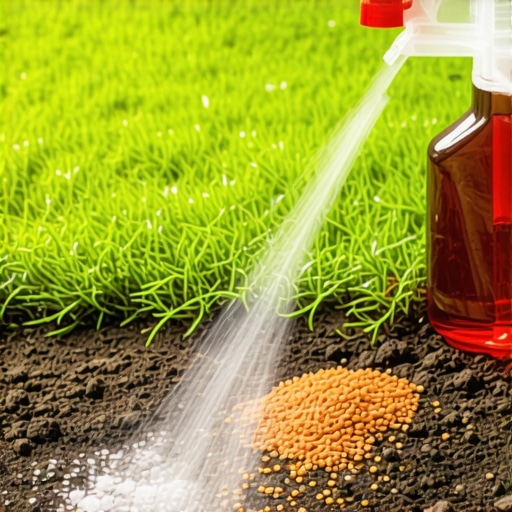
The Chemical Autopsy: Why Your Granular Fertilizer Failed
Liquid fertilizer delivers nutrients in a plant-available ionic form that enters the turf through foliar absorption and the root zone simultaneously. This dual-pathway delivery ensures a rapid metabolic response, bypassing the breakdown phase required by granular salts, which is vital for recovery after a heavy yard cleanup or recent sod install.
I recently got called out to a property where a homeowner had completely torched their front lawn. They bought three bags of high-nitrogen granular weed-and-feed from a big-box store and dumped it on a July afternoon when the temperature was pushing 95 degrees. They didn’t calibrate their spreader, and they didn’t water it in. Within 48 hours, the lawn looked like it had been hit with a flamethrower. The high salt index of the granular nitrogen sucked the moisture right out of the grass blades through osmotic desiccation. That is the reality of ‘mow-and-blow’ logic. It is reckless. My crew had to strip the dead organic matter, perform a massive yard cleanup, and prep the site for a fresh sod install because the soil was effectively sterilized by salt burn.
“Soluble nitrogen sources like urea or ammonium sulfate provide an immediate turf response, but their high salt index requires precise application to avoid tissue necrosis.” – Penn State Center for Turfgrass Science
The Science of Foliar Absorption and Bioavailability
Foliar feeding allows for the direct entry of nutrients through the stomata and the ectodesmata of the grass blade, providing an almost instantaneous metabolic boost. Unlike granular products that must wait for irrigation or rainfall to dissolve the outer coating and move into the soil solution, liquid ions are ready for work the second they hit the tissue.
When you apply a liquid UAN (Urea-Ammonium-Nitrate) solution, you are dealing with three forms of nitrogen. The nitrate is ready for the roots immediately. The ammonium attaches to soil particles for a medium-term feed. The urea can be absorbed directly through the leaf. This is not just ‘feeding the grass.’ It is managing the chemical potential of the soil. If you are doing a sod install, you cannot wait two weeks for a granular prill to break down. You need the roots to knit into the native soil now. Liquid applications, specifically those with chelated iron and manganese, provide that deep, dark green color without the surge growth that forces you to mow every three days.
The Engineering Checklist for Liquid Application
Precision is the difference between a professional result and a dead lawn. You must measure your output in gallons per thousand square feet. Do not guess. If your PSI is too high, you get drift. If it is too low, you get uneven coverage. Use the following checklist for every application:
- Conduct a soil test to determine current NPK levels and Cation Exchange Capacity (CEC).
- Calibrate your sprayer using the ‘ounce calibration’ method to ensure 1,000 square feet of coverage per gallon.
- Check wind speeds; anything over 5 MPH risks off-target drift and uneven distribution.
- Verify irrigation systems are functional to lightly rinse the product into the root zone after foliar uptake.
- Clean all nozzles to prevent ‘streaking’ caused by clogged spray tips.
| Feature | Liquid Fertilizer | Granular Fertilizer |
|---|---|---|
| Uptake Speed | 12-24 Hours | 7-14 Days |
| Salt Index | Low (when diluted) | High (concentrated salts) |
| Application Uniformity | High (molecular level) | Moderate (limited by prill size) |
| Leaching Risk | Low (targeted) | High (heavy rain wash-off) |
| Equipment Cost | High (Sprayers/Pumps) | Low (Spreaders) |
Hydraulic Management and the Role of Irrigation
Proper irrigation is the engine that drives nutrient transport within the plant’s vascular system. Without sufficient volumetric water content in the soil, the plant cannot move the nitrogen from the roots to the shoots, regardless of how much fertilizer you apply.
Most homeowners over-water the surface but under-water the root zone. You need deep, infrequent cycles. One inch of water per week, delivered in two heavy sessions, forces the roots to chase the moisture downward. This develops a resilient root architecture. If you just finished a sod install, your irrigation schedule is the only thing standing between a successful take and a $5,000 pile of brown hay. During the first fourteen days, the soil must stay consistently moist, but not saturated. Saturated soil lacks oxygen. No oxygen means no root respiration. The plant will drown.
“The efficiency of nitrogen recovery in turfgrass systems is significantly influenced by the timing of irrigation following application to minimize ammonia volatilization.” – Texas A&M Agronomy Manual
How much liquid nitrogen per 1000 square feet?
For a standard maintenance dose, you should aim for 0.1 to 0.25 pounds of actual nitrogen per 1,000 square feet when using liquid foliar applications. This ‘spoon-feeding’ approach prevents the massive growth spikes associated with heavy granular applications and reduces the frequency of yard cleanup requirements by managing clipping volume.
Is liquid fertilizer safe for new sod install?
Yes, liquid fertilizer is actually preferred for a new sod install because it can be applied at lower concentrations more frequently. This avoids the risk of salt burn on the delicate, newly cut roots while providing the phosphorus needed for root development and the nitrogen needed for establishment.
The Forensic Reality of Soil pH and Nutrient Lockout
If your soil pH is 8.2, you can dump all the granular iron you want on that lawn and it will never turn green. The iron becomes chemically locked in the soil and unavailable to the plant. This is where liquid chelated minerals save the day. Chelation is a process where the nutrient ion is ‘wrapped’ in an organic molecule that prevents it from reacting with the soil. It stays available for the plant to grab. Most ‘mow-and-blow’ guys don’t even know what a pH meter looks like. They just see yellow grass and add more nitrogen. That makes the problem worse. It increases the salt load. It kills the microbiology. Don’t be that guy. Test the soil. Fix the chemistry. Use the right tools for the job. Landscaping is a science, not a hobby. Your yard is a living, breathing hydraulic system. Treat it like one. Don’t skip the details. It will fail if you do.