
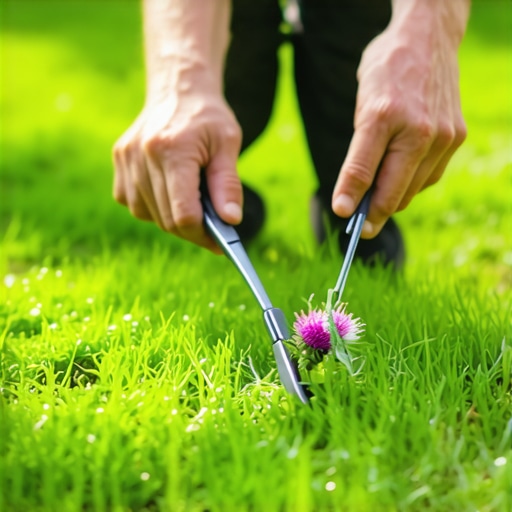
Understanding the Thistle Invasion: Why Your Lawn is Losing
To get rid of thistle without damaging your lawn, you must use selective broadleaf herbicides containing Clopyralid or Triclopyr during the rosette stage, combined with soil aeration to eliminate the anaerobic, compacted conditions where these weeds thrive. This targeted approach attacks the weed’s vascular system while leaving your turfgrass blades untouched. It is a game of chemical precision and soil biology, not brute force. I have seen too many homeowners treat their property like a scorched-earth war zone, only to realize that thistle is better at surviving a fire than fescue is. A homeowner called me in a panic after they completely torched their front lawn by applying a 40% concentration of industrial vinegar and a high-dose non-selective herbicide they bought online. They thought they were being ‘thorough.’ Instead, they created a dead zone of gray, shriveled grass and left the thistle taproots perfectly intact. The thistle was back in three weeks; the grass was dead for the season. We had to perform a full yard cleanup, scrape the top two inches of poisoned soil, and do a complete sod install just to get the property back to baseline. It was a $5,000 mistake that could have been avoided with a $30 bottle of the right selective agent.
The Anatomy of a Survivor: Why You Cannot Just Pull Them
Thistles, particularly Cirsium arvense (Canada Thistle), are biological marvels designed to survive trauma. Unlike a simple dandelion, a thistle is a colony. Its root system can extend 15 feet deep and spread horizontally via rhizomes. When you pull a thistle head and leave even an inch of the root, you are not killing the plant; you are pruning it. Each root fragment contains adventitious buds capable of generating a entirely new plant. This is why a botched landscaping attempt often results in four thistles appearing where there was once only one.
“Canada thistle is a perennial weed that spreads by seeds and an extensive, deep-rooting system. Success in controlling it requires a multi-year commitment to depleting the plant’s energy reserves.” – Penn State Agricultural Extension
How deep do thistle roots go?
Thistle taproots are notorious for reaching depths of 6 to 15 feet, allowing them to tap into water tables that your turfgrass cannot reach. This gives them a massive advantage during summer droughts when your irrigation system might be struggling to keep the upper three inches of soil moist. In compacted clay soils, these roots act like structural rebar, anchoring the plant firmly against manual extraction. If you do not kill the root to the tip, the plant will regenerate.
The Technical Strike: Selecting the Right Herbicide
To win this fight, you need a selective herbicide. These chemicals are designed to exploit the physiological differences between monocots (grasses) and dicots (broadleaf weeds). I tell my crew: focus on the growth stage. You want to hit them when they are in the ‘rosette’ stage—that flat, circular pattern before the stalk shoots up. This is when the plant is aggressively pulling nutrients down into the root system for the winter. If you spray during the ‘bolt’ or flowering stage, the plant is pushing energy upward, and your herbicide will not reach the deep rhizomes. You need chemicals like 2,4-D, Dicamba, and MCPP, but for the hard stuff, look for products containing Triclopyr. It mimics a growth hormone that causes the weed to literally grow itself to death by accelerating cell division until the vascular system collapses. It will rot the weed from the inside out.
| Control Method | Effectiveness | Impact on Grass | Cost Level |
|---|---|---|---|
| Manual Pulling | Low (Roots Regrow) | Low | Zero |
| Glyphosate (Roundup) | High (Non-selective) | Total Kill (Bad) | Low |
| Triclopyr/2,4-D Mix | High (Selective) | Negligible | Moderate |
| Soil pH Correction | Long-term Success | Beneficial | Moderate |
Soil Compaction: The Thistle’s Best Friend
Thistle thrives in ‘junk’ soil. If your yard is compacted from heavy foot traffic or poor landscaping design, the grass roots will suffocate from a lack of oxygen, but thistle will dominate. High-end turf requires a Soil Organic Matter (SOM) level of around 5% and a pH between 6.2 and 7.0. Thistle loves high-pH, low-nitrogen environments where the soil is hard as a brick. If you want a long-term solution, you must fix the mechanical structure of the ground.
“Properly timed aeration and overseeding are the most effective cultural controls for reducing broadleaf weed pressure in cool-season turf.” – Texas A&M Agrilife Extension
Will vinegar kill thistle in grass?
Vinegar, or acetic acid, is a contact herbicide that destroys the waxy cuticle of a leaf, causing it to dehydrate. However, it is non-selective, meaning it will kill your grass just as fast as the weed. Furthermore, vinegar rarely penetrates the deep taproot of a thistle. You will see the top turn brown, but the root will remain healthy, resulting in a quick regrowth. It is a ‘hack’ that usually leads to more yard cleanup work later.
The Forensic Recovery: A Step-by-Step Protocol
If your lawn is currently more thorns than blades, follow this professional-grade checklist to reclaim the territory without destroying your investment.
- Step 1: Soil Test. Get a core sample. If your pH is over 7.5, you are inviting thistle to the party. Apply elemental sulfur to bring it down.
- Step 2: Selective Spraying. Apply a Triclopyr-based solution on a windless day when the temperature is between 60 and 80 degrees. Do not mow for two days before or after.
- Step 3: Core Aeration. Pull 3-inch plugs across the entire lawn. This breaks the compaction and lets oxygen reach the grass roots.
- Step 4: Irrigation Audit. Thistle loves inconsistent moisture. Ensure your irrigation provides 1 inch of water per week in a single, deep soaking. Do not ‘mist’ the lawn daily.
- Step 5: Nitrogen Boost. Apply a slow-release nitrogen fertilizer. Grass loves nitrogen; thistle hates the competition from a dense, thick turf canopy.
If the infestation is so thick that more than 60% of the area is weed, do not waste money on spot treatments. Cut your losses. Spray the whole area with a non-selective herbicide, wait two weeks, and bring in a crew for a professional sod install. Sometimes, you have to clear the deck and start over with high-quality, weed-free cultivars. Once the new sod is down, maintain a strict 3-inch mowing height. Scalping your lawn is the fastest way to let the sunlight hit those dormant thistle seeds in the soil. Keep the canopy thick, keep the roots deep, and the thorns will stay away. Its that simple. No fluff. Just biology.