
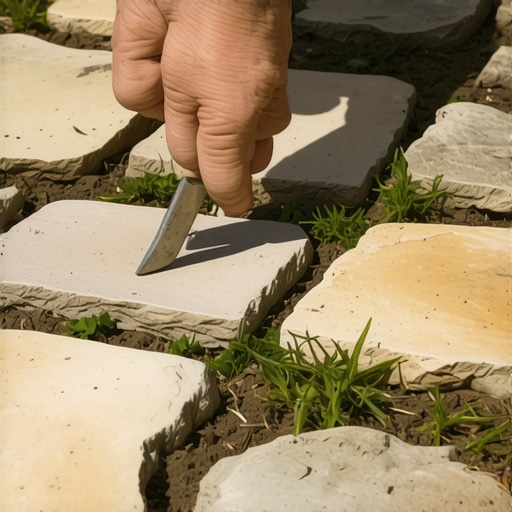
The Sickening ‘Clack’: Diagnosing Your Unstable Walkway
A wobbling flagstone path is usually the result of point loading where the stone rests on a high spot of the base material rather than a flat, compacted plane. This instability is exacerbated by poor drainage, soil erosion, and the lack of a proper geotextile fabric layer to separate the subgrade from the gravel base.
The Hardscape Autopsy: Why Most Paths Fail
I recently got called out to tear up a $30,000 patio that was sinking because the previous contractor used play sand as a primary base material instead of a structural 2A modified gravel. You could see the water tracks where the subgrade had simply liquefied and washed away. It was a textbook case of ignoring hydrostatic pressure. When you see a stone tip, you aren’t just looking at a loose rock; you are looking at a failure of civil engineering at the four-inch depth. Most homeowners think they can just shove some dirt under it. They are wrong. Dirt compresses. Soil holds moisture. Moisture expands during the freeze-thaw cycle. That expansion exert massive upward force, popping your stones out of alignment. If you do not have a properly compacted, free-draining base, your path is just a slow-motion landslide.
“A retaining wall doesn’t fail because of the stone; it fails because of the water trapped behind it.” – Hardscape Engineering Axiom
How much modified gravel do I need for a patio base?
A standard pedestrian flagstone path requires a minimum of 4 inches of compacted modified gravel topped with 1 inch of coarse sand or stone dust. To calculate the volume, multiply the square footage by the decimal equivalent of your depth (0.33 feet for 4 inches) and divide by 27 to get cubic yards.
| Base Material | Compaction Rating | Permeability | Best Application |
|---|---|---|---|
| Modified 2A Gravel | High (95% Proctor) | Low to Moderate | Structural load-bearing base |
| Clean #57 Stone | Moderate | High | Drainage-heavy environments |
| Stone Dust / Screenings | Low | Very Low | Final leveling/shimming layer |
| Common Topsoil | Zero | Variable | Growing grass, not holding stone |
The 10-Minute Fix: Stabilization Through Shimming
The fastest way to stabilize a single wobbling flagstone is to identify the pivot point, remove the stone, and shim the low spots with stone dust or coarse screenings. This is a temporary measure that addresses the surface leveling layer without requiring a full excavation of the subgrade or the installation of new sod install material around the edges.
- Step 1: Identify the high point (pivot) by stepping on all four corners of the stone.
- Step 2: Lift the stone carefully using a pry bar to avoid chipping the edges.
- Step 3: Clear out any organic matter or mud that has infiltrated the base.
- Step 4: Add dry stone dust to the low areas, creating a flat plane.
- Step 5: Set the stone back and tap it into place with a 3-pound dead-blow hammer.
- Step 6: Sweep polymeric sand into the joints and mist with water to lock it.
Why Yard Cleanup and Irrigation Matter for Path Stability
Your irrigation system is often the silent killer of a good path. If your heads are hitting the stone directly, water infiltrates the joints. If the joints aren’t sealed with polymeric sand, that water reaches the base. Once the base stays saturated, it loses its load-bearing capacity. You end up with a ‘squish’ effect. During a routine yard cleanup, I often see homeowners blowing debris into the cracks. This organic material rots, turns into soil, and creates a medium for weeds to grow. Those roots will eventually heave the stones. You must keep your joints clean and sealed. Deep, infrequent watering for your lawn is better than daily misting that keeps your hardscape base constantly damp. One inch of water per week is the standard. Don’t drown your stones.
How to prevent flagstone from shifting in clay soil?
To prevent shifting in heavy clay, you must over-excavate the area and use a non-woven geotextile fabric between the clay and your gravel base. This prevents the clay particles from migrating upward and contaminating your drainage layer, which is the primary cause of sinking in regions with poor soil drainage. While the internet tells you to water every day, turf grass actually needs deep, infrequent watering exactly 1 inch per week to force roots to chase the water down. This prevents the surface soil near your path from becoming a muddy mess that allows stone migration.
“Soil saturation reduces the effective stress of the soil particles, leading to a total loss of shear strength in non-compacted subgrades.” – USDA Soil Mechanics Manual
The Physics of Polymeric Sand
If you aren’t using polymeric sand, you aren’t finishing the job. This isn’t just fancy dirt. It’s a high-tech blend of graded sand and binders that turn into a flexible grout when hydrated. It prevents lateral movement. It stops the ‘creep’ of stones over time. It is the only thing standing between your path and the local weed population. Don’t skip it. Don’t use play sand. Play sand is round; it acts like ball bearings under your feet. You need angular sand that locks together. The difference is measurable in years of service life. It will rot if you use organic filler. Stick to the engineering specs. Your path will stay put. Your back will thank you.