
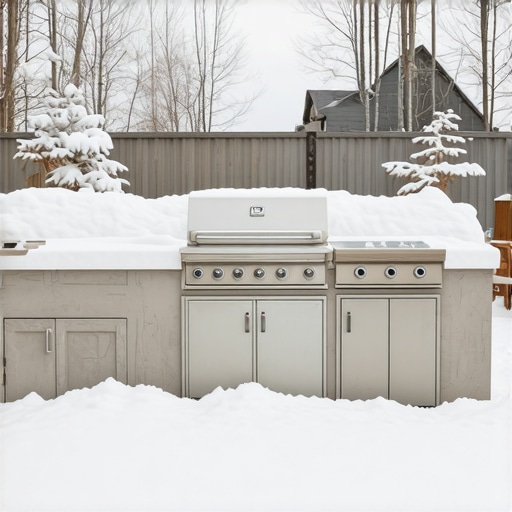
The Brutal Reality of Winter Hardscaping
I recently got called out to tear up a $30,000 patio that was sinking because the previous contractor thought he could skimp on the base and skip the drainage. It was a forensic autopsy of a failed dream. The granite counters were snapped like crackers, the mortar joints in the outdoor kitchen had turned to dust, and the expensive grill was lopsided because the entire foundation shifted three inches to the left. This is what happens when you treat hardscaping like a cosmetic project rather than a civil engineering task. Water is the enemy. When it gets into your sub-base and freezes, it expands by roughly 9 percent. That expansion exert massive hydrostatic pressure that can lift a concrete slab weighing thousands of pounds. If you don’t have the right drainage and base-layer compaction, your outdoor investment is just expensive debris waiting to happen. Most ‘mow-and-blow’ hacks won’t tell you this because they want to get in and out with your check before the first frost hits. But I have 20 years of dirt under my fingernails, and I have seen the same mistakes repeated from suburban backyards to high-end estates.
Why Outdoor Kitchens Fail in Winter
To prevent an outdoor kitchen from cracking during winter, you must mitigate hydrostatic pressure and frost heave by ensuring the base-layer drainage is clear and all irrigation lines are blown out with high-volume air to prevent expansion-related structural failure of the masonry and utility connections. Failure usually begins at the microscopic level. Water molecules migrate into the pore spaces of your pavers or concrete. When the temperature drops, that water crystallizes and expands, pushing the material apart from the inside out. This is known as the freeze-thaw cycle. If your kitchen was built on a standard four-inch concrete slab without a proper modified gravel base, it will crack. It is not a matter of if, but when. Soil types like heavy A-7-6 clay are particularly dangerous because they hold onto moisture with a death grip. In my firm, we don’t even look at a project until we’ve analyzed the soil pH and drainage capacity. We use 21A or 57 stone for the base because it provides the interstitial space necessary for water to move through the structure rather than staying trapped inside it.
“A retaining wall doesn’t fail because of the stone; it fails because of the water trapped behind it.” – Hardscape Engineering Axiom
How much modified gravel do I need for a patio base?
For a stable outdoor kitchen foundation, you need a minimum of 6 to 8 inches of compacted modified gravel (such as 21A or CR-6) topped with 1 inch of bedding sand to ensure proper drainage and load distribution. Anything less is a compromise. You have to understand base-layer compaction. We use vibrating plate compactors and we do it in ‘lifts’ of no more than two inches at a time. If you dump six inches of gravel and run a compactor over the top, the bottom four inches are still loose. The first time the ground freezes, that loose gravel is going to shift. The tamper should literally bounce off the compacted base when it is ready. That is the sound of a foundation that will outlast the house.
The Critical Role of Irrigation and Plumbing Blowouts
Properly winterizing your outdoor kitchen requires a complete irrigation blowout of all water lines and gas supply checks to ensure that no residual moisture remains in the pipes to cause thermal expansion cracks or fitting failures. This is the part people forget. They turn off the valve inside the house and think they are safe. They aren’t. There is still water trapped in the low points of the line. You need a high-cfm air compressor to push every drop out of those lines. This applies to your sod install irrigation as well. If those lines burst under your new lawn, you won’t know it until spring when you have a massive sinkhole and a $500 water bill. We also look at the hydrostatic pressure behind any masonry walls. If the weep holes are clogged with debris from a poor yard cleanup, the water builds up, freezes, and pushes the wall out of plumb. You cannot fight physics; you can only give the water a path of least resistance.
Yard Cleanup is Structural Maintenance
Executing a thorough yard cleanup before the first snow is essential for hardscape longevity because organic debris traps moisture against stone surfaces and clogs drainage systems, leading to accelerated weathering and structural heaving. Don’t think of raking leaves as a chore; think of it as protecting your masonry. Wet leaves are acidic. When they sit on your travertine or bluestone all winter, they don’t just stain; they start a chemical reaction that can weaken the surface. More importantly, those leaves find their way into your French drains and catch basins. If those systems are blocked, the water that should be moving away from your outdoor kitchen foundation stays right there, saturating the soil and preparing to heave. A clean yard is a dry yard. We tell our clients that the yard cleanup is the final inspection of the year. It’s when we check the polymeric sand in the joints. If the sand is washed out, that is an entry point for water. It will rot the base. Don’t skip the maintenance.
“The primary cause of failure in segmental pavement systems is the lack of proper edge restraint and sub-base compaction.” – ICPI Tech Spec Number 2
How do I winterize outdoor kitchen plumbing?
To winterize outdoor kitchen plumbing, you must shut off the main supply, open all faucets to drain the lines, and then use an air compressor to blow out remaining moisture from the irrigation pipes and sink lines. Make sure you also empty the P-trap or add a non-toxic antifreeze. If you have a fridge or ice maker, those lines are even more delicate. A tiny crack in a copper line can cause a slow leak that ruins your cabinetry long before you notice it in the spring. Landscaping isn’t just about plants; it’s about the systems that keep the space functional. If you are doing a sod install late in the season, make sure the grading is pulling water at a 2 percent slope away from these utility lines. If the water pools near the pipes, the frost line will drive deeper and reach those lines faster.
The Maintenance Protocol for High-End Hardscapes
The move to keep your kitchen from cracking is a multi-step process that starts in the dirt and ends at the finish. You need to be proactive. Waiting until the ground is frozen to think about drainage is a recipe for disaster. Here is the professional checklist my crew uses for every high-end site we manage:
- Inspect all polymeric sand joints for gaps and refill where necessary to prevent water ingress.
- Blow out all irrigation and kitchen water lines with a minimum 100 CFM compressor.
- Clear all French drains and catch basins of organic debris to ensure 100% flow capacity.
- Apply a high-quality silane-siloxane sealer to porous stones to prevent capillary suction.
- Check the grading around the kitchen to ensure no water is pooling near the foundation.
- Remove and store all outdoor kitchen appliances or cover them with breathable, waterproof materials.
Landscaping is a game of inches and percentages. If you get the soil pH right, the plants thrive. If you get the compaction and drainage right, the hardscape lasts forever. Don’t be the homeowner who spends $50,000 on a kitchen and $0 on the engineering that keeps it standing. The cold truth is that nature wants to tear down what you build. Your job is to make it as hard as possible for the winter to win. This is the difference between a contractor and a craftsman. One builds for the photo; the other builds for the decade. Choose wisely.