
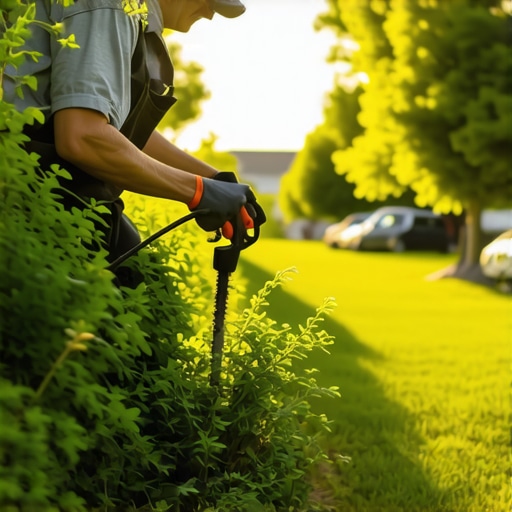
The Engineering of a Clean Property Line
Clearing a property line without a chainsaw requires using brush mowers, manual grubbing tools, and systemic herbicides to remove vegetation while protecting the soil structure. This method prevents the stump regrowth and soil erosion often caused by improper mechanical clearing or aggressive chain-cutting that leaves root systems intact. I always drill into my new crew members: if you don’t fix the soil grading first, every plant you put in the ground is just expensive compost. This applies to brush clearing too. If you just hack at the surface without addressing the root mass or the underlying soil health, you are simply pruning the weeds for a more aggressive return next season. I have seen guys spend thousands on sod install projects only to have wild blackberry and woody brush punch through the new turf within six months because they did not handle the reclamation phase with engineering precision. You have to understand the biological reality of what you are fighting. Woody brush like buckthorn or multiflora rose is not just a plant; it is a vascular system designed to survive. When you cut it, the plant sends a hormonal signal to the root crown to produce epicormic shoots. A chainsaw makes this worse by leaving a jagged surface that resists chemical penetration. We do it differently. We use leverage, soil science, and high-intensity manual tools that actually solve the problem.
Selecting the Right Tools for Manual Reclamation
To clear heavy brush without a chainsaw, you must utilize leverage-based tools like brush grubbers and heavy-duty loppers designed for three-inch diameters. These tools allow for the extraction of the root ball, which is the only way to ensure the vegetation does not return.
“Brush management is more than just removal; it is the manipulation of plant communities to achieve a desired land use.” – Texas A&M AgriLife Extension
Manual clearing is not just about muscle; it is about the physics of the lever. A brush grubber attaches to a tractor or even a heavy-duty truck and uses a chain system to pull the entire plant out of the earth. This is superior to cutting because it removes the 12 to 18 inches of root material where the plant stores its nitrogen and carbohydrates. If you are working by hand, a specialized tool like a ‘Uprooter’ or ‘Extractigator’ uses a high-pivot point to multiply your force by a factor of 12. This allows a 180 pound person to exert over 2,000 pounds of upward pressure on a root system. It is clean, it is quiet, and it does not involve a spinning chain that can catch on a hidden wire fence or kick back on a knot of dead oak. For smaller stems under one inch, a high-quality brush scythe or a heavy-duty hedge shear with geared bypass action is the standard. Avoid the cheap stamped-steel tools from big-box retailers; they will flex and fail within the first hour of real work in thicket.
How do I clear heavy brush without a chainsaw?
Clearing heavy brush without a power saw is best achieved using a high-leverage puller tool or a brush mower to mechanically exhaust the plant. By extracting the root crown, you permanently disrupt the plant’s ability to regenerate, which is more effective than simple surface cutting. Don’t skip the root extraction. If you leave the crown, you’re just wasting time.
| Tool Type | Max Diameter | Labor Intensity | Best Use Case |
|---|---|---|---|
| Brush Grubber | 3-4 inches | Moderate (requires vehicle) | Removing whole shrubs with roots |
| High-Leverage Puller | 2 inches | High (manual) | Selective removal in tight spaces |
| Geared Bypass Loppers | 1.5 inches | Low | Cutting back lateral branches |
| Systemic Herbicide (Triclopyr) | N/A | Very Low | Preventing stump regrowth after cutting |
The Ground-Up Build: A Systematic Approach to Clearing
The first step in any property line reclamation is mapping the utility lines and property markers to avoid costly damage to irrigation systems or underground power. You must call 811 before you start pulling anything out of the ground. Once the lines are marked, we move to the mechanical suppression phase. This involves taking down the vertical mass. If you aren’t using a chainsaw, you are using high-tension loppers. Work from the outside of the plant inward. Do not try to take the whole bush at once. Strip the lateral branches until you are left with the main stems. This gives you a clear view of the root flare. Once you see where the wood meets the dirt, you apply your extraction tool. If the soil is dry and compacted, wait for rain. Pulling brush from bone-dry clay is a fool’s errand that will result in the stem snapping off, leaving the root in the ground. You want the soil at field capacity, where the moisture has lubricated the root-to-soil bond. After extraction, you are left with a disturbed soil area. This is where most people fail. They leave the raw dirt exposed. This is an invitation for invasive seeds. You must immediately grade the area to ensure positive drainage away from the property line. If you leave a depression where a root ball used to be, water will pool, causing hydrostatic pressure issues if there is a nearby retaining wall or foundation.
“A retaining wall doesn’t fail because of the stone; it fails because of the water trapped behind it.” – Hardscape Engineering Axiom
This engineering principle applies to your yard cleanup too. Every hole you dig must be filled and compacted to match the surrounding soil density.
- Mark all property stakes with high-visibility flagging tape.
- Identify invasive species versus native hardwoods to keep.
- Cut lateral branches to access the central root crown.
- Apply a 25 percent concentration of Triclopyr to any stems you cannot pull.
- Rake out all leaf litter and woody debris to expose bare soil.
- Fill and compact all holes to prevent water ponding.
How much modified gravel do I need for a patio base?
To calculate gravel for a patio base, multiply the square footage by the desired depth in feet, then divide by 27 to get cubic yards. Typically, a 4-inch base of modified crushed stone requires approximately 1.25 tons of material per 100 square feet after compaction.
Reclaiming the Soil for Landscaping and Sod Install
After the brush is cleared, the soil is often nutrient-depleted and structurally compromised by the aggressive root systems of the previous occupants. If your goal is a sod install or a high-end landscaping bed, you cannot just lay grass over the top. You need to test the soil pH. Woody brush often acidifies the soil. Use a soil probe to take samples from at least six locations along the property line. You are looking for a pH between 6.0 and 7.0 for most turf grasses. If you are below 5.5, your new sod will never thrive because the nutrient uptake is chemically blocked. You will need to apply pelletized lime to raise the pH. Furthermore, the yard cleanup process likely removed a lot of organic matter. We recommend tilling in a 2-inch layer of composted organic matter to restore the microbiological activity of the soil. This creates a capillary mat that allows your irrigation system to work efficiently. Without organic matter, water just runs off or evaporates before it reaches the roots. When you finally move to the sod install, ensure you are using a starter fertilizer with a high phosphorus count to encourage rapid root knitting. If the property line is on a slope, use sod staples to prevent the new turf from sliding before the roots can anchor into the subgrade. This is the difference between a hack job and professional land management. You aren’t just clearing brush; you are re-engineering the ecosystem of your property line.