
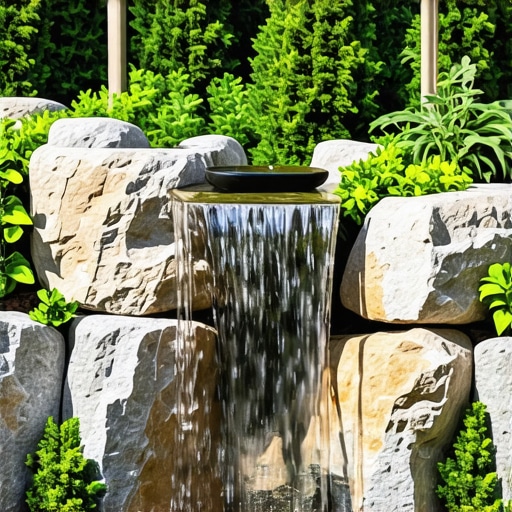
Engineering the Perfect Disappearing Pondless Waterfall for Small Urban Landscapes
I recently got called out to tear up a $30,000 patio and water feature that was sinking because the previous contractor thought he could skip the compaction phase. The homeowner was watching their investment literally slide into a muddy pit because the base layer wasn’t engineered for the hydrostatic pressure of the surrounding soil. Most ‘landscapers’ treat water features like a bathtub in the dirt. They are wrong. A disappearing pondless waterfall is a complex hydraulic system that requires precise calculations of water volume, flow rates, and structural load-bearing capacity. If you don’t understand the difference between 45-mil EPDM and PVC liners, you shouldn’t be digging in the first place.
The Core Anatomy of a Small-Scale Pondless System
A disappearing pondless waterfall functions by circulating water from a hidden underground reservoir through a pump vault, up to a spillway, and back down a rocky streambed. For small yards, this system maximizes vertical space and auditory impact while minimizing the safety risks and biological maintenance associated with open-standing water or traditional ponds.
The first mistake amateurs make is sizing the basin incorrectly. You aren’t just burying a bucket. You need to calculate the ‘transit volume’—the amount of water that will be in motion on the rocks once the pump starts. If your basin is too small, the pump will suck air and burn out within forty-eight hours. You need a reservoir that holds at least 2.5 times the amount of water moving through the stream. This isn’t a suggestion; it is physics.
“A retaining wall doesn’t fail because of the stone; it fails because of the water trapped behind it.” – Hardscape Engineering Axiom
How much modified gravel do I need for a waterfall basin?
Calculating gravel for a pondless basin depends on the void space of the material used. If you use standard 2-inch round stone, you have a 30% void space. However, utilizing high-density plastic matrix blocks (AquaBloX) provides 95% void space, allowing for a much smaller footprint in tight urban landscapes. For a small 4×4 foot basin, you typically need 1.5 tons of clean, washed 57 stone to stabilize the perimeter and cover the matrix blocks.
Excavation and Structural Foundation
Proper excavation for a pondless waterfall requires a multi-tiered approach that accounts for soil stability, drainage, and utility clearances. In small yards, you must identify irrigation lines and utility conduits via 811 before digging, as these features often compete for the same limited subterranean real estate in modern property designs.
When we dig the basin, we don’t just hack a hole. We create a level shelf for the pump vault. The vault must be the deepest point. We then line the entire excavation with a non-woven geotextile underlayment. If you put a rubber liner directly on the soil, a single sharp pebble or a hungry rodent will puncture it. The underlayment acts as a sacrificial layer. Once the 45-mil EPDM liner is in, we use a second layer of underlayment on top of it to protect it from the weight of the boulders. This is the ‘sandwich’ method. Don’t skip it. It’s the difference between a ten-year lifespan and a six-month leak.
| Feature Component | Recommended Material | Engineering Purpose |
|---|---|---|
| Liner | 45-mil EPDM Fish-Safe Rubber | UV resistance and puncture durability |
| Reservoir | Eco-Blox/Matrix Blocks | Maximizes water storage in small footprints |
| Pump Type | Asynchronous Solids-Handling | Energy efficiency and continuous duty rating |
| Underlayment | Non-woven Geotextile | Prevents soil abrasion and liner punctures |
The Hydraulics of the Waterfall Spillway
The spillway is the mechanical heart of the waterfall, requiring a level installation and a GPH (Gallons Per Hour) rating that matches the desired aesthetic. For a standard 24-inch spillway, you need a pump capable of delivering 2,500 to 4,000 GPH at the specific head height of your feature to achieve a solid sheet of water.
Most people buy a pump based on the box description. This is a failure. You have to calculate ‘Total Dynamic Head’ (TDH). This includes the vertical lift from the pump to the spillway, the friction loss of the pipe length, and every 90-degree elbow in the line. If your pipe is too thin—say, 1 inch instead of 2 inches—you create massive friction. The pump works harder, gets hotter, and dies faster. We use 2-inch flexible PVC. It doesn’t crack in freeze-thaw cycles and offers minimal resistance. Use it.
What size pump do I need for a 3-foot waterfall?
For a waterfall with a 3-foot vertical drop and a 12-inch wide spillway, you need a pump that delivers approximately 1,500 GPH at the top. Since you lose pressure as the water climbs, you should spec a pump rated for 2,500 GPH at zero feet to ensure you have enough ‘push’ to overcome the gravity and friction of the plumbing run.
“Effective water management in landscaping requires an understanding of soil porosity and the hydraulic conductivity of the media used in filtration.” – USDA Soil Mechanics Manual
Integrating Irrigation and Softscapes
A water feature should never sit in isolation; it must be integrated into the existing yard cleanup and landscaping plan through strategic sod install and irrigation adjustments. Proper grading away from the feature prevents nutrient-rich runoff from entering the water system, which would otherwise trigger massive algae blooms and foul the pump filters.
When we finish the rock work, we look at the ‘splash zone.’ Water will inevitably escape the stream during high-wind events. If you have mulch right up to the edge, it will wash into the basin and rot, clogging your pump. We use a transition of river rock and then move into a high-quality sod install. Ensure your irrigation heads are pointed away from the feature. You do not want chlorinated city water or high-nitrogen fertilizers from your lawn care routine getting into the waterfall. It will wreck the biological balance of the system.
The Professional Installation Checklist
- Call 811 to mark all underground gas, electric, and communication lines.
- Excavate the basin 6 inches deeper than your matrix blocks to allow for a leveling base of sand or fine gravel.
- Use professional-grade pond foam to seal gaps between boulders; this forces water over the rocks rather than behind them.
- Install an auto-fill valve connected to a dedicated irrigation line to maintain water levels during evaporation.
- Check the pump vault for level every three steps; if the vault tilts, the plumbing will eventually stress and leak.
- Perform a 24-hour leak test before backfilling the edges with soil.
Maintaining a Small Yard Water Feature
Forget the ‘set it and forget it’ myth. Even a pondless system needs maintenance. You need to clean the debris net in the pump vault once a week. In the fall, a yard cleanup is mandatory. If leaves get into the rocks and rot, they turn into muck that suffocates the pump. This isn’t just about looks; it’s about mechanical longevity. If you live in a region with deep freezes, you need to pull the pump and store it in a bucket of water in the garage. If the seals dry out, the pump is garbage. It’s a simple rule: take care of the equipment, and the equipment takes care of the atmosphere. Don’t be the homeowner who lets a $10,000 feature become a mosquito breeding ground because you were too lazy to spray down the filter mat. The physics of water don’t care about your schedule.”