
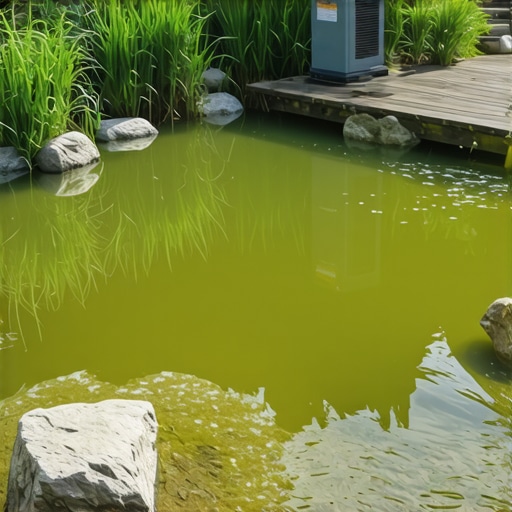
Why Your Pond Water Stays Murky: The Forensic Engineering of Filtration Failure
I always drill into my new crew members: if you don’t fix the soil grading first, every plant you put in the ground is just expensive compost. This technical wisdom applies double to water features. I recently walked onto a job site where a homeowner had spent five figures on a custom pond, only to have it look like a bowl of pea soup. They had the best filters money could buy, but they were fighting a losing battle against physics and biology. They had just completed a massive sod install on a slope leading directly to the water’s edge. Every time the irrigation kicked on, it washed high-nitrogen fertilizer and fine silt into the basin. A filter is a component, not a miracle worker. If your pond is brown or green despite having a pump, you aren’t dealing with a ‘dirty’ pond; you’re dealing with a system in biological and structural collapse.
The Core Conflict of Pond Filtration and Water Clarity
Murky pond water persists because mechanical filters only catch large debris, failing to address suspended solids, tannins, and dissolved organics that require biological intervention or specific UV-C sterilization to remediate properly. Most people think a filter is like a vacuum bag. It isn’t. In a pond, your filter is actually a breeding ground for nitrifying bacteria. If your water stays cloudy, your mechanical stage is likely bypassing, or your biological colony hasn’t reached the bioload capacity needed to process ammonia into nitrates. You cannot skip the nitrogen cycle. It takes time. Don’t rush it.
“A pond is a closed-loop biological reactor; if the input of organic matter exceeds the aerobic capacity of the filtration system, anaerobic decomposition will dominate, leading to increased turbidity and gas buildup.” – Modern Limnology and Pond Engineering Manual
How much water flow do I need for a pond pump?
To maintain clarity, your pump must move the entire volume of the pond through the filter at least once every hour. For a 2,000-gallon pond, you need a pump rated at a minimum of 2,000 GPH (Gallons Per Hour) at the specific head pressure of your plumbing. Under-sizing your pump leads to stagnant pockets where anaerobic bacteria thrive and particulates settle, turning your pond floor into a sludge factory.
Can I use tap water to fill my pond?
Tap water contains chlorine or chloramines which are lethal to the beneficial bacteria your filter needs. If you do a massive water change during a yard cleanup, you must use a dechlorinator. Failure to do so nukes your bio-filter, and you will see a ‘bacterial bloom’—that milky white cloudiness—within 48 hours as the ecosystem tries to reset itself.
The Engineering of Particle Size and Mechanical Failure
Mechanical filtration is measured in microns. If your filter uses a coarse mat, it might catch leaves and twigs, but it will never catch colloidal clay or planktonic algae. These particles are small enough to pass right through standard sponges. This is where the engineering fails. You need a polishing pad or a pressurized bead filter to catch the fine stuff. [IMAGE_PLACEHOLDER]
| Filter Component | Particle Size Caught | Operational Goal | Maintenance Frequency |
|---|---|---|---|
| Skimmer Basket | >5,000 Microns | Surface Debris Removal | Daily/Weekly |
| Filter Mat (Coarse) | 500 – 1,000 Microns | Solid Separation | Weekly |
| Pressurized Beads | 50 – 100 Microns | Water Polishing | Bi-weekly |
| UV-C Clarifier | N/A (Microscopic) | DNA Flocculation of Algae | Annual Bulb Change |
The Impact of External Landscaping on Water Turbidity
Your pond does not exist in a vacuum. It is the lowest point of your yard’s landscaping. If you have performed a sod install recently, the phosphorus in the starter fertilizer is like jet fuel for algae. During a yard cleanup, if your crew is blowing grass clippings or leaf litter into the water, they are injecting dissolved organic compounds (DOCs) that turn the water the color of tea. This is known as tannin staining. No mechanical filter removes tannins; you need activated carbon or frequent water changes to fix this. Check your irrigation heads. If they are over-spraying into the pond, they are bringing in city water chemicals and yard runoff. Stop the leak at the source. It is cheaper than buying chemicals.
“Mechanical filtration is secondary to hydraulic design; if the pond’s floor has ‘dead zones,’ sediment will accumulate regardless of the filter’s size.” – ICPI Hardscape & Water Feature Standards
Step-by-Step Diagnostic for Murky Water
- Test the water for Ammonia, Nitrites, and Nitrates to ensure the nitrogen cycle is active.
- Inspect the pump intake for clogs to ensure maximum GPH flow through the media.
- Check for soil intrusion from recent landscaping or sod install projects.
- Measure the KH (Carbonate Hardness); low KH causes pH swings that kill clear-water bacteria.
- Verify the age of your UV bulb; they lose 60% of their effectiveness after 9,000 hours.
The Chemical Reality of Flocculants
Sometimes the particles are so fine they have a negative charge and repel each other, staying suspended forever. This is common in areas with heavy clay soil. You need a flocculant. This chemical acts like a magnet, clumping tiny particles together into larger masses that the filter can actually grab. It is a temporary fix. The permanent fix is proper yard cleanup and grading to prevent the clay from entering in the first place. Don’t be lazy with your edges. Use a high-quality pond liner and stone coping to create a barrier. It works. Stick to the plan.