
The Fundamentals of Hydrological Site Management
I always drill into my new crew members: if you don’t fix the soil grading first, every plant you put in the ground is just expensive compost. Most homeowners see a puddle and think they need more dirt. In reality, they need a managed infiltration system. A rain garden is not a pond. It is a biological engine designed to process stormwater runoff from impervious surfaces like roofs, driveways, and compacted turf. If your landscaping strategy does not account for the volume of water your roof sheds during a two-inch rain event, you are simply rearranging the deck chairs on the Titanic. You need to understand peak flow and sub-surface saturation points before you even pick up a shovel.
“A rain garden is a depressed area in the landscape that collects rain water from a roof, driveway or street and allows it to soak into the ground.” – USDA Natural Resources Conservation Service
Understanding the Hydraulic Reality of Your Yard
To plan a rain garden that stops backyard flooding, you must calculate your drainage area and soil infiltration rate to design a shallow basin filled with engineered soil and native plants. This system captures runoff, allowing it to soak into the ground within 24 to 48 hours. This prevents the standing water that kills a sod install and creates breeding grounds for mosquitoes. When we talk about drainage, we are dealing with the Hydrologic Soil Group (HSG). If you have Type D soil, which is high-density clay, your infiltration rate might be as low as 0.05 inches per hour. You cannot ignore these physics. If you build a basin in clay without amending the soil matrix, you have built a bathtub, not a garden. The goal is to facilitate deep-root penetration and macro-pore formation in the soil profile.
How do I calculate the size of my rain garden?
Calculating size requires measuring the square footage of the impervious surface feeding the garden. For a standard residential roof, you find the area of the roof section draining into a specific downspout. If that area is 500 square feet, and you have sandy soil, your garden should be about 10 percent of that size, or 50 square feet. For heavy clay, you may need to go up to 30 percent. Depth is also a factor. A basin that is 6 inches deep is the industry standard. This allows for enough ponding depth to hold a standard storm event without drowning the vegetation. Go too deep, and you risk anaerobic conditions. Go too shallow, and the water overshoots the basin and continues flooding your yard. Precision in grading is the difference between success and a muddy mess.
| Soil Type | Infiltration Rate (in/hr) | Recommended Garden Size (% of Drainage Area) | Recommended Basin Depth (inches) |
|---|---|---|---|
| Sand/Loamy Sand | 2.0 – 6.0 | 10% – 12% | 8 |
| Silt Loam | 0.5 – 2.0 | 15% – 20% | 6 |
| Clay Loam/Clay | 0.05 – 0.5 | 25% – 30% | 4 – 5 |
The Site Preparation and Grading Phase
Before any yard cleanup or planting begins, you must locate your garden at least 10 feet from the house foundation. This prevents hydrostatic pressure from forcing water into your basement or crawlspace. You also need to call 811 to mark underground utilities. Once the location is set, you start the excavation. You are not just digging a hole; you are creating a level-bottomed basin. If the bottom of your rain garden is sloped, the water will pool at one end, causing uneven infiltration and plant stress. Use a transition level or a laser level to ensure the floor of the basin is perfectly flat. The soil removed from the basin can be used to construct a berm on the downhill side. This berm must be compacted. If it is loose soil, the first heavy rain will wash it away. Think of the berm as a mini-dam that must be engineered with a structural spillway for extreme weather events.
What tools do I need for a rain garden install?
To execute this properly, you need more than a garden spade. Professional results require professional tools. You will need:
- Laser level or line level for accurate grading
- Sharpshooter spade for heavy clay excavation
- Mechanical plate compactor for the downhill berm
- Percolation test kit (or a post-hole digger and a stopwatch)
- Non-woven geotextile fabric for the overflow spillway
- Shredded hardwood mulch (avoid pine nuggets which float away)
Engineering the Soil Matrix and Plant Selection
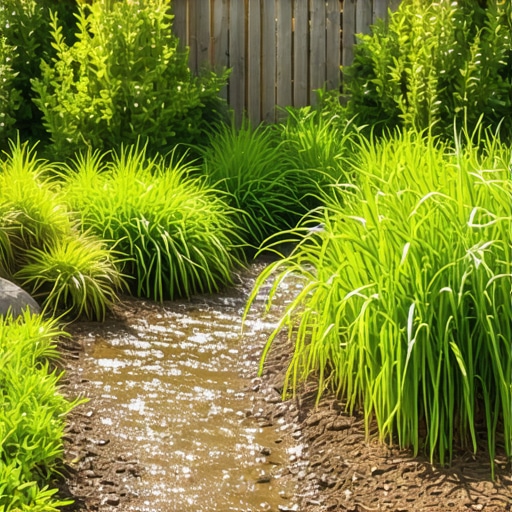
The dirt you dug out is likely garbage. To make a rain garden work, you need an engineered soil mix. I typically recommend a ratio of 50 percent sand, 20 percent topsoil, and 30 percent leaf compost. This mix provides enough structural void space for water to move while offering the organic matter necessary for plant health. Do not use irrigation systems in a rain garden unless you are in a period of extreme drought. These systems are designed to be self-sustaining. The plants you choose must be “stunt doubles”: they need to handle being submerged in water for 24 hours and then survive a week of dry heat. Native species like Asclepias incarnata (Swamp Milkweed) or Panicum virgatum (Switchgrass) have root systems that can reach five to ten feet deep. These roots create channels in the soil that act like natural pipes, dragging water down into the aquifer.
[image_placeholder]
“Deep-rooted native plants are essential for increasing the hydraulic conductivity of the soil profile over time.” – Pennsylvania Department of Environmental Protection
Managing the Inflow and Outflow
How the water gets to the garden is just as important as the garden itself. You can use a grass swale, which helps slow the water down and filter out sediment, or you can use a buried 4-inch PVC pipe. If you use a pipe, ensure the exit point has a flared end section and rip-rap stone to dissipate the energy of the water. If the water enters the garden too fast, it will scour the soil and uproot your new plants. You also need a planned exit. Every rain garden will eventually overflow during a 100-year storm event. This overflow must be directed to a safe location, such as a municipal storm drain or a lower part of the property, away from neighbors. Use a rock-lined spillway for this. This is where many DIY projects fail: they don’t plan for the water they can’t catch. If you don’t control the overflow, the overflow will control you.
The Long-Term Maintenance Cycle
A rain garden is not a zero-maintenance feature. In the first year, weed management is critical. Because you are providing a high-moisture, high-nutrient environment, invasive species will try to take over. Once the native plants establish their deep root systems, they will out-compete most weeds. You also need to monitor sediment buildup. If you see a layer of fine silt forming on top of your mulch, you need to remove it. Silt is the enemy of infiltration. It clogs the macro-pores in your soil mix and turns your garden into a swamp. Every three years, you should refresh the shredded hardwood mulch to maintain the organic layer that helps break down pollutants like oils and fertilizers from the runoff. If you follow these engineering steps, your backyard flooding issues will become a thing of the past. Stop fighting the water and start managing it.”