
The Fundamentals of Slope Stabilization
Proper erosion control on steep banks requires a deep understanding of soil physics and hydraulic flow. I always drill into my new crew members: if you don’t fix the soil grading first, every plant you put in the ground is just expensive compost. Most landscaping failures on hillsides happen because the contractor treated the symptom instead of the structural cause. Before you buy a single sod install or a 1-gallon pot, you have to assess the angle of repose and the soil’s shear strength. We are looking at how water moves across the surface versus how it infiltrates the subsurface. If you ignore the subsurface, gravity wins every single time. It is not just about aesthetics; it is about preventing a 40-ton landslide from hitting your foundation.
“Soil stability on slopes is primarily a function of root reinforcement and the reduction of pore water pressure through transpiration.” – USDA Natural Resources Conservation Service Technical Note
The Science of Root Shear Strength
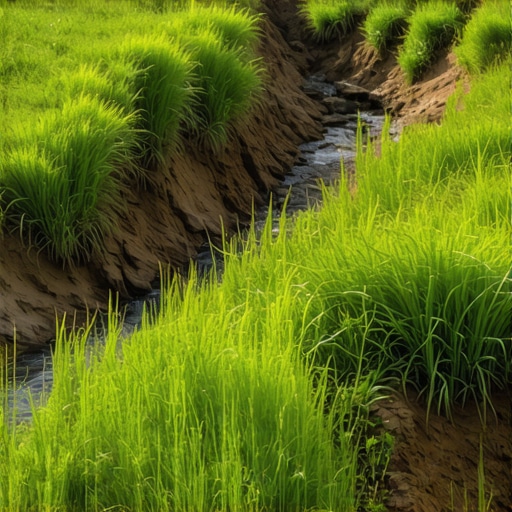
Ornamental grasses fix erosion on steep banks by creating a dense, fibrous root network that binds soil particles together while the above-ground biomass slows water velocity. These native perennials act as a living anchor, significantly reducing surface runoff and sediment displacement on unstable inclines. Unlike trees, which can become heavy and actually pull a slope down during a saturation event, grasses provide high surface-area coverage with minimal weight. The root-to-shoot ratio of many prairie grasses is staggering. Some species send roots ten feet deep into the subsoil. This is biological civil engineering at its finest. You are building a subterranean grid that locks the dirt in place. Don’t skip the site prep. A clean yard cleanup to remove invasive vines is mandatory before the first plug goes in.
How much modified gravel do I need for a bank transition?
Calculating material for a bank transition depends on the hydrostatic pressure and the slope angle, typically requiring a 6-inch base of 2A modified gravel for any structural toe walls or drainage outlets. This base must be compacted to 95 percent Proctor density to ensure it does not shift under the weight of the bank. If you are integrating a dry creek bed for irrigation runoff, that gravel depth increases to 12 inches with a non-woven geotextile fabric underneath. Do not use pea gravel. It acts like ball bearings and will wash away in the first rain. You need angular stone that locks together.
| Grass Species | Root Depth (Inches) | Drought Tolerance | Growth Pattern |
|---|---|---|---|
| Little Bluestem | 60-96 | High | Bunching |
| Switchgrass | 96-120 | High | Rhizomatous |
| Prairie Dropseed | 48-60 | Extreme | Fine Bunching |
| Side-oats Grama | 36-48 | Medium | Sod-forming |
Installation Protocols for High-Velocity Runoff
When installing grasses on a 2:1 slope, the technique differs significantly from a standard flat-land landscaping project. You cannot just dig a hole and drop the plant in. You must create a ‘shelf’ for each plant to capture water, preventing the root ball from drying out before it establishes. If the bank is particularly steep, we utilize coconut coir blankets or jute netting. This temporary matrix holds the soil for 12 to 24 months while the grasses reach their mature anchoring capacity. Without this, a heavy thunderstorm will wash your $5,000 investment into the neighbor’s pool. We also look at the irrigation needs. You cannot use standard spray heads on a hill; the water just runs off. We use pressure-compensating drip emitters buried two inches deep. It gets the water to the roots, not the driveway.
- Excavate the slope toe to prevent base slippage.
- Apply 3 inches of hardwood mulch to suppress weeds, but avoid ‘mulch volcanoes’.
- Install plugs in a staggered, triangular pattern for 100 percent coverage.
- Check 811 / Dig Safe before any deep anchoring or trenching.
- Monitor for yard cleanup needs during the first two seasons to remove competing weeds.
Common Pitfalls in Slope Landscaping
The most frequent mistake I see is homeowners trying to use a standard sod install on a slope greater than 3:1. Kentucky Bluegrass has a root system that is barely 4 inches deep. It is a carpet, not an anchor. During a heavy saturation event, the water gets between the clay and the sod, and the whole thing slides off like a wet rug. Ornamental grasses like Panicum or Schizachyrium are different. They are built for this. Another failure point is improper irrigation timing. Over-watering a slope leads to soil liquefaction. You want deep, infrequent cycles that force the roots to chase the moisture downward into the harder subsoil layers. This makes the plant, and the hill, much stronger.
“A retaining wall doesn’t fail because of the stone; it fails because of the water trapped behind it.” – Hardscape Engineering Axiom
How do I choose between seeding and plugs for erosion?
Choosing between seeding and plugs for erosion control depends on the slope gradient and budget, with plugs providing immediate structural stability and a higher success rate on inclines greater than 30 degrees. Seeds are prone to washing away before germination, even with hydro-seeding slurries or straw blankets. Plugs allow you to jumpstart the biological anchoring process by 18 months. If you are on a budget, you can seed the less-steep areas, but the ‘critical zones’ near drainage outlets or steep transitions require the physical mass of established plants. We often use a 4-inch plug for maximum impact.
Soil Composition and pH Management
The chemical reality of your soil dictates the health of your grasses. In areas with heavy red clay, the soil is often compacted and lacks pore space for oxygen. We use a mechanical auger to break the ‘glaze’ of the planting hole. If you don’t, the roots will just circle the hole until the plant dies. This is called root girdling. We also test the pH. Most ornamental grasses thrive in a 6.0 to 7.0 range. If you are dealing with acidic soil from pine needles, you need a lime application months before planting. Grasses won’t grow in dead soil. You need the microbiology to be active so the nitrogen cycle can feed the deep root growth required for stabilization. This is not a ‘set it and forget it’ situation. It requires engineering precision. Final Specs: Monitor the slope after every major rain event for the first year. Look for small rills or washouts. Fix them immediately with more stone or more plugs. Once the canopy closes and the roots knit together, you have a permanent, maintenance-free solution that looks better than any concrete wall.