
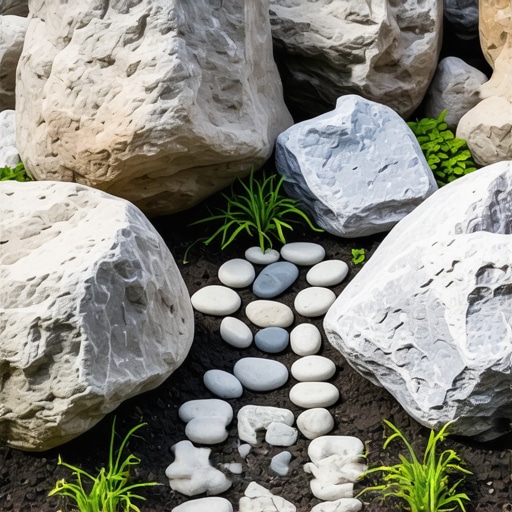
The Engineering Reality of Perimeter Hardscaping
Using boulders for landscape edging creates a structural anchor for your property that small, four-inch edging stones simply cannot match due to their lack of mass and depth. While big-box retailers sell thin masonry units as a DIY fix, these lightweight materials fail to resist hydrostatic pressure and soil movement during freeze-thaw cycles. I recently got called out to tear up a $30,000 patio that was sinking because the previous contractor used flimsy plastic edging and thin bricks to hold back a four-foot grade change. Within eighteen months, the lateral pressure of the saturated soil had pushed the entire perimeter out by three inches. The pavers didn’t fail; the edging did. We had to excavate the entire site, haul away three tons of debris, and replace the perimeter with 300-pound granite boulders keyed into a six-inch modified gravel base. It was an expensive lesson in physics for that homeowner.
“A retaining wall doesn’t fail because of the stone; it fails because of the water trapped behind it.” – Hardscape Engineering Axiom
The Science of Mass and Frost Heave
Small stones are victims of the earth’s natural movement. In regions with heavy clay, soil expands and contracts with moisture. Boulders, when installed correctly with one-third of their mass buried below grade, utilize their own weight to remain stationary. This is known as shear resistance. When you perform a yard cleanup, you’ll notice small stones are often scattered by lawnmowers or foot traffic; a boulder stays where the crew sets it. We use a vibratory plate compactor to ensure the subgrade is at 98% Proctor density before the first stone touches the dirt. If the base isn’t solid, your hardscape is just a slow-motion landslide.
| Feature | Small Edging Stones | Landscape Boulders |
|---|---|---|
| Average Weight | 2-10 lbs | 150-1,000+ lbs |
| Installation Depth | Surface Level | 1/3 Body Buried |
| Frost Heave Resistance | Negligible | Superior |
| Lifespan | 3-5 Years | Indefinite |
| Cost vs. Longevity | High (Replacement required) | Low (Permanent) |
How deep should a boulder be buried for landscape edging?
To ensure structural stability and prevent lateral shifting, a landscape boulder should be buried at a depth equal to one-third of its total height into a compacted gravel trench. This anchoring technique, known as “keying in,” allows the boulder to resist the weight of the sod install and soil behind it while preventing the stone from rolling during heavy rain events or equipment operation. Skip the burial and you’re just placing a rock on the grass; bury it, and you’ve built a wall.
Irrigation and the Rain Shadow Effect
One critical factor my crew monitors is the irrigation spray pattern. Boulders create what we call a “rain shadow.” Because of their size, they can block sprinkler heads from reaching the sod install directly behind the stone. When we design these perimeters, we always relocate the heads to a “head-to-head” coverage pattern that accounts for the stone’s height. If you don’t adjust your irrigation, you’ll have a ring of dead, brown fescue around every beautiful boulder you install. We use high-efficiency rotary nozzles to ensure the water arches over the stone to reach the root zone.
“Compaction is the single most important factor in hardscape longevity; without it, the soil’s load-bearing capacity is compromised by pore space and air pockets.” – USDA Soil Mechanics Manual
What is the best stone for landscape edging in high-moisture areas?
For high-moisture environments or areas with poor drainage, igneous rocks like granite or basalt are the superior choice for landscaping because they have low porosity and will not degrade from water absorption. Sedimentary rocks like limestone or sandstone can spall or crack over time as water enters the layers and freezes, leading to structural failure of the edging line. Granite provides the density needed to withstand hydrostatic pressure without chemical breakdown.
The Correct Installation Workflow
Don’t let a contractor tell you they can “just set the stones down.” That’s a lie. Here is the professional checklist for a boulder edging landscaping project:
- Utility Marking: Always call 811. Irrigation lines and gas pipes often run right where you want to dig.
- Trench Excavation: Dig 8-12 inches deeper than the planned burial depth to accommodate the base.
- Base Preparation: Fill with 4-6 inches of 2A modified gravel (crushed limestone with fines).
- Compaction: Use a hand tamper or plate compactor until the base is rock hard. No movement.
- Geotextile Layer: Lay down a non-woven filter fabric to prevent the gravel from mixing with the native soil.
- Setting the Stone: Use a machine with a stone-handler attachment. Align the “face” of the boulder outward.
- Backfilling: Use clean 2B stone for drainage behind the boulder, then top with soil for sod install.
Soil Grading and Yard Cleanup Integration
Boulders allow for more aggressive grading. If your yard has a slight slope, a small edging stone will be buried by silt within one season. A boulder acts as a mini-retaining wall, allowing us to level the area for a fresh sod install. During a final yard cleanup, the mass of the boulders makes it easier to use high-powered blowers and mechanical edgers without dislodging the perimeter. It makes the maintenance crew’s life easier and keeps the lines of the property crisp for decades. It will last. Cheap stones won’t.