
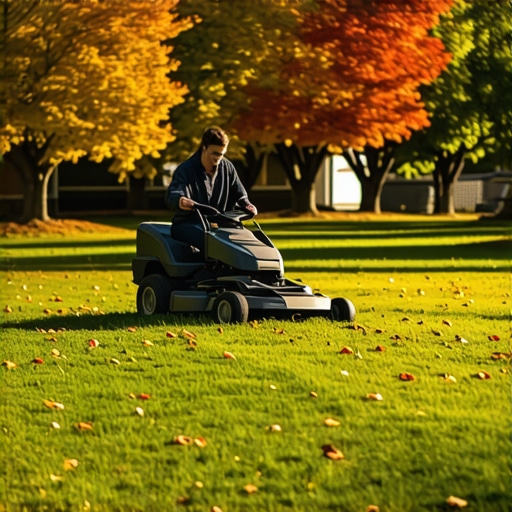
The Last Cut: Why Your November Routine Determines Your April Success
I always drill into my new crew members: if you don’t fix the soil grading first, every plant you put in the ground is just expensive compost. This technical wisdom applies double to the last mow of the year. Most homeowners treat the final pass of the season like a chore to be rushed through, but in my 20 years of running a firm, I have seen more lawns destroyed by a bad November mow than by a July drought. If you leave the grass too long, it mats down under snow and invites gray snow mold. If you scalp it too short, you expose the crown to desiccation and winter kill. You are not just cutting grass; you are managing the physiological transition of a biological organism into a state of dormancy. Don’t be the guy who spends $5,000 on sod install in the spring because he was lazy in the fall.
The Ideal Height: Engineering the Perfect Final Cut
The last mow of the year should reduce turf height to 2 to 2.5 inches for cool-season grasses to prevent snow mold and leaf matting. This height balances root protection with the need to minimize excess tissue that harbors fungal pathogens during winter dormancy and spring thaws.
How short should I cut my grass before winter?
For species like Tall Fescue or Kentucky Bluegrass, you want to gradually bring the height down over the last three mows. Dropping the deck more than one-third of the blade height at once is a mechanical shock the plant cannot recover from before the first hard freeze. I tell my guys to aim for 2.5 inches. This is short enough to prevent the blades from falling over on themselves when the weight of the snow hits, yet long enough to provide a thermal blanket for the rhizomes. If you are dealing with dormant warm-season grasses like Bermuda in the south, you can go even shorter, but for the transition zone, 2.5 is the golden number. [IMAGE_PLACEHOLDER_1]
The Biology of Winter Turf Management
During the late fall, the nitrogen cycle in your soil slows down, but the roots are still active. They are busy translocating carbohydrates from the blades down into the root system. This is why landscaping professionals focus on late-season fertilization. You want a high-potassium blend to strengthen cell walls against freezing.
“The primary goal of late-fall fertilization is not to encourage foliar growth but to enhance the storage of carbohydrates within the plant’s crown and root system for spring green-up.” – Penn State Center for Turfgrass Science
I see hacks putting down high-nitrogen ‘winterizers’ that force new, tender growth right as the frost hits. That is a death sentence. That new growth is 80 percent water; when it freezes, the cell walls rupture, and you get a mushy, brown mess come March. You want a 10-10-10 or a 12-4-14 ratio, not some 30-0-0 big-box store garbage. Check your soil pH now. If you are below 6.0, your grass cannot even uptake the nutrients you are throwing at it. It is literally like trying to feed a man with his mouth taped shut.
The Yard Cleanup Protocol: Removing Pathogen Vectors
A proper yard cleanup is not about aesthetics; it is about sanitation. Any leaf litter left on the lawn creates a micro-environment of high humidity and zero airflow. This is the exact condition required for Typhula incarnata (Gray Snow Mold).
Is it okay to leave some leaves on the lawn over winter?
No. If you can see more than 10 percent of the soil surface covered in leaf fragments, you are at risk. I have seen sod install projects that cost $15,000 rot away in a single winter because the homeowner let the oak leaves pile up. If you must, mulch them with a high-lift blade, but only if the fragments are small enough to fall between the grass blades to the soil surface where they can decompose. Otherwise, bag them and get them off the property. Don’t forget the corners of your landscaping beds. Heavy leaf buildup against the stems of woody ornamentals traps moisture against the bark, leading to fungal cankers and rodent damage. Voles love a thick layer of unraked leaves; it gives them a tunnel system to chew on your expensive shrubs undetected all winter.
Irrigation Winterization: Avoiding Hydrostatic Failure
If you don’t blow out your irrigation system, you are an amateur. I don’t care if you live in a region where the frost line is only four inches deep. All it takes is one ‘polar vortex’ to freeze the water in your backflow preventer. When water freezes, it expands by approximately 9 percent. That expansion generates enough hydrostatic pressure to crack a brass valve body or shatter Schedule 40 PVC. We use a high-volume air compressor, not a home garage unit. You need at least 50 to 80 CFM (Cubic Feet per Minute) to move the water out of the lines. A small compressor just blows air over the top of the water. You need a wall of air to push that column of water out of every head. Keep the pressure under 60 PSI for PVC and under 40 PSI for poly pipe. If you go higher, you will melt the internal seals of the rotors from the friction of the air. It is a precise science. Don’t skip the blow-out.
The Professional Comparison: Mow Height and Disease Risk
| Grass Variety | Final Mow Height (Inches) | Primary Winter Risk | Soil Moisture Requirement |
|---|---|---|---|
| Tall Fescue | 2.0 – 2.5 | Gray Snow Mold | Moderate |
| Kentucky Bluegrass | 2.0 | Desiccation / Wilt | Low |
| Perennial Ryegrass | 1.5 – 2.0 | Ice Encapsulation | Moderate |
| Bermuda (Dormancy) | 1.0 – 1.5 | Crown Freeze | Very Low |
The Late-Season Checklist
- Decrease mowing height by 0.5 inches per week until reaching the 2.5-inch target.
- Remove all organic debris, including fallen fruit, thick leaf layers, and dead annuals.
- Perform an irrigation blowout using a high-volume compressor (minimum 50 CFM).
- Apply a low-nitrogen, high-potassium fertilizer once the top-growth has ceased.
- Sharpen mower blades; a ragged cut in late fall leaves the plant open to infection.
- Flag all sprinkler heads to avoid damage during the final heavy cleanup.
Sod Install and Late Season Realities
People ask me all the time:
Is it too late to install sod in November?
The answer depends on your soil temperature, not the air temperature. You can lay sod as long as the ground isn’t frozen, but you better understand that the roots won’t knit until spring. You are essentially ‘dormant seeding’ with mats of grass. If you do a late sod install, you must continue to water it through the winter whenever the temperature is above 40 degrees. Winter desiccation is the number one killer of new sod. The wind peels the moisture right out of the blades, and since the roots haven’t hit the subsoil yet, the plant has no way to replenish that water. It will die. If you aren’t prepared to drag a hose across a freezing lawn in January, don’t lay sod in November. Wait until the ground thaws in the spring and do it right.
“A retaining wall doesn’t fail because of the stone; it fails because of the water trapped behind it.” – Hardscape Engineering Axiom
The same logic applies to your lawn. It doesn’t fail because of the cold; it fails because of the moisture management and the physical state you left it in. Professional landscaping is about anticipating the stresses of the next six months, not just making the yard look ‘clean’ for the holidays. Follow the physics, respect the biology, and your lawn will actually stand a chance when the snow melts.