
The Chemical Nightmare: Why Your New Sod is Turning Straw-Brown
A homeowner called me in a panic last season after they completely torched their front lawn by applying a high-nitrogen ‘starter’ fertilizer during a 95-degree heatwave, right after a fresh sod install. They thought they were helping the grass ‘green up.’ Instead, they created a saline environment that sucked every molecule of moisture out of the tender root tips. This is the reality of modern landscaping: if you don’t understand the chemistry of the soil and the physics of irrigation, you are just throwing money into a woodchipper. Kentucky Bluegrass (Poa pratensis) is a high-maintenance turf that requires specific physiological conditions to thrive. Most homeowners and ‘mow-and-blow’ crews treat it like a plastic rug, but it is a complex biological system that requires a rigorous watering schedule to survive the first 12 months.
The Critical 14-Day Establishment Phase for New Kentucky Bluegrass
The establishment phase for new Kentucky Bluegrass requires keeping the top 2 inches of soil consistently moist without creating anaerobic conditions. You must irrigate 3 to 4 times daily for 10 to 15 minutes per zone to prevent the sod rhizomes from drying out. This prevents the edges of the sod from shrinking, which creates gaps that allow weed seeds to germinate and irrigation water to bypass the root zone. Stop thinking in terms of ‘minutes’ and start thinking in terms of ‘soil saturation depth.’ In my 20 years of landscaping, I have seen more yards die from three days of neglect than from a whole month of poor soil. You have exactly 72 hours from the moment the sod is harvested at the farm to get it in the ground and saturated before the plant enters a state of permanent wilt. If you miss that window, your 2026 lawn goals are already dead.
How much water does new sod need every day?
During the first week, your goal is simple: total saturation of the sod mat and the top half-inch of your native soil. If you lift a corner of the sod and the soil underneath isn’t muddy, you aren’t watering enough. However, if you see puddling that lasts more than 20 minutes, your soil grading is likely flawed, and you are drowning the roots. Kentucky Bluegrass rhizomes need oxygen as much as they need water. If you fill every pore space in the soil with water, the plant will suffocate. This is why a proper sod install starts with yard cleanup and soil aeration to break up compaction before the first roll is laid down.
“Proper irrigation scheduling for Kentucky Bluegrass must account for the high water-use rate of the species, which typically requires 1 to 1.5 inches of water per week during the peak growing season to maintain physiological health.” – Agricultural Extension Agronomy Manual
2026 Watering Schedule by Growth Phase
Use the following table to calibrate your irrigation controller. These figures assume a standard rotary nozzle output of 0.5 inches per hour at 40 PSI. If your pressure is lower, you must adjust the run times upward.
| Growth Phase | Frequency | Duration per Session | Target Soil Depth |
|---|---|---|---|
| Days 1-7 | 4 times daily | 10-15 mins | Surface (0.5 inch) |
| Days 8-14 | 2 times daily | 20 mins | 1 inch |
| Days 15-28 | Once daily | 30 mins | 3 inches |
| Day 29+ | 3 times per week | 45-60 mins | 6 inches |
The Physics of Irrigation: Head-to-Head Coverage and PSI
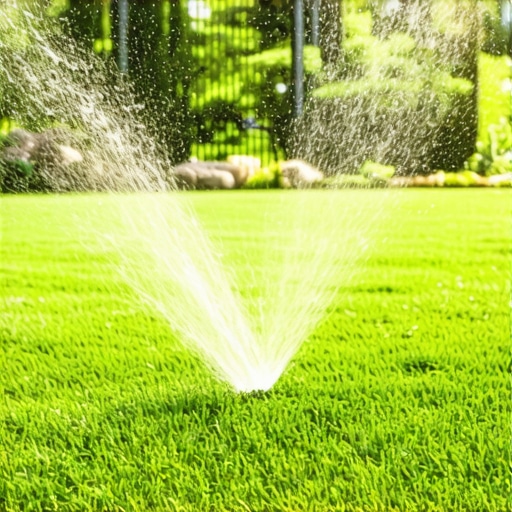
Achieving 100% head-to-head coverage is the only way to ensure your Kentucky Bluegrass receives the uniform 1 inch of water it requires weekly. Inconsistent spray patterns leave ‘donuts’ of dry turf that lead to localized dry spot, which is often misdiagnosed as a fungal infection or pest issue. Check your irrigation system for ‘low head drainage’ and ‘mist’ issues. If your heads are misting, your PSI is too high, and your water is evaporating before it hits the ground. This is a rookie mistake. Use pressure-regulated heads (PRS) to keep the flow at a steady 30 or 45 PSI. This ensures the water droplets are heavy enough to penetrate the thatch layer and reach the root zone. You aren’t just watering a lawn; you are managing a hydraulic system.
“A retaining wall doesn’t fail because of the stone; it fails because of the water trapped behind it.” – Hardscape Engineering Axiom
This same principle applies to your lawn’s subgrade. If your yard cleanup didn’t include proper grading, the water you pour onto the sod will simply pool in low spots, causing root rot (Pythium) while the high spots bake in the sun.
How often should I water my lawn in 2026?
By 2026, SMART irrigation controllers will be the industry standard. These systems use local weather data and evapotranspiration (ET) rates to determine if your lawn actually needs water. Stop using ‘set it and forget it’ timers. Instead, follow the rule of ‘Deep and Infrequent.’ Once the sod is established (after 4 weeks), you want to force the roots to grow deep into the soil profile. If you water for 5 minutes every day, the roots will stay near the surface where the water is. If you water for an hour twice a week, the surface dries out, and the roots are forced to chase the moisture down 6 inches into the earth. This makes the grass drought-tolerant. A shallow-rooted lawn is a weak lawn.
Essential New Sod Care Checklist
- Check for ‘hot spots’ (brown edges) every afternoon during the first 14 days.
- Ensure the irrigation controller battery backup is functional to avoid missed cycles.
- Perform a ‘cup test’ to measure exactly how many inches of water your system puts out per hour.
- Never mow more than one-third of the grass blade height in a single session.
- Avoid heavy foot traffic for the first 30 days to prevent soil compaction and rutting.
The Foreman’s Final Word on Soil Chemistry
Before you even think about an irrigation schedule, you must know your soil pH. Kentucky Bluegrass thrives in a slightly acidic to neutral range (6.5 to 7.0). If your soil is too alkaline, your grass cannot uptake iron or manganese, regardless of how much you water it. It will look yellow and sickly. This is not a water problem; it is a chemistry problem. During your initial yard cleanup and site prep, pull a soil sample. If you need to add sulfur or lime, do it before the sod install. Trying to fix soil pH after the grass is down is like trying to change the oil in a car while the engine is running. It’s messy and inefficient. Get the foundation right, follow the schedule, and you will have a lawn that survives the 2026 heat. Skip the prep, and you are just buying expensive compost.