
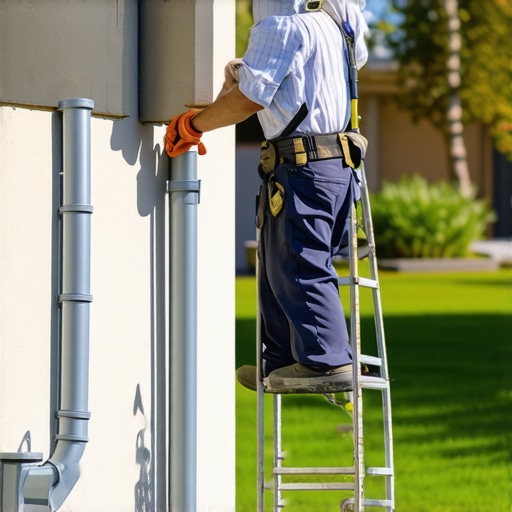
The Hidden Physics of Yard Drainage and Foundation Integrity
Yard drainage relies on the efficient redirection of roof runoff through gutter downspouts to prevent soil saturation, foundation erosion, and the destruction of expensive sod installs. When downspouts are clogged or improperly graded, hydrostatic pressure builds against foundation walls, leading to structural failure and anaerobic soil conditions that kill turf. I recently got called out to tear up a $30,000 patio that was sinking because the previous contractor ignored the downspout exit points. The water was pooling under the modified gravel base, turning the subgrade into a slurry of mud. Every time it rained, the weight of the water shifted the pavers by fractions of an inch until the entire surface looked like a topographical map of the Andes. We had to excavate three feet down just to reach stable soil again. It was a total loss for the homeowner. Do not be that guy. Most homeowners think a gutter cleaning is about preventing overflow at the roofline, but as a veteran landscaper, I know the real battle is happening at the soil level. If your downspouts aren’t clear, you are effectively pumping hundreds of gallons of water directly into your home’s footings.
How much water comes off a roof during a storm?
To calculate your drainage needs, multiply your roof square footage by 0.623 gallons for every inch of rainfall; a 2,000 square foot roof sheds 1,246 gallons during a one inch storm. This volume of water must be moved at least 10 feet away from the structure.
“A retaining wall doesn’t fail because of the stone; it fails because of the water trapped behind it.” – Hardscape Engineering Axiom
The Forensic Autopsy of a Failed Sod Install
Sod install failure often stems from gutter downspout neglect which creates localized flooding, drowning the root zones of new landscaping and causing 2026-era turf diseases. When water accumulates, it displaces oxygen in the soil pores, causing Pythium root rot and immediate nitrogen leaching. During a yard cleanup, I often see what I call the ‘Downspout Delta.’ This is a fan-shaped area of dead grass or eroded soil directly beneath a gutter exit. It is a sign of poor engineering. If you just lay new sod over that area without fixing the drainage, you are wasting money. You need to understand soil horizons. Most yards have a layer of topsoil over a compacted clay subgrade. When the downspout dumps water, it travels through the topsoil but hits that clay like a brick wall, moving laterally toward your basement.
What are the signs of poor yard drainage?
Look for standing water 24 hours after rain, spongy turf, or white mineral deposits (efflorescence) on basement walls. These indicate that your irrigation and drainage systems are working against you.
“Poor surface drainage is the primary cause of pavement distress and subgrade failure in residential hardscaping.” – ICPI Tech Spec 2
The Science of Hydrostatic Pressure and Soil Compaction
The primary goal of cleaning 2026 gutter downspouts is to mitigate hydrostatic pressure which can exert thousands of pounds of force against your landscaping walls and home foundation. Water is heavy. One cubic foot of water weighs 62.4 pounds. If that water is trapped in the soil behind a wall or against a foundation because your downspouts are clogged, it will find the path of least resistance. Usually, that is through your foundation cracks.
| Material Type | Durability (Years) | Flow Efficiency | Best Use Case |
|---|---|---|---|
| Corrugated Pipe | 5 to 10 | Low (Debris Traps) | Temporary DIY Fixes |
| SDR-35 PVC | 30 plus | High (Smooth Bore) | Main Drainage Lines |
| Schedule 40 PVC | 50 plus | Maximum | Under Driveways/Patios |
Technical Steps for a Professional Yard Cleanup and Drainage Audit
To perform a professional yard cleanup focused on drainage, you must verify the structural integrity of every gutter downspout and ensure the discharge points are clear of debris. Use a high-pressure hose to flush the lines. If the water doesn’t exit the pop-up emitter within seconds, you have a subterranean blockage. Don’t skip the flush. You should also check the irrigation sensors. If your sprinklers are running while your downspouts are dumping water, you are creating a swamp. We use a 1 percent minimum grade for all drainage pipes. That is a 1/8 inch drop for every foot of run. Anything less and the water slows down, allowing silt to settle and clog the pipe.
- Inspect gutter seams for leaks that drip onto foundation plantings.
- Verify that downspout extensions reach at least 10 feet from the house.
- Clear all debris from catch basins and pop-up emitters.
- Check the soil grade: it must slope away from the house at 6 inches over the first 10 feet.
- Aerate the lawn to reduce soil compaction and improve water infiltration.
Where should gutter water go in a landscape?
The best practice is to direct water into a dedicated French drain, a dry well, or a rain garden planted with water-loving native species to allow for natural filtration. Never pipe your water directly into a neighbor’s yard or onto a public sidewalk. This is often illegal and always poor form. In many municipalities, 2026 codes require on-site water retention. This means you have to deal with your own runoff. A dry well is an excavated pit filled with clean 1.5 inch crushed stone, wrapped in non-woven geotextile fabric. It acts as a holding tank while the water slowly percolates back into the water table. This is real civil engineering in your backyard. Don’t treat it like an afterthought.