
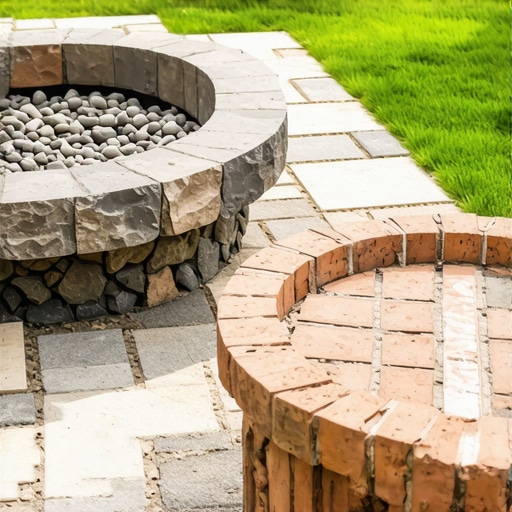
The Hardscape Autopsy: Why Most Fire Pits Fail by Year Five
I recently got called out to tear up a $30,000 patio that was sinking because the previous contractor used a simple sand base over uncompacted clay, and the fire pit in the center had literally split in half. Fire pit durability depends entirely on how the thermal mass interacts with the sub-grade soil compaction and the compressive strength of your chosen masonry. This was a classic case of ignoring hydrostatic pressure and thermal expansion. The homeowner thought they were buying a permanent fixture, but they actually bought a pile of expensive rubble. Any hack can stack stones in a circle. A professional builds a structure that manages 2,000 degree heat and 10,000 pounds of lateral soil pressure. This guide breaks down the engineering reality of choosing between stone and brick for your 2026 build.
Building a 2026 Fire Pit: Stone vs Brick Durability
Building a fire pit in 2026 requires choosing natural stone for its high PSI ratings and aesthetic longevity or fire-rated brick for its thermal shock resistance. While brick is susceptible to spalling if not kiln-fired correctly, natural igneous rocks like granite offer superior resistance to freeze-thaw cycles in professional landscaping applications.
“A retaining wall or fire pit doesn’t fail because of the stone; it fails because of the water trapped behind it or the lack of thermal expansion joints.” – Hardscape Engineering Axiom
How much modified gravel do I need for a fire pit base?
A standard residential fire pit requires a minimum of 6 inches of 21A or 3/4-inch modified gravel base, compacted in 2-inch lifts to achieve 98 percent Standard Proctor Density. You cannot just dump gravel and start building. Use a vibratory plate compactor. If your soil is heavy clay, you must increase the base depth to 12 inches and include a non-woven geotextile fabric to prevent soil migration. This is the difference between a pit that stays level and one that heaves after the first winter.
The Science of Thermal Shock and Material Choice
Brick and stone react differently to the intense heat of a wood fire. Most people think “brick is brick,” but that is a lie. Common red bricks used for house siding are not rated for fire. They contain moisture pockets. When you heat them, that moisture turns to steam and the brick explodes. This is called spalling. You must use refractory fire bricks (also known as firebricks) for the inner lining. These bricks are made from fire clay and have high alumina content, allowing them to withstand 2,000 plus degrees without cracking. Natural stone like granite or basalt is excellent for the exterior because of its density. However, avoid sedimentary rocks like limestone or river rocks. They are porous and can explode when the moisture trapped in their layers expands.
Which lasts longer stone or brick fire pits?
Natural stone fire pits typically outlast brick structures by 30 to 40 years because stone is less prone to alkali-silica reactions and surface degradation from UV exposure. While brick masonry is durable, the mortar joints in brick fire pits often require re-pointing every decade due to thermal fatigue and moisture penetration.
The Role of Yard Cleanup and Site Preparation
A successful install starts with a brutal yard cleanup. You have to remove every scrap of organic matter. If you leave a 2-inch layer of old thatch or sod under your base, it will rot. As it rots, it creates air pockets. Air pockets lead to settling. Settling leads to cracked masonry. I tell my crew: if the site isn’t down to raw mineral soil, don’t even pull the levels out.
Integrating Irrigation and Drainage
You must consider your irrigation system before you lay a single stone. High-heat fire pits will melt Polyethylene pipes if they are buried too shallow or too close to the pit. We always re-route irrigation lines at least five feet away from the pit perimeter. Furthermore, a fire pit acts as a drainage basin. If you don’t install a drainage port or a wicking layer at the bottom of the pit, it will fill with water every time it rains. Standing water in a fire pit causes the base material to saturate and lose its load-bearing capacity.
Material Comparison for 2026 Hardscapes
| Material | Thermal Tolerance | Compressive Strength | Lifetime Expectancy | Porosity Level | | :— | :— | :— | :— | :— | | Refractory Fire Brick | 2,400 F | 3,500 PSI | 20 Years | Low | | Natural Granite | 1,200 F | 19,000+ PSI | 60+ Years | Very Low | | Cast Concrete Pavers | 500 F | 8,000 PSI | 15 Years | Medium | | Sandstone | 400 F | 6,000 PSI | 10 Years | High |
The Precision Sod Install: Finishing the Perimeter
Once the masonry is set, the sod install is the final step. Do not just slap grass up against the stone. Use a metal or plastic bender board to create a 4-inch buffer zone filled with non-combustible mulch or river rock. This prevents the heat from the pit from scorching the turf and ensures your mower doesn’t clip the stone.
“Properly compacted aggregate bases are the foundation of all durable hardscapes; without them, the structural integrity of the masonry is irrelevant.” – ICPI Tech Manual
Checklist for a Permanent Fire Pit Build
- Soil Test: Determine if you are building on expansive clay or stable loam.
- Excavation: Dig 12 inches wider than the pit to allow for over-excavation and stable shoulders.
- Compaction: Use a mechanical tamper. Hand tamping is a waste of time.
- Thermal Gap: Leave a 1-inch air gap between the firebrick lining and the veneer stone.
- Ventilation: Install at least two air intake vents at the base to improve oxygen flow and reduce smoke.
Managing Hydrostatic Pressure and Movement
Ground movement is inevitable. In regions with freeze-thaw cycles, the ground can lift several inches. If your fire pit is mortared to a rigid concrete pad that isn’t below the frost line, it will snap. I prefer a flexible base made of crushed stone. This allows the structure to move slightly with the earth without catastrophic failure. Use polymeric sand in the outer joints to allow for minor shifting while preventing weed growth and ant hills. It is not just about looking good. It is about geotechnical stability. If you ignore these specs, you are just building a very expensive campfire. Get the soil pH checked if you are planting around the pit, as lime leaching from the mortar can spike the alkalinity and kill your new landscaping. Do it right once, or do it twice and pay me double.