
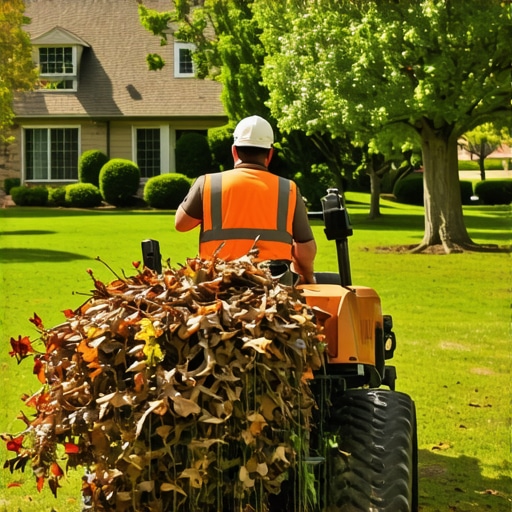
I always drill into my new crew members: if you don’t fix the soil grading first, every plant you put in the ground is just expensive compost. It is the same with leaf management. If you leave a three-inch mat of wet oak leaves on top of high-dollar fescue, you aren’t ‘recycling nutrients,’ you’re suffocating a biological engine. Most homeowners and ‘mow-and-blow’ hacks think yard cleanup is about aesthetics. They are wrong. It is about maintaining the gas exchange between the soil and the atmosphere. When you have five acres of deciduous canopy dropping five tons of organic matter in three weeks, you need a system based on civil engineering and bulk density management, not a plastic rake and a sore back.
The Logistics of High-Volume Debris Management
The fastest way to bag leaves on a large property involves using commercial-grade debris loaders, high-CFM stand-on blowers, and zero-turn mowers equipped with collection systems to consolidate and compact organic material. Manual bagging is discarded in favor of bulk vacuuming and off-site hauling to maintain the soil’s nitrogen-to-carbon balance and prevent turf suffocation. You have to think in terms of cubic yards, not bags. A single mature oak can drop 50 pounds of dry leaves, which triples in weight once the dew point hits or a light rain moves in. If you aren’t moving that mass mechanically, you are losing money and killing grass.
How much time does a leaf vacuum save?
On properties exceeding two acres, a truck-mounted debris loader with a 16-HP or larger engine can reduce labor hours by 70% compared to manual bagging. These machines use a centrifugal impeller to mulch leaves at a 15:1 ratio, meaning 15 bags of loose leaves become one compacted bag of mulch. This is not just about speed; it is about the physics of volume reduction. Every minute your crew spends walking to a dump site is a minute you aren’t clearing ground. We use Scag Giant Vacs or Billy Goat stand-on blowers to push everything into windrows. If you are still using a backpack blower for three acres, you are bringing a knife to a gunfight.
| Equipment Type | Productivity (Acres/Hr) | Reduction Ratio | Best Use Case |
|---|---|---|---|
| Commercial Stand-on Blower | 2.5 – 4.0 | N/A | Moving dry mass into windrows |
| Zero-Turn with Collection | 1.5 – 2.0 | 4:1 | Simultaneous mow and leaf pick-up |
| Truck-Mounted Debris Loader | N/A (Stationary) | 15:1 | Loading compacted waste for haul-away |
| Tow-Behind Leaf Vacuum | 1.0 – 1.5 | 10:1 | Direct collection on large turf spans |
What is the best mower for leaf collection?
For professional yard cleanup, a zero-turn mower with a commercial bagging system and high-lift blades is the standard. High-lift blades create the static pressure necessary to pull heavy, damp leaves off the turf and into the chute without clogging. It’s not just about the mower; it’s about the air movement. If your deck isn’t clean, your airflow is restricted. We scrape decks daily during leaf season. A clogged deck leaves a trail of debris that requires a second pass, doubling your fuel cost and soil compaction. Don’t do it.
“The decomposition of organic matter is governed by the Carbon-to-Nitrogen ratio; excessive leaf litter creates a nitrogen deficit that can starve turfgrass roots if not managed before the first hard frost.” – University of Minnesota Extension Service
The Science of Turf Suffocation and Pathogen Load
Leaving leaves on the ground is a recipe for a fungal disaster. When leaves mat down, they create an anaerobic environment. This traps moisture against the crown of the grass, which is the exact environment Microdochium nivale (Snow Mold) needs to thrive. If you just finished a sod install, those leaves are even more dangerous. New sod hasn’t established a deep root system yet; it’s living off the energy stored in the blades. Block the sun for a week, and that $10,000 lawn is gone. You also have to consider the weight. Wet leaves can exert enough pressure to crush the air pockets in the soil, leading to compaction that even a core aerator will struggle to fix in the spring.
- Check Soil pH: Large amounts of decomposing oak leaves can slightly lower surface pH over time.
- Clear Irrigation Heads: Leaves trapped in pop-up irrigation heads will freeze and crack the seals.
- Avoid Soil Smothering: Never let a leaf layer exceed 1/2 inch on cool-season grasses.
- Protect the Crown: Use blowers to clear the base of trees to prevent trunk rot.
- Mulch Wisely: Only mulch if the leaf cover is light enough to see 50% of the grass blades through it.
The Operational Blueprint: From Perimeter to Pile
We start by clearing the perimeter. You have to blow debris away from fence lines, landscaping beds, and foundation plantings into the open turf. This is where the engineering comes in. We use the ‘windrow method.’ Instead of blowing leaves into one giant pile in the middle of the yard, we create long lines that the zero-turn mower can follow. This minimizes travel time. If the property has an irrigation system, we flag the heads first. You do not want a 1,200-pound mower or a heavy vacuum hose snapping a commercial-grade rotor. It is a simple step that saves a $200 repair bill and a frustrated client.
“A retaining wall doesn’t fail because of the stone; it fails because of the water trapped behind it. Similarly, a lawn doesn’t fail because of the cold; it fails because of the moisture trapped by unmanaged debris.” – Hardscape Engineering Axiom
The Maintenance Protocol: Post-Cleanup Care
Once the leaves are bagged and hauled, the job isn’t done. We check the turf for signs of stress. If we see thinning, we might recommend a late-season dormant seeding, though it is risky. More importantly, we look at the irrigation. Fall is the time to blow out the lines. If you have leaf debris in your valve boxes, they will hold moisture, freeze, and crack your manifold. We use a 185 CFM air compressor to ensure no water remains in the lines. This is the difference between a landscaper and a guy with a lawnmower. One understands the system; the other just sees the grass.
FAQ: Professional Leaf Management
Wet leaves require more mechanical force. We use ‘power raking’ attachments on our mowers or high-velocity blowers with a concentrated nozzle to break the surface tension of the water before moving the mass.
Only if the volume is low. If you can’t see the soil, you have too much carbon. Excessive mulching leads to a thick thatch layer that prevents water and nutrients from reaching the root zone.
Yes. Ticks, fleas, and rodents overwinter in leaf litter. By removing the debris, you are removing the habitat for pests that will emerge in the spring.