
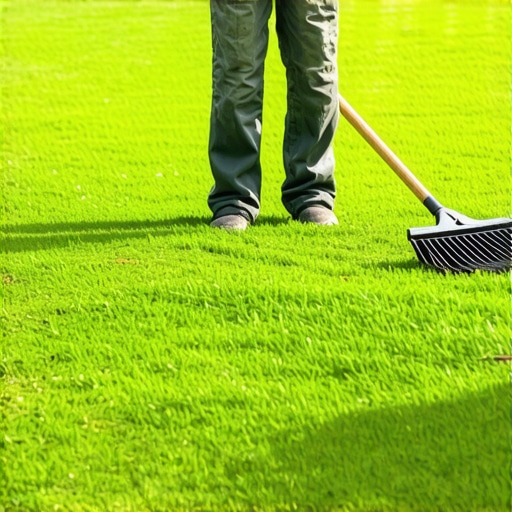
That grey, crusty matting on your lawn isn’t just a winter hangover; it is a structural failure of your turf’s respiratory system. When the snow retreats, many homeowners see matted, web-like patches and assume the grass is simply dormant. It isn’t. It is suffocating under a fungal colony. As a veteran in the landscaping industry, I have seen thousands of yards destroyed because a ‘mow-and-blow’ contractor didn’t understand the microscopic reality of the thatch layer. If you don’t break that crust now, you are looking at a full sod install by June.
The Biology of the Grey Mat: Why Spring Raking is Critical
Spring raking is critical for stopping snow mold because it physically breaks the mycelial bonds, allows oxygen to reach the crown of the grass, and facilitates the evaporation of excess moisture trapped in the thatch layer. This mechanical disruption stops Typhula blight and Microdochium nivale from progressing into the root system and causing permanent turf death.
I always drill into my new crew members: if you don’t fix the soil grading first, every plant you put in the ground is just expensive compost. This applies to your lawn cleanup too. I once saw a site where the homeowner had a state-of-the-art irrigation system but neglected his spring cleanup. He let the snow mold sit. By May, the entire $15,000 turf stand had turned into a slimy, anaerobic soup. He thought he could just water his way out of it. He was wrong. He created a petri dish. We had to excavate three inches of topsoil just to get rid of the pathogen load before we could even think about a new sod install. If he had spent two hours with a stiff-tined rake in March, he would have saved ten grand.
“Snow mold occurs when snow falls on unfrozen ground, creating an insulated environment where temperatures remain near freezing and moisture is high—perfect conditions for fungal pathogens.” – Penn State Center for Turfgrass Science
Identifying the Pathogen: Gray vs. Pink Snow Mold
You need to know what you are fighting before you grab the tools. Gray Snow Mold (Typhula incarnata) is the more common, less lethal version. It usually stays in the leaf blades. You will see light-gray or white crusty patches that look like spider webs. It is ugly, but manageable. Pink Snow Mold (Microdochium nivale), however, is a killer. It thrives in cool, wet weather even without snow cover. It produces a pinkish hue and, more importantly, it attacks the crown. If the crown dies, the plant is gone. There is no recovery. You are looking at a localized sod install or heavy over-seeding.
The Forensic Autopsy of a Failing Lawn
Why does this happen? It starts in the fall. If you left your grass long (over 3 inches) or failed to clear the last of the leaves, you created a compression blanket. When the snow piles on top, it creates a high-pressure, low-oxygen environment. This is the anaerobic zone. The grass blades are flattened, and the moisture from the melting snow is trapped against the soil surface by a layer of thatch. Thatch is that layer of living and dead organic matter between the green vegetation and the soil surface. A little thatch is fine. Too much is a sponge for disease.
| Condition | Gray Snow Mold (Typhula) | Pink Snow Mold (Microdochium) |
|---|---|---|
| Temperature Range | 32°F – 36°F | 32°F – 50°F |
| Visual Marker | Grayish-white mycelium | Pinkish-tan circular patches |
| Root Impact | Leaf blades only | Can kill the crown/root |
| Recovery Time | 2-4 weeks after raking | Often requires reseeding |
The Step-by-Step Remediation: How to Rake Like a Pro
Don’t just tickle the grass with a plastic leaf rake. You need a stiff-tined spring rake or a power rake if the acreage is large. The goal is to ‘fluff’ the grass. You want to stand those blades back up so the wind can get between them. Focus on the edges of your driveway and sidewalks where snow was piled the deepest. These areas have the highest compaction and the most moisture. You should feel the rake teeth ‘bite’ into the thatch. If you aren’t pulling up a bit of brown debris, you aren’t going deep enough. But don’t scalp it. You aren’t trying to reach the dirt; you are trying to aerate the canopy.
“A retaining wall doesn’t fail because of the stone; it fails because of the water trapped behind it. Similarly, a lawn doesn’t fail because of the cold; it fails because of the moisture trapped within the thatch.” – Hardscape Engineering Axiom
How much modified gravel do I need for a patio base?
While this seems unrelated to yard cleanup, it speaks to the drainage logic of your entire property. If your patio base was installed without proper grading, the runoff will saturate the nearby turf, creating a permanent breeding ground for snow mold every spring. For a standard patio, you need a minimum of 6 inches of compacted 21A or 3/4-inch modified stone. This ensures that water moves away from the lawn and into the subsoil, rather than sitting under your grass mats.
Checklist for a Professional Yard Cleanup
- Remove all lingering leaf debris from the corners of the fence line.
- Use a stiff-tined rake to lift all matted ‘snow mold’ patches.
- Clean out all drainage grates and French drain exits to ensure meltwater moves.
- Inspect the irrigation heads for frost heave or cracked casings.
- Apply a light, low-nitrogen soil conditioner to jumpstart microbiology, avoiding heavy synthetic fertilizers that cause ‘tender growth’ susceptible to further fungus.
The Connection Between Irrigation and Fungal Outbreaks
Your irrigation schedule in the late fall dictates your mold risk in the spring. If you kept your zones running late into the autumn without accounting for the lower evaporation rates, your soil entered the winter saturated. This is a rookie mistake. Saturated soil loses its structural integrity and stays colder longer. When we perform a yard cleanup, we check the soil moisture levels. If the ground is squishy, stay off it with heavy equipment. You will cause ruts and further compact the soil, making it impossible for the roots to breathe once the temperature hits the 50s. Wait for the ‘thaw-dry’ cycle before you do your heavy aeration.
Does snow mold go away on its own?
Technically, the fungus goes dormant when temperatures rise above 60°F, but the damage remains. If you don’t rake it out, the dead, matted grass forms a barrier that prevents new shoots from breaking through. This leads to thin spots in your lawn which are then colonized by crabgrass and dandelions in the summer. Raking is not just about aesthetics; it is about clearing the path for the next generation of turf. It is a mechanical necessity.