
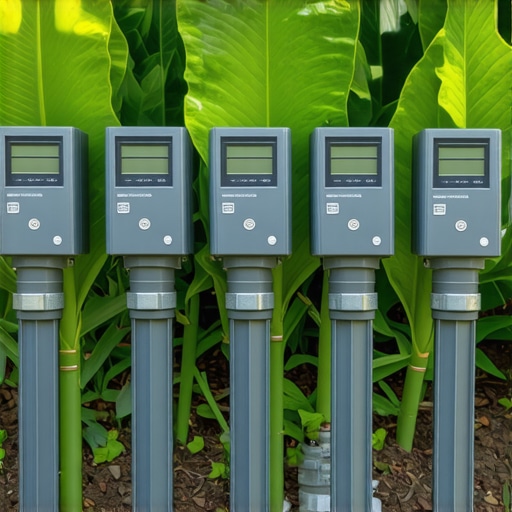
You can hear it before you see it. That unmistakable squish under your boots when a lawn has been systematically drowned. I recently walked onto a property where a homeowner had spent eighteen thousand dollars on a custom sod install and a complex irrigation system. Three months later, the yard was a graveyard of Pythium blight and anaerobic soil. They had their timer set to run for twenty minutes every single morning, regardless of the humidity, the rain, or the actual needs of the turf. They were literally paying the city to rot their own roots. They thought more water equaled more growth. It does not. It equals expensive compost. Most residential systems are configured by people who do not understand the first thing about soil physics or plant biology. If you want to stop flushing money into the storm drain, you need to stop guessing and start measuring. Modern sensors take the human error out of the equation. They treat the yard like a biological engine that needs precise inputs. Let is break down the hardware that actually works.
The Critical Role of Soil Moisture Sensors
Soil moisture sensors measure the actual volumetric water content in the root zone, preventing over-watering by overriding scheduled cycles when soil is already at field capacity. This technology reduces water waste by 40 to 70 percent in residential applications. Unlike a standard timer that runs on a clock, these probes live in the dirt. They detect the electrical conductivity or dielectric constant of the soil. When the water level hits a specific threshold, the sensor tells the controller to skip the next cycle. This is vital because soil retains water differently based on its texture. A heavy clay soil holds water like a sponge, while a sandy loam drains in minutes. You cannot manage what you do not measure.
“Soil moisture sensors have the potential to significantly reduce irrigation water application by skipping irrigation cycles when the soil water content is above a set threshold.” – University of Florida IFAS Extension
The biggest mistake I see is guys burying these sensors too shallow. If you put a sensor two inches down, it is going to dry out in the afternoon sun while the actual root zone six inches down is still saturated. This leads to short-cycling. You have to place these sensors where the majority of the fibrous roots are located. For most turf species like Kentucky Bluegrass or Tall Fescue, that is the four to six-inch range. If you are dealing with ornamental shrubs, you are looking deeper. Stop guessing. Use a soil probe to find your root depth first. It is the only way to calibrate the system correctly.
1. TDR Soil Moisture Probes
TDR soil moisture probes utilize Time Domain Reflectometry to send an electrical pulse through the soil, measuring the speed of the return to calculate precise water volume. These are the gold standard for professionals who demand scientific accuracy in their irrigation management. They do not just tell you if the soil is wet: they tell you exactly how wet it is as a percentage of volume. This allows for hyper-precise tuning of your irrigation zones. In a yard cleanup or new sod install, these sensors are the difference between the grass knitting into the soil or floating on top of it. If your soil is compacted, these probes will also highlight drainage issues you did not know you had. Compaction is the silent killer. It prevents gas exchange. Without oxygen, roots die. It is that simple. Don’t skip the aeration before you install these.
2. Smart Evapotranspiration (ET) Controllers
ET sensors calculate water loss from the soil and plant transpiration by measuring solar radiation, temperature, and wind to adjust run times daily based on environmental demand. Think of this as a weather station for your lawn. It does not just look at the ground; it looks at the sky. If it is a hundred degrees with a ten mile per hour wind, the ET rate spikes. The controller knows the grass is sweating more and adds time to the cycle. If it is overcast and cool, it pulls back. This is how you maintain a healthy yard without wasting a drop. It mimics the natural cycle of the plant. Most people do not realize that plants lose the majority of their water through stomata in their leaves. This process is driven by the vapor pressure deficit in the air. A smart ET controller manages this microscopic biological process automatically.
| Sensor Type | Primary Function | Estimated Water Savings | Typical ROI Period |
|---|---|---|---|
| Soil Moisture Sensor | Direct root zone measurement | 40-70% | 1-2 Years |
| ET Controller | Weather-based adjustment | 30-50% | 2 Years |
| Rain/Freeze Sensor | Emergency shut-off | 10-20% | 1 Season |
| Flow Sensor | Leak detection | Variable (High) | Immediate in leaks |
3. Rain and Freeze Sensors
Rain and freeze sensors are essential shut-off devices that halt irrigation during precipitation or near-freezing temperatures to prevent root rot and ice damage. These are the most basic and required components of any professional setup. If I see a sprinkler system running during a thunderstorm, I know a hack installed it. It is embarrassing for the homeowner and a waste of resources. These sensors use a hygroscopic disk that expands when wet, physically breaking the circuit to the valves. When it dries out, the disk shrinks, and the circuit closes again. Simple physics. The freeze sensor side is just as important. Watering when it is 32 degrees creates an ice rink on your driveway and can cause cellular rupture in your plants. It will kill your new sod instantly. Don’t risk it.
4. Irrigation Flow Sensors
Irrigation flow sensors monitor the volume of water moving through the main line and can automatically shut down the system if they detect a burst pipe or a missing sprinkler head. This is your insurance policy. I have seen a single broken lateral line wash out a three-thousand-dollar retaining wall in one night because it ran for six hours. The hydrostatic pressure from a leak can shift a base layer of modified gravel and cause a patio to sink. A flow sensor prevents this. It learns the normal flow for each zone. If a head pops off and the flow jumps from ten gallons per minute to twenty, the sensor kills the master valve. It saves your lawn, your hardscape, and your basement. Every high-end system needs a master valve and a flow sensor. Period.
“A retaining wall doesn’t fail because of the stone; it fails because of the water trapped behind it.” – Hardscape Engineering Axiom
5. Ultrasonic Wind Sensors
Ultrasonic wind sensors measure wind speed and direction to prevent irrigation cycles when high winds would cause significant water drift or evaporation. If you are watering in a fifteen mile per hour wind, half of that water is hitting your house or your neighbor’s driveway. It never reaches the root zone. This creates dry spots and uneven growth. Wind sensors pause the cycle until the air is still. This ensures that the head-to-head coverage designed by your contractor actually happens. Uniformity is the key to a healthy lawn. Without it, you get a checkerboard of green and brown that no amount of fertilizer can fix. Precision matters.
How much water does my lawn actually need?
Most turf grass species require exactly one inch of water per week, including rainfall, to maintain deep root health. The goal is to apply this water in one or two deep sessions rather than daily light misting. Deep watering forces the roots to chase the moisture down into the soil profile. This makes the lawn drought-resistant. Daily shallow watering creates lazy, surface-level roots that die the first time the temperature hits ninety degrees. Use a tuna can or a rain gauge to measure your output. If your system takes an hour to put down an inch, run it for an hour once a week. It is that simple. Check your soil pH too. High alkalinity can lock up nutrients, making even a well-watered lawn look pale. It is about the whole system, not just the water.
How to install an irrigation sensor?
The installation of irrigation sensors requires careful placement and integration with your existing controller to ensure accurate data collection and system response. Use this checklist to get it right.
- Identify the driest zone in your yard for soil moisture sensor placement.
- Excavate a small hole to the depth of the active root zone, usually 6 inches.
- Place the sensor horizontally into undisturbed soil to ensure good capillary contact.
- Backfill the hole, tamping the soil to remove air pockets that cause false readings.
- Wire the sensor to the ‘Sensor’ terminals on your irrigation controller.
- Program the controller to recognize the sensor type (normally closed or normally open).
- Test the system by manually wetting the sensor to ensure it triggers a bypass.