
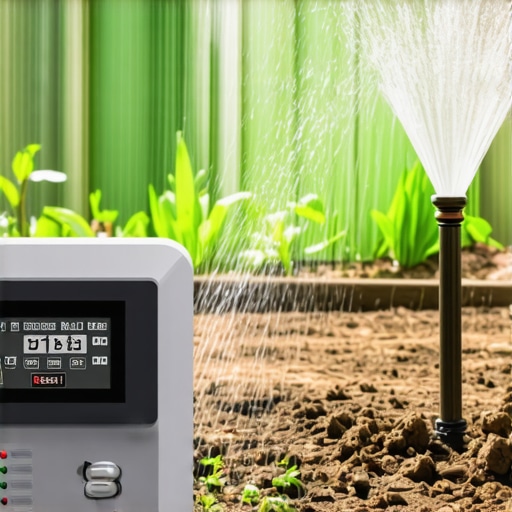
The Ghost in the Machine: Why Your Irrigation Controller Reverts to Factory Settings
If your sprinkler timer keeps resetting, it is typically due to a dead CMOS battery, a defective 24V transformer, or an electrical short in the solenoid valves or field wiring that forces the microprocessor to reboot to prevent permanent board damage from high amperage. Understanding the electrical load requirements of your irrigation system is the only way to stop the cycle of lost schedules and dried-out turfgrass.
I always drill into my new crew members: if you don’t fix the electrical continuity first, every program you punch into that clock is just a wish list. I recently visited a site where a client was convinced their brand-new controller was a lemon. They had replaced the unit twice in one month. Upon opening the valve box, I found a slurry of mud and corroded wire nuts. The master valve solenoid was drawing nearly 2 amps, which is four times the rated capacity for most residential controllers. Every time the system tried to kick on, the surge was so high the internal breaker tripped and wiped the memory. If you aren’t testing your ohms, you aren’t an irrigation tech; you’re just a guy with a shovel. This is the forensic reality of modern landscaping. We are dealing with sophisticated micro-controllers that demand clean power and specific resistance levels to operate the solenoids that manage your water distribution.
“Irrigation controllers are sensitive electronic devices; any fluctuation in the 24-volt AC circuit caused by a failing solenoid can trigger a logic reset in the microprocessor.” – Irrigation Association Technical Manual
How to diagnose a failing sprinkler timer transformer
To determine if the transformer is the culprit, you must measure the output voltage using a digital multimeter set to AC volts. A standard residential transformer should put out between 24 and 28 volts AC. If you see a reading below 22 volts, the transformer is failing under load. If you see 0 volts, the internal fuse is blown or the primary 120V circuit is dead. High-end landscaping installations require stable power because even a 10 percent drop in voltage can cause the relay to chatter, which generates heat and eventually resets the logic board. [image_placeholder] This is especially critical during a new sod install where consistent watering is the difference between root establishment and a total loss of the pallet. If the clock resets during the first 72 hours of a fescue or St. Augustine install, the crown of the plant will desiccate and die. You cannot afford a hardware failure when $3,000 of grass is on the line.
| Component | Expected Reading | Diagnostic Status |
|---|---|---|
| Transformer (Primary) | 120V AC | Power Source OK |
| Transformer (Secondary) | 24V – 28V AC | Output Voltage OK |
| Solenoid Coil | 20 – 60 Ohms | Normal Operation |
| Solenoid Coil | < 10 Ohms | Short Circuit / Replace |
| Solenoid Coil | > 100 Ohms | Open Circuit / Failing |
Check for the silent killer: The 9-volt or CR2032 backup battery
Many homeowners overlook the small battery tucked behind the faceplate. While modern non-volatile memory chips are becoming standard, older Hunter Pro-C or Rain Bird ESP units rely on a 9-volt battery to keep the time and date during brief power flickers. If that battery is dead, a micro-second brownout will send the clock back to January 1, 1990. During a standard yard cleanup, I make it a policy for my crew to swap these batteries out regardless of their state. It is cheap insurance. If your timer resets every time the air conditioner kicks on or the dishwasher runs, your household circuit is drawing too much current, and your controller has no backup to bridge the gap. You are essentially rebooting your landscaping brain every time you do chores.
How much modified gravel do I need for a patio base?
While this seems unrelated to irrigation, it highlights the engineering mindset required for all landscaping. For a standard 4 inch compacted base, you need approximately 1 ton of modified gravel (2A or 2B) for every 50 square feet of patio. This same focus on materials applies to your irrigation wiring. You should only use 18-gauge multi-strand direct-burial wire. Using thin, indoor-rated bell wire is a recipe for resistance issues. Resistance is measured in Ohms, and in an irrigation system, the sweet spot is 20 to 60 Ohms per zone. If you have 5 Ohms, you have a short. If you have 500 Ohms, you have a corroded connection or a broken wire. Either scenario can cause the controller to freak out and reset to factory defaults to save itself from melting.
- Step 1: Disconnect the common wire and the zone wire from the controller.
- Step 2: Set your multimeter to the Ohms (Ω) setting.
- Step 3: Place one probe on the common and one on the zone wire.
- Step 4: Check the reading. If it is outside the 20-60 range, go to the valve box.
- Step 5: Replace the solenoid or fix the wire nut connection with waterproof DBR/Y connectors.
“Proper grounding of an irrigation system is the only defense against the transient voltages that cause 90 percent of controller board failures.” – ASABE Standards for Turf Irrigation
Why does my sprinkler timer screen go blank then come back on?
This is a symptom of a ‘soft reset’ usually caused by an electrical surge from the solenoids. When the controller sends 24 volts to a valve, the solenoid creates an electromagnetic field to lift the plunger. If the internal wiring of that solenoid is frayed, it can send a spike back up the line. This spike hits the microprocessor and forces it to restart. It is the same as your computer restarting after a power surge. In regions with heavy clay soil, like the red clay of Georgia, moisture retention around the valve boxes can lead to faster corrosion of poorly sealed wires. You must use grease-filled wire nuts. Standard electrical tape will not work. It will rot. Moisture will enter. The circuit will short. The clock will reset. This is the cycle of failure for ‘mow-and-blow’ contractors who don’t understand the physics of the yard.
Maintaining your system after the fix
Once you have stabilized the power and resistance, you must establish a maintenance schedule. Check your controller every month. Verify the time and date are correct. If you see a ‘Sensor Off’ or ‘No AC’ message, address it immediately. In the heat of July, an irrigation system that skips just two days can result in permanent wilting point for your grass. A proper landscaping professional doesn’t just plant things; they manage the life-support systems of the property. Check your rain sensor for debris. If the sensor is shorted, it can also cause logic errors in some cheaper off-brand controllers. Stick to the big three: Hunter, Rain Bird, or Toro. They are built for the field, not the shelf of a big-box store. Your yard is a biological engine. Feed it, water it, and keep the electronics dry and stable. Anything less is just expensive compost.