
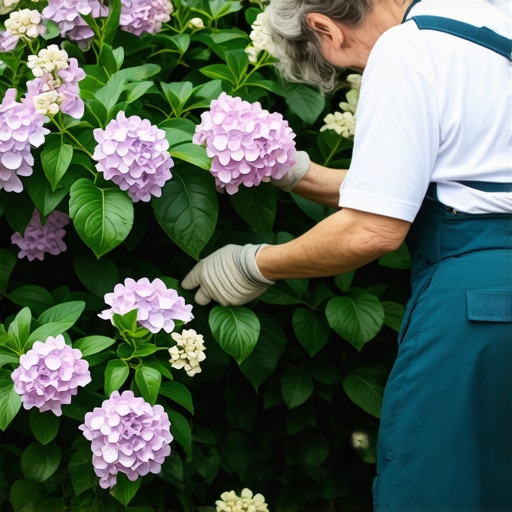
The Forensic Autopsy of a Bloomless Shrub
Every July, I get the same phone call from homeowners who are staring at a massive, leafy green bush that hasn’t produced a single flower. They see the 5-foot-tall wall of foliage and assume the plant is healthy, but as a professional, I see a failure of horticultural engineering. I always drill into my new crew members: if you don’t fix the soil grading first, every plant you put in the ground is just expensive compost. The same logic applies to the bypass pruners. If you don’t understand the terminal bud chemistry of the specific cultivar you are standing over, you aren’t pruning; you are committing arboricultural malpractice. Most homeowners hack their hydrangeas back in November because they want the yard to look ‘clean’ for the winter. By doing so, they literally throw next year’s flowers into the green waste bin.
The Critical Distinction: Old Wood vs. New Wood
To prune overgrown hydrangeas without losing blooms, you must first identify if the species sets buds on old wood (growth from previous seasons) or new wood (current spring growth). Pruning Bigleaf hydrangeas (Macrophylla) in late winter effectively removes all potential flowers, while Panicle hydrangeas (Paniculata) require aggressive structural thinning to maintain canopy integrity and prevent branch breakage under the weight of heavy sepals. If you are looking at a Hydrangea macrophylla, those flower buds were formed in August and September of the previous year. You cannot simply ‘clean up’ the yard in February and expect results. It will fail. Every time.
“Bud initiation in many Hydrangea species occurs as day lengths shorten and temperatures drop in late summer, meaning the floral potential for the following year is already stored in the stems during the dormant season.” – Penn State Agricultural Extension
How much should I cut back an overgrown hydrangea?
For an overgrown specimen, you should never remove more than one-third of the total mass in a single season to avoid triggering a massive stress response. Focus on removing the oldest, woodiest stems down to the soil level to encourage basal rejuvenation and improve airflow through the center of the shrub. This isn’t just about aesthetics; it’s about reducing the hydrostatic pressure requirements on the root system during peak summer heat. If the canopy is too dense, the plant’s irrigation needs skyrocket, and the interior leaves will succumb to powdery mildew due to lack of transpiration. We use a ‘thinning cut’ rather than a ‘heading cut’ to maintain the natural habit of the plant while reducing its overall footprint.
| Hydrangea Type | Bloom Wood | Optimal Pruning Window | Max Removal % |
|---|---|---|---|
| Bigleaf (Macrophylla) | Old Wood | Immediately after flowering | 30% |
| Panicle (Paniculata) | New Wood | Late Winter / Early Spring | 50% |
| Oakleaf (Quercifolia) | Old Wood | Post-bloom (Mid-summer) | 25% |
| Smooth (Arborescens) | New Wood | Late Winter | 100% (optional) |
Can I prune hydrangeas in the winter?
You can only prune Panicle and Smooth hydrangeas in the winter because they develop their flower buds on the growth that emerges in the spring. For Bigleaf or Oakleaf varieties, winter pruning is a death sentence for your flowers; you are cutting off the dormant embryos of the blooms. If you must perform a yard cleanup in the winter, limit your work on these varieties to removing only dead, damaged, or diseased wood—the ‘Three Ds.’ Look for stems that are brittle, grey, and lack a green cambium layer when scratched with a fingernail. If the stem doesn’t show green, it’s dead. Cut it.
The Step-by-Step Rejuvenation Process
When dealing with a massive, 8-foot monster that is eating your walkway, you need a multi-year plan. Don’t try to fix five years of neglect in twenty minutes. Start by sterilizing your tools with a 70% isopropyl alcohol solution. This prevents the spread of Cercospora leaf spot. Next, identify the ‘renewal’ stems. These are the thickest, most bark-covered branches. Take your loppers and cut one out of every three of these old stems down to the ground. This forces the plant to redirect its nitrogen and carbohydrate reserves into new, vigorous shoots from the crown. If you are doing a sod install nearby, be careful not to bury the root flare of the hydrangea with excess soil; this causes stem rot and eventual decline.
- Tool Inspection: Ensure bypass pruners are sharp enough to cut paper without tearing. Dull blades crush vascular tissue.
- Sanitation: Dip blades in disinfectant between every individual shrub to prevent pathogen transfer.
- The Three Ds: Remove Dead, Damaged, and Diseased wood first.
- Airflow: Remove any branches that are crossing or rubbing against each other in the center.
- Ground Clearance: Prune any branches that are touching the soil to prevent soil-borne fungal infections.
“Excessive nitrogen fertilization can lead to vigorous vegetative growth at the expense of flower production, particularly in woody ornamental shrubs where the carbon-to-nitrogen ratio is critical for bud differentiation.” – Agronomy Manual of Woody Plants
The Maintenance Schedule for Structural Integrity
Once you have reclaimed the shrub, the work shifts to moisture management and nutrient balance. Hydrangeas are biological pumps. They move massive amounts of water. If your irrigation system is hitting the foliage rather than the root zone, you are inviting fungal disaster. Adjust your emitters to provide 1 inch of water per week at the base. Forget the big-box store ‘Bloom Booster’ fertilizers. They are often too high in phosphorus and can lead to salt buildup in the soil. Use a slow-release, acid-heavy fertilizer if you want blue flowers, but remember: the pH of the soil dictates the availability of aluminum, which provides the pigment. Pruning is just the mechanical side of the equation; the chemistry of the soil is what keeps the plant from becoming ‘expensive compost.’ Monitor the new growth in the spring. If you see ‘leggy’ stems, it means the plant is reaching for light or has too much nitrogen. Correct the environment, don’t just hack the plant. It will survive.